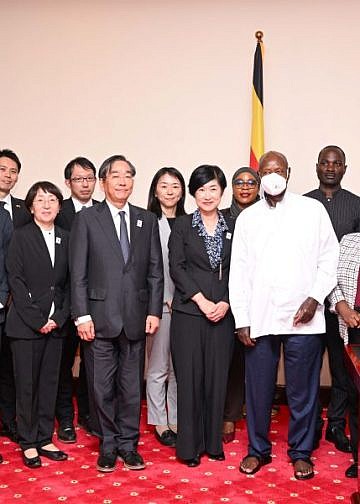











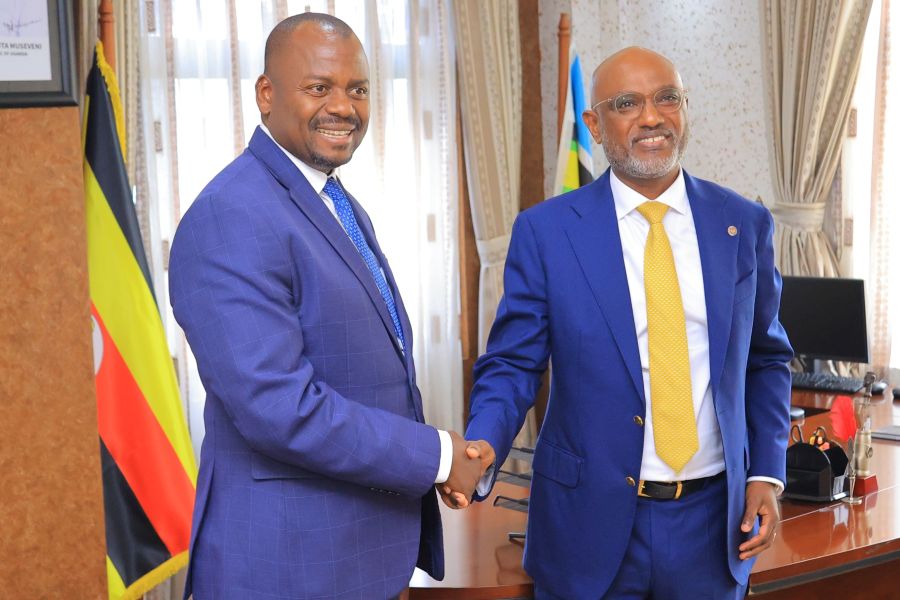
Adonia Ayebare has assumed office as the new Minister for Foreign Affairs, taking over from Haruna Kasolo who has been in acting capacity.
Speaking during the handover held at the Ministry of Foreign Affairs headquarters in Kampala, Ayebare said it is high time issues at the ministry and foreign missions are fixed.
“We can really do better. If there are quarrels at the missions, they give us a bad image. Quarrels are a sideshow, and they are very unprincipled when you look further. You know, I always wonder why with a lot of work in missions, why people get time to even quarrel. It always puzzles me,” Ayebare said.
“And if there are problems, we can always, there is the permanent secretary, there is the political leadership. A quarrel in one mission really affects our commercial diplomacy building relations in that country. The embassy is always looked at as a, you know, by the foreign ministries as problematic.”
Uganda’s foreign missions have on several occasions complained of lack of enough budgets to run their activities.
Ayebare said on Wednesday that he will help advocate for more resources for the foreign missions to enable their effectively do their work, adding that diplomats work under difficult circumstances and deserve better support from headquarters.
“Those colleagues really work under difficult circumstances and they really do a good job,” he said.
“Ours is to make sure that the people that run our foreign ministry are really motivated. We will never promise heaven on earth that we will have all the resources, but at least people must be motivated to do their work.”
Ayebare also pledged to improve communication between Uganda’s diplomatic missions and the Ministry of Foreign Affairs headquarters, saying delays in responding to missions have previously affected the country’s diplomatic work.
“Now that I’ve come here, there is no excuse why we cannot support missions and support missions in real time.”
Ayebare, who previously served as Uganda’s Permanent Representative to the United Nations in New York, said his experience at the mission demonstrated the consequences of poor communication between headquarters and missions abroad.
“We used to really do badly with communication between missions and headquarters and back. I don’t know how many times I… and some missions are really very critical, like the one I had in New York. You need instructions from headquarters. But they rarely came on time.”
He said the ministry must now ensure that instructions and responses reach diplomatic missions promptly.
“There is no excuse why we cannot support missions and support missions in real time,” Ayebare reiterated.
He also called for the Foreign Affairs Ministry to improve how it handles foreign diplomats accredited to Uganda, saying delays in accessing senior officials can undermine diplomatic relations.
“Not only missions abroad, our missions abroad, but also missions in Kampala that are presented here. We have to be service providers.We have to answer their queries.”
He questioned why foreign ambassadors should face difficulties accessing Uganda’s political leadership.
“There is no reason why an ambassador from a next country should take days making an appointment to see a minister. There is no reason why we shouldn’t be represented at their national days.”
According to Ayebare, such issues may appear minor but have a direct impact on Uganda’s diplomatic standing.
“You know, those sound small issues, Minister, but they really affect our work. Diplomacy, the way I really simplify it, and I always talk at universities, is to build relations, simple, and sustain them. The rest really builds on that.”
Ayebare also called for the introduction of formal accountability mechanisms for Uganda’s ambassadors and heads of diplomatic missions.
He said one of the weaknesses he experienced as a head of mission was the absence of a formal performance charter between himself and the ministry.
“I’ve been a head of mission, the charter… I was looking to sign a charter, which is a contract with my minister. It didn’t happen,” he said.
Ayebare said Uganda cannot expect diplomatic missions to deliver effectively without clear agreements defining their responsibilities and expected results.
“So for the last five, four years, I don’t know whether Paul right there had a charter. So we’ve been working without contract. There is, as an accountability tool for heads of missions, and I’ve been talking to heads of service, the Head of Service, actually they are working on a tool for ambassadors to be accountable to us,” Ayebare said.
He stressed that such a mechanism would help prevent diplomatic missions from operating without adequate oversight.
“And that tool is important because if you don’t have a tool, you can have impunity,” he said.
Ayebare also explained that Uganda’s diplomatic missions are staffed by both career diplomats and political appointees, saying both categories must work within the same professional standards.
“It’s a mix. Ambassadors, some of them like me, we are career, we are civil servants. We went through the ranks, but most of them are political,” he said.
He acknowledged that political appointees may experience a culture shock when they move from leading large political constituencies or government institutions to running relatively small diplomatic missions.
“And when you come from politics, as you know, sometimes it’s a culture shock. Missions are very small. You know, you have been leading a constituency or a ministry. Now you have four people.”
However, Ayebare said the solution is not to discriminate between political and career appointees but to establish structures that clearly define responsibilities and hold everyone accountable.
“I think our legacy here will be to make sure that there are no quarrels in the embassy. Political appointees, whether political appointees or career appointees, they are accountable and they deliver for this country.”
The state Minister for Foreign Affairs, Haruna Kyeyune Kasolo welcomed Ayebare to the ministry, urging him to ensure he breaks the culture of working in silos at the ministry.
“ Our achievements are scattered that’s why we are not seen as a vibrant ministry but now that you are here you may wish to build on the foundation that I have already laid because I had advised that going forward all our representatives in our respective embassies once they get to convince the investors they should come with them to Uganda. They should report here. They don’t have the powers to start taking our investors to the rest of the ministries. This is the ministry for MOFA that is supposed to coordinate and also to receive reports from our representatives abroad,” Kasolo urged.