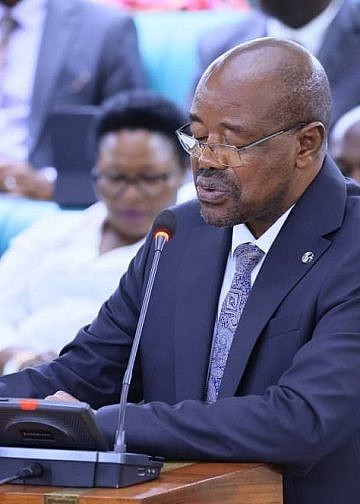












Former Leader of the Opposition Mathias Mpuuga has criticised the Bank of Uganda’s decision to raise its key interest rate, warning that the move could worsen economic hardship for households, businesses and workers.
The Bank of Uganda raised the Central Bank Rate (CBR) from 9.75% to 12% following a special Monetary Policy Committee meeting held on October 14, 2026.
The central bank said the decision was intended to contain rising inflation risks driven by higher fuel prices and exchange rate pressures while maintaining price stability.
It also raised the Cash Reserve Requirement (CRR) from 11% to 13.5%, effective September 24, 2026, as part of efforts to manage excess liquidity in the banking system and strengthen the effectiveness of monetary policy.
However, Mpuuga argues that the tighter monetary policy could place additional pressure on an economy already grappling with supply-side challenges, including high energy and food prices.
In a statement responding to the policy decision, Mpuuga said the central bank had adopted an approach that could undermine people’s welfare.
“The monetary policy wonks at the Central Bank elected to ‘eat away’ people’s welfare without dust or noise,” Mpuuga said.
He attributed the current economic pressures partly to the global energy crisis and prolonged drought, which he said had reduced food supplies in several parts of the country.
“We are all alive to the global energy crisis and how it ends up in our pockets and munches away the precious dollar. The implication is that the price of gas paints the overall basic basket,” he said.
Mpuuga also questioned whether Uganda was adequately positioned to benefit from a weaker shilling through increased export earnings, arguing that the country remained heavily dependent on imports of key commodities, including energy and steel.
“Our exports sector has very limited manufacturing capability,” he said, adding that coffee, which accounts for a significant share of Uganda’s export earnings, had also been affected by prolonged drought.
He questioned whether other export sectors could generate sufficient foreign exchange earnings to help the country benefit from a stronger dollar.
“Where is the rest of the expectation to take advantage of the rising Dollar? Dairy products? Gold? Or other precious metals? Very fragile prospects!” Mpuuga said.
He further criticised the decision to raise the CBR by 2.25 percentage points, arguing that the move could worsen existing supply constraints and increase borrowing costs.
“The CBR being raised by 3% has heart-stopping implications for the already existing supply constraints,” he said.
Mpuuga warned that higher lending costs could have wider consequences for businesses, employment and government revenue, particularly as commercial banks may adjust their lending rates in response to changes in the central bank’s policy rate.
“Has the Central Bank thought about possible job losses in the short-run and local revenue implications?” he asked.
He also expressed concern about the impact of higher interest rates on borrowers and fixed-income earners, particularly those whose purchasing power is already being eroded by rising prices.
“What is the fate of the local borrower who is likely to receive notification of revised interest rates? What of the implications for the basic basket of the fixed-income earners, since the Central Bank seems to have made assumptions of demand side inflation?” he asked.
Mpuuga argued that the Government should consider introducing targeted relief measures to cushion households and businesses against the effects of tighter monetary policy.
Among his proposals were utility rebates on water and energy bills, tax relief for lower-income fixed-salary earners and the release of at least 10% of domestic arrears owed to key sectors to support production and employment.
“Should we then ready ourselves for a government follow-up in the form of: utility rebates on water and energy?” he asked.
He also proposed “Payee rebates for the lower-bracket fixed-salary earners for at least two quarters so that their basic basket doesn’t shrink further,” alongside “at least 10% domestic arrears payment release for key sectors to sustain production and employment.”
Mpuuga maintained that the Government should complement monetary policy measures with targeted interventions to protect vulnerable households, sustain business activity and support economic production.