







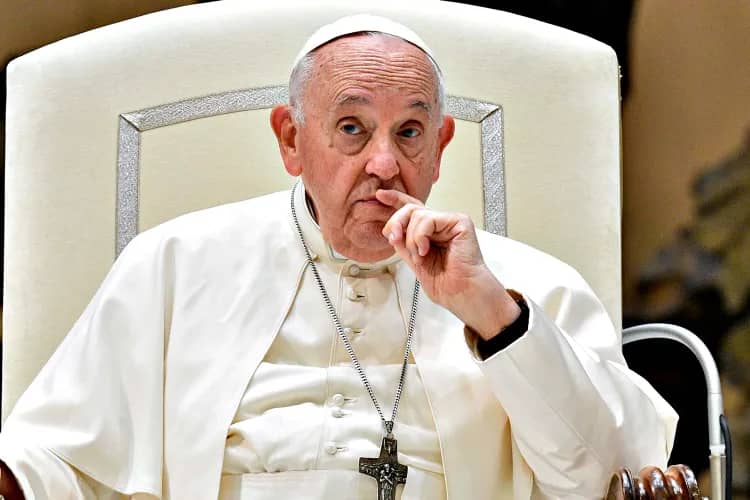
The private diary of the late Pope Francis has revealed deeply personal accounts of his spiritual struggles, including a frightening experience in which he believed he had witnessed the entrance to hell and encountered the devil.
The former pontiff also endured a two-year spiritual crisis over the exercise of power, confessing that he feared becoming a leader who manipulated people for his own convenience rather than serving them.
The revelations are contained in The Private Diary of Pope Francis, a 160-page book released on Tuesday, November 24, 2026. The publication offers an unusually intimate account of the late pope’s spiritual battles, personal fears, weaknesses and challenges of leadership.
Compiled and contextualised by Cardinal Víctor Manuel Fernández, one of Francis’ closest aides and head of the Vatican’s Dicastery for the Doctrine of the Faith, the diary contains handwritten reflections dating from 1992 to August 18, 2024.
Francis, who died on April 21, 2025, aged 88, led the Catholic Church for 12 years.
Among the most striking revelations are accounts of what Francis described as encounters with the devil. In an entry dated January 24, 2021, he recalled seeing and hearing a terrifying presence during a meeting in Rome.
“I saw him and heard his voice, triumphant, possessing everything: ‘Now I’ve gotten everything I wanted,'” Francis wrote.
He added that he could not forget the voice’s powerful raspiness, describing the experience as one of three occasions when he had no doubt that the devil had appeared physically.
The Argentine-born pontiff also recounted a frightening experience in June 2018, when he believed he had seen the entrance to hell.
“Last night I saw the entrance to hell. Pagan seduction in full force. I peeked in to look a little, and it terrified me,” he wrote.
Francis said he immediately reached for his rosary for protection.
“I grabbed the Rosary as a weapon. I thank the Lord for this help,” he added.
Beyond the accounts of supernatural experiences, the diary reveals that Francis endured what Cardinal Fernández described as perhaps the most difficult period of temptation in his life, between 2021 and 2022.
The crisis was largely connected to the pressures of governing the Catholic Church, the burden of making difficult decisions and the temptation to exercise power without restraint.
According to Fernández’s commentary, the pope’s struggles were compounded by deteriorating health, severe physical pain and turmoil within the Vatican, including a major financial investigation he had authorised.
Francis was particularly troubled by the possibility of becoming a leader who manipulated people instead of serving them.
Recounting a 2023 meeting involving Francis and another bishop, Cardinal Fernández explained that the pope had been asked why he did not publicly rebuke a Vatican official who had criticised him.
Francis reportedly responded that he believed God did not want him to become a “puppeteer who uses and manipulates people according to his own convenience.”
In a reflection dated December 2022, Francis described the crisis as follows:
“It was all mixed with governance issues, pressure regarding decisions to make, and aridity and desolation.”
By December 30, 2022, Francis appeared to have emerged from the difficult period by surrendering himself to God’s mercy.
Cardinal Fernández explained that the pope eventually understood the experience as an invitation to confront his inner struggles and overcome what he described as accumulated darkness.
Chile abuse scandal and the gates of hell
The diary also revisits one of the most difficult episodes of Francis’ papacy: his handling of allegations of clerical sexual abuse in Chile.
During a January 2018 visit to the South American country, Francis faced widespread criticism after publicly defending a bishop accused of covering up sexual abuse.
Following questions from journalists aboard his flight back to Rome, the pope ordered an investigation and eventually acknowledged that he had been misled by Church leaders.
Reflecting on the controversy, Francis wrote:
“I became aware of how serious the problem was. … It was hard for me to admit what happened in Chile; I didn’t think it was so serious.”
He later described the scandal as an encounter with the entrance to hell, reflecting on the shame and damage it had brought upon the Catholic Church.
“What shame and evil this has brought on the church!” he wrote in another reflection.
The Chilean scandal became one of the defining challenges of Francis’ papacy and his efforts to confront sexual abuse within the Catholic Church.
What the diary reveals about Pope Leo XIV
The publication also contains Francis’ personal assessment of his successor, Pope Leo XIV, who was Cardinal Robert Prevost at the time.
Francis offered a glowing description of the American-born pontiff, calling him:
“A great pastor, a generous missionary and an irreproachable man.”
Cardinal Fernández said Francis had entrusted him with the diary during his lifetime, effectively asking him to make its contents public after his death.
Fernández later discussed the publication with Pope Leo XIV, who reportedly showed considerable interest in the project.
However, the published book does not contain the complete diary. Fernández explained that some of Francis’ most confidential reflections were written in an indecipherable code and could not be reproduced. He also excluded entries that might affect third parties.
Released internationally in several languages, the book offers readers a rare glimpse into the private spiritual life of a pope whose public ministry was widely associated with humility, compassion, reform and service.