










By Michael Woira
Concerned Citizen
There are places you can read about, places you can hear about, and places you must visit to truly understand.
My recent field visit to Uganda’s Albertine Graben with the Judiciary was one of those experiences. It reminded me that national transformation cannot always be understood from conference rooms, policy documents and technical reports. Sometimes, you have to travel the roads, walk the sites, speak to the people and see the projects for yourself.
That is when fact-finding becomes personal rather than something based on hearsay.
I had the opportunity to travel with judicial officers led by the Chief Justice, Justice Dr Flavian Zeija, alongside the Governor of the Bank of Uganda, Dr Michael Atingi-Ego, and officials from the Uganda Revenue Authority, Petroleum Authority of Uganda, Uganda National Oil Company and other institutions involved in Uganda’s petroleum development.
What struck me most was not only the scale of the oil and gas projects we visited, but also the attitude of the people we travelled with.
Judges are often perceived from a distance as serious, formal and perhaps intimidating figures. And indeed, they have to be tough in their wigs and robes when the law demands firmness.
But on the ground in the Albertine, I saw another side of them.
They were curious, approachable, attentive and deeply interested in people-centred issues.
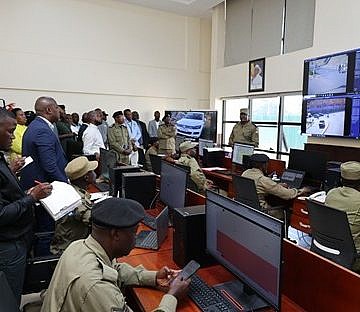
They asked questions. They listened. They interacted with engineers, project managers, technical experts, workers and ordinary members of communities around the projects.
At almost every stop, they went beyond the formal briefings to understand what was actually happening and how the developments were affecting people.
Tough in wigs, humble on the ground.
That became one of my defining impressions of the journey.
Uganda’s oil story is becoming reality
One of the clearest lessons from the trip was that Uganda’s oil story is no longer simply about what we hope to build in the future.
Much of what was once presented as a plan is now physically taking shape.
Our field engagements began at Pump Station One (PS1) in Kikuube District, the starting point of the East African Crude Oil Pipeline (EACOP).
We were briefed that the project was 91 per cent complete, with more than 1,536 kilometres of line pipe welded and more than 1,300 kilometres of the 24-inch insulated mainline laid and buried.
The installation of high-voltage trace-heating cables was also ongoing to keep Uganda’s naturally waxy crude flowing.
Seeing this progress first-hand offered a much clearer picture of the infrastructure and engineering required to take Uganda towards First Oil.
At Kingfisher, we saw further progress in Uganda’s upstream petroleum operations, including the Central Processing Facility. What was once largely discussed through technical presentations is now a substantial piece of infrastructure taking shape before our eyes.
At Tilenga in Buliisa, another major component of Uganda’s petroleum development is taking shape, including the Central Processing Facility and other supporting infrastructure.
Standing at these sites gives one a different perspective.
You begin to appreciate the engineering, human effort, investment and coordination required to move a country from petroleum discovery to production.
But there was another important lesson: development and environmental protection must move together.
Oil development and environmental responsibility
We travelled through parts of Murchison Falls National Park and visited areas where exploration activities had previously taken place.
At the rehabilitated Jobi-Rii 2 exploration well, the restoration work was particularly telling. The site had been restored after exploration, and unless you knew what had happened there before, there was little to suggest that drilling activities had once taken place.
For the judicial officers, this was more than a technical site visit. It was an opportunity to see first-hand how environmental restoration, regulation and petroleum development intersect.
It was encouraging to see their interest in how environmental safeguards are being implemented.
Uganda’s petroleum journey must be one in which development and environmental responsibility move together. The two should not be presented as opposing objectives.
They must complement each other.
The success of Uganda’s oil industry should not be measured only by how many barrels we eventually produce. It should also be measured by how responsibly we manage the environmental and social consequences of production.
Kabalega Airport and the infrastructure of transformation
Our visit to Kabalega International Airport was equally significant.
The airport is at an advanced stage of construction, with the control tower among the facilities taking shape. We were informed that the remaining works are progressing towards completion.
For those who have followed Uganda’s infrastructure development, this is an important milestone.
An airport in the Albertine is not simply about aircraft landing and taking off. It represents connectivity, investment, tourism, business, logistics and the broader infrastructure required to support a region that is rapidly becoming central to Uganda’s economic story.
Standing there and seeing the progress physically was a reminder that national transformation is often a collection of individual projects that eventually come together to change the character of an entire region.
The forgotten side of oil: waste management
Another important stop was the Luwero Industries Waste Management Facility, Uganda’s specialised oil and gas waste treatment facility managed by Luwero Industries Ltd, a subsidiary of the National Enterprise Corporation (NEC), the commercial arm of the UPDF.
The facility handles both liquid and solid waste from petroleum operations, including hazardous and non-hazardous waste.
Commissioned in January 2023, the facility has the capacity to manage up to 70,000 tonnes of waste while creating employment and supporting environmentally responsible petroleum development.
The visit was a reminder that Uganda’s oil story is not only about wells, pipelines and processing facilities.
Waste management is equally important.
If petroleum development is to be sustainable, the country must pay as much attention to what happens after waste is generated as it does to what happens when oil is extracted.
Why the Judiciary must understand the oil sector
Perhaps the most important lesson from the entire field visit was why the Judiciary must understand Uganda’s petroleum sector.
As the country moves closer to First Oil, disputes will inevitably arise around land, compensation, contracts, taxation, environmental protection, infrastructure, community rights and commercial arrangements.
It is difficult to make fully informed decisions about matters one has encountered only in books.
The Chief Justice repeatedly emphasised the importance of judicial officers understanding the sector they may eventually be called upon to adjudicate.
I found that position compelling.
A judge does not need to become a petroleum engineer. But a judge handling a petroleum-related dispute must have enough appreciation of the industry to understand the context in which that dispute has arisen.
That is why field exposure matters.
It brings the law closer to reality.
Development needs institutions that understand the ground
What I will probably remember most from the trip, however, is not the machinery, rigs, processing facilities or infrastructure.
It is the people.
I watched judicial officers engage with communities and workers with genuine curiosity. They did not carry themselves as distant figures who had come simply to observe.
They asked questions. They listened to explanations. They interacted with people at different levels and showed interest in understanding their experiences.
At several sites, the interaction was relaxed and surprisingly human. There were moments of laughter, serious discussions and occasions when a simple question from a judicial officer opened up a much broader conversation about how these projects are affecting communities.
That human side matters.
Institutions are ultimately made up of people, and public confidence is strengthened when citizens see those institutions willing to step out of their offices and understand realities on the ground.
The Chief Justice’s message that the Judiciary should have a development mindset also stayed with me.
This does not mean compromising judicial independence or lowering the standards of justice.
Quite the opposite.
It means understanding the importance of national development while ensuring that the law remains the foundation upon which development is built.
Uganda needs institutions that can protect rights, resolve disputes fairly, enforce compliance and, at the same time, understand the economic and social importance of the projects before them.
The Albertine field visit demonstrated that this kind of institutional preparation is already taking place.
The Judiciary is preparing its officers. Technical institutions are building capacity. Government agencies are working together. Infrastructure is taking shape. Petroleum facilities are being constructed. Environmental restoration is taking place.
And perhaps most importantly, people are beginning to see the transformation for themselves.
The real measure of Uganda’s transformation
I travelled to the Albertine expecting to learn more about Uganda’s petroleum sector.
I returned with a much broader appreciation of what national transformation looks like on the ground.
I saw infrastructure rising, oil facilities taking shape, an airport nearing completion, environmental restoration and specialised waste management.
I saw engineers, technicians, workers, communities and government institutions playing different but important roles in one national development agenda.
Above all, I saw a Judiciary that understands that knowledge of the law must sometimes be complemented by a practical understanding of the ground on which that law will operate.
The Albertine is changing, and it is changing rapidly.
But development is not only about concrete, steel, pipelines and processing facilities.
It is also about institutions, communities, environmental responsibility and the people who make these projects possible.
As Uganda moves towards First Oil, we must build with ambition, regulate with responsibility, protect our environment, listen to our communities and prepare our institutions for the complexity that comes with transformation.
And perhaps there is no better way to describe the judicial officers I travelled with than this:
Tough in wigs. Humble on the ground. Willing to learn.
That, in my view, is exactly the kind of institutional attitude Uganda needs as it enters a new chapter of its economic story.