







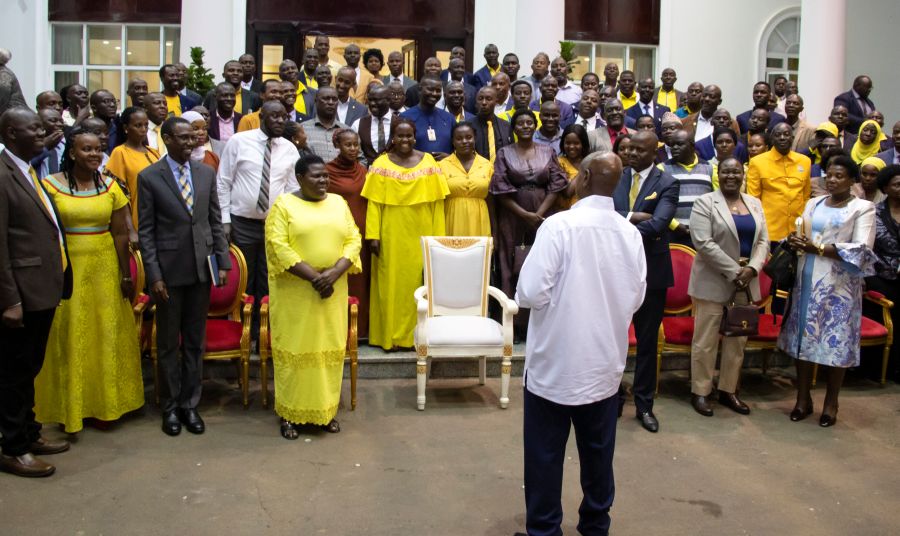
President Museveni has praised members of the ruling National Resistance Movement (NRM) in Buganda who lost in the party’s recently concluded primaries for putting aside personal ambition and pledging support to the official flag bearers ahead of the 2026 general elections.
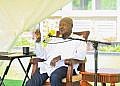
Speaking during a meeting held at State House Entebbe on Wednesday, September 17, Museveni—who also serves as NRM’s National Chairman—described the move as a demonstration of political maturity and renewed dedication to party cohesion.
“I want to congratulate you, and I can see the spirit of the National Resistance Army (NRA) is coming back. Go back and support the flag bearers,” Museveni urged, emphasizing that unity within the party is vital for electoral success.
Museveni noted that internal divisions have historically undermined the NRM’s performance in Buganda, citing the 2021 elections as an example.
“You hear that the NRM MPs in Buganda have been 31 out of 105, but in about 29 constituencies, the NRM had won by majority, but they divided the vote. If you had not divided your votes, the NRM would have had 60 seats instead of 31,” he observed.
The meeting drew participation from NRM cadres across the Buganda region, including many who had lost in primaries but resolved to rally behind those selected to carry the party flag.
Museveni used the platform to revisit Uganda’s turbulent political past, warning of the dangers of disunity among political actors. He referenced historical conflicts, including the aftermath of the disputed 1980 elections and the political disagreements between the Uganda People’s Congress (UPC) and Democratic Party (DP), which he said contributed to the 1981–1986 war.
“When we came, we tried to persuade them to go back to the message of unity under the Uganda National Liberation Front (UNLF). They didn’t agree, and they tried to bring back DP and UPC. If they had agreed, there would have been no war from 1981 to 1986,” he recalled.
He also cited events surrounding the 1961 elections, where Kabaka Yekka (KY) supporters boycotted the polls and later retaliated by cutting down coffee trees—a response he described as rooted in political miscalculation.
Museveni warned that failure to unite around a common national vision could plunge the country back into chaos.
“Not supporting NRM is very risky; the country can be in total chaos, because if you have got people who don’t see that Uganda should be one, suppose they are the ones in charge of the country. What will happen?” he asked.
Linking political stability to economic development, Museveni emphasized that supporting the NRM is crucial not just for peace but also for long-term socio-economic transformation.
“Supporting NRM is first of all for stability, but also secondly, for the future, because you can see the factories are now coming. The whole of Matugga is factories, Kawempe factories, in Namanve, they are producing,” he said, pointing out that Uganda’s growing industrial output relies on regional markets in East Africa, South Sudan, and the Democratic Republic of Congo.
He reiterated the NRM’s ideological pillars: patriotism, Pan-Africanism, socio-economic transformation, and democracy.
“It is politics of aims, not politics of jobs, not politics of groups,” Museveni stressed, cautioning against self-serving political agendas.
The President urged the NRM cadres to root their politics in ideology, not personal ambition, and recalled how clarity of purpose had helped shape key national decisions, such as the restoration of cultural institutions.
“We told everybody, yes, we are restoring the cultural institutions, but keep out of politics. No powers of administration, no powers of legislation, because these are with the people,” he said.
He warned that politics without ideology was a “big danger” and likened political leadership to medical practice—requiring the right diagnosis and appropriate solutions.
“When we started fighting Idi Amin, some people said we started fighting him because he killed people. I didn’t know that Amin would kill people because even if Amin had not killed people, we would have fought him because he didn’t know what he was doing,” he said.
Museveni highlighted Uganda’s contributions to regional peace and integration, noting that a large number of Ugandans now live in South Africa, even though many remain unaware of the country’s role in shaping Africa’s liberation movements.
NRM’s Vice National Chairperson for Buganda, Haruna Kyeyune Kasolo, commended Museveni for what he described as a timely “ideological lecture.”
“The elections of 2021 didn’t go well in Buganda, but come 2026, we are more than determined to win highly. What we are asking for is your time whenever we ask for advice,” he said, noting that Buganda remains one of the key beneficiaries of national development.
“We pledge that we shall bring back this team after we have won the election,” Kasolo added.
The meeting was attended by several senior government officials and NRM party leaders, including Attorney General Kiryowa Kiwanuka, NRM Deputy Secretary General Rose Namayanja-Nsereko, Buvuma County MP Migadde Ndugwa, Gomba District Woman MP Sylvia Nayebare, Energy Minister Ruth Nankabirwa, and Lwengo District Woman MP Cissy Namujju.
Their presence underscored the strategic importance of Buganda to the NRM’s 2026 electoral roadmap.