


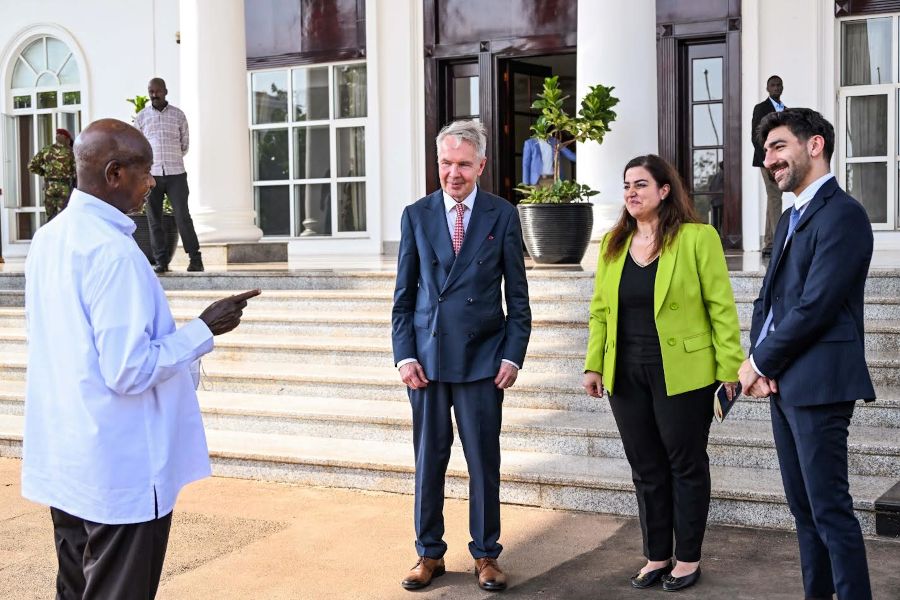
President Museveni has called for dialogue, democratic governance and respect for diversity as the foundation for achieving lasting peace in Sudan during talks with the United Nations Secretary-General’s Personal Envoy for Sudan, Pekka Haavisto.
The meeting, held at State House Entebbe, focused on the ongoing conflict in Sudan, the worsening humanitarian situation and the broader peace and security landscape in the region.
The two leaders discussed the need to strengthen dialogue among the parties to the conflict, enhance regional cooperation and support initiatives aimed at securing a sustainable and inclusive political settlement in Sudan.
President Museveni said the country’s prolonged instability stems from unresolved ideological and political differences, stressing that inclusive governance and democratic processes remain the most effective way of resolving conflict.
He cautioned against what he described as “sovereignism” in multinational states, arguing that attempts to impose a single identity on diverse societies have often triggered recurring political crises.
“There is an ideological crisis. We have been telling them for years that they should respect the identities of their people. If people do not agree, why don’t they go for elections? Using force to settle political differences is a wrong idea,” President Museveni said.
The President also reaffirmed Uganda’s commitment to hosting people fleeing conflict, saying the country’s refugee policy is rooted in humanitarian principles as well as the historical and cultural ties shared by communities across the region.
“These refugees are our people. They are contributing and building Uganda. They come with knowledge, so we don’t mind. They can come because this is their country. We have slightly more than two million refugees, including Congolese and South Sudanese, and many of our cultural groups are connected,” he said.
Museveni urged all parties to the Sudan conflict to remain committed to dialogue and appealed to regional and international actors supporting the peace process to prioritise negotiation over confrontation in pursuit of a lasting political settlement.
Haavisto commended Uganda for maintaining its open-door refugee policy, describing the country’s role in hosting refugees as an example recognised by the international community.
“I want to thank Your Excellency for hosting so many Sudanese refugees. Everyone recognises that effort, and the United Nations is very grateful that Uganda has kept its doors open to refugees,” Haavisto said.
He said the United Nations continues to engage the warring parties through dialogue, with discussions focusing on improving humanitarian access, securing the release of detainees and supporting young people whose lives have been disrupted by the conflict.
Haavisto also noted that President Museveni’s engagement with both sides of the Sudan conflict places him in a unique position to support ongoing peace efforts.
He expressed optimism that sustained dialogue, backed by regional and international cooperation, could help improve the situation and pave the way for lasting peace and stability in Sudan.