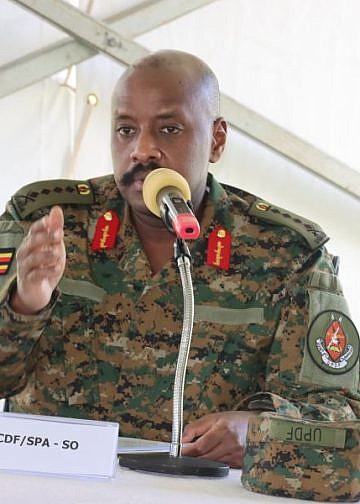









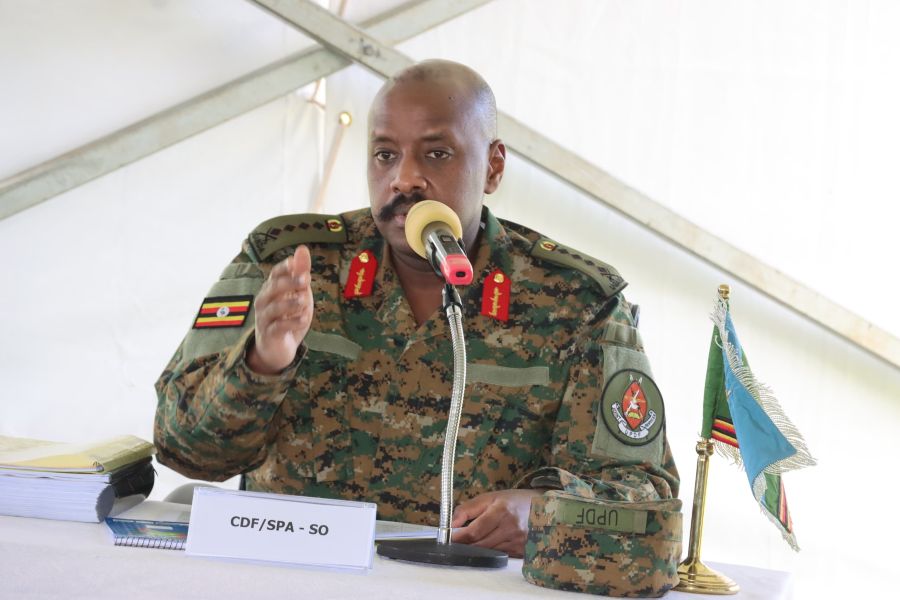
The UPDF has dismissed allegations published by The New York Times against Chief of Defence Forces (CDF) Gen Muhoozi Kainerugaba, insisting that the military chief has never met exiled Ugandan writer Kakwenza Rukirabashaija.
In a statement o Saturday, Col Chris Magezi, the acting Director of Defence Public Information, accused Western media organisations of promoting what he described as imperialist propaganda against Kainerugaba and the Ugandan government.
Magezi was responding to an article by American journalist Megan K. Stack titled “The Authoritarian Future Is Already Here,” published by The New York Times on October 8, 2026.
The article included allegations by Rukirabashaija concerning his alleged torture and humiliation while in detention.
The UPDF spokesperson rejected the allegations, insisting that the claims against Kainerugaba were false and intended to undermine his reputation.
“To put it clearly, General Muhoozi Kainerugaba has never met Kakwenza Rukirabashaija in his life. Kakwenza is a known fiction teller, and the latest episode in the previously respectable New York Times is a fine figment of his imagination,” Magezi said.
He accused Western media outlets of perpetuating a sustained campaign against the military chief, arguing that their coverage was driven by political interests rather than objective reporting.
“The latest publication in the New York Times is a continuation of a vile campaign in recent years by Western media conglomerates against General Muhoozi Kainerugaba, for quite obviously imperialistic reasons,” Magezi said.
He cited previous reports published by The Telegraph, The Wall Street Journal and The Economist, arguing that the publications had portrayed Kainerugaba negatively while speculating about Uganda’s political succession.
Magezi referenced a September 2024 article by The Telegraph titled “Hardman Who May Be Uganda’s Next President Is Putin Fan and Asked Meloni to Marry Him,” as well as a September 2025 Wall Street Journal article titled “He Jokes About Trump and Invading Kenya — and May Be Uganda’s Next President.”
He also cited a September 2026 publication by The Economist titled “From Autocracy to Despotism.”
“In all cases, the articles and ‘expert analysis’ are trivial, sensational and low on substance,” Magezi said.
He further alleged that some Western media organisations had a preferred candidate to succeed President Yoweri Museveni, arguing that Uganda’s leadership should ultimately be determined by its citizens.
“What is clear, though, is that General Muhoozi Kainerugaba is not their preferred successor of choice to a post-Museveni Uganda. They would rather have the lackey Robert Kyagulanyi in charge, or others of similar kin,” Magezi said.
“However, the future of Uganda is a choice that will be firmly determined by Ugandans when the time comes,” he added.
In the New York Times article, Rukirabashaija alleged that Gen Kainerugaba visited him during detention, ordered him to expose himself and later offered him money to remain silent about the alleged abuse.
The writer also alleged that he had been severely beaten while in detention, suffering fractured ankle bones, kidney damage and extensive scarring on his back.
Magezi dismissed the account, questioning the consistency of the allegations and arguing that the reported injuries contradicted the description of events in the article.
“The inconsistencies in the story are quite laughable. In one instance, Kakwenza, allegedly the taller of the two men, is ordered to ‘bend over to make himself shorter’, and in the next, his ankles are shattered and ‘he could not even stand’. Quite remarkable,” Magezi said.
He described the allegations as false and urged the public not to accept what he characterised as attempts to damage the reputations of African leaders.
“The lies are clear to see, outlandish, cheap and miserable. What is more, baseless and unfounded character assassination of African leaders should be dismissed out of hand by rational-thinking members of society with the contempt deserved,” he said.
However, the allegations surrounding Rukirabashaija’s detention predate the latest article. In February 2022, Human Rights Watch called for an investigation into his allegations of torture and enforced disappearance. The organisation reported that Rukirabashaija had said he was taken to meet Kainerugaba after being rearrested following a court-ordered bail release.
Magezi also defended Gen Muhoozi ‘s record as a military officer, describing him as a decorated serviceman whose achievements should not be dismissed because of social media remarks or media reports.
“General Muhoozi Kainerugaba is a decorated military officer with decades of dedicated service and outstanding achievements in his field. To reduce him and his substantial achievements based on social media banter, misguided and false media reports is absurd and a desperate attempt to satisfy prejudiced Western audiences about the supposed failings of Africa,” Magezi said.
He further challenged what he described as the selective treatment of Uganda’s political and institutional affairs by foreign commentators.
“Secondly, Uganda is a constitutional and democratic polity. Cherry-picking online remarks or jokes while disregarding the broader institutional and constitutional frameworks, including the laws of Uganda within which the country operates, is the height of hypocrisy,” he said.
Magezi argued that allegations of human rights abuses should be supported by credible evidence and subjected to rigorous scrutiny rather than accepted on the basis of accounts he characterised as hearsay.
“The allegations of human rights abuses attributed to Gen. Muhoozi Kainerugaba are presented without proper verification and rigorous scrutiny. It is hearsay. Serious accusations require serious evidence, not reliance on anecdotal or politically motivated sources,” he said.
The army spokesperson also defended the conduct of the UPDF, saying the institution operates within Uganda’s legal and constitutional framework.
He said the military would continue to support civilian authorities in carrying out their responsibilities, including maintaining law and order when called upon to do so.
“The UPDF, which General Muhoozi Kainerugaba commands, operates within the confines of the law. The UPDF will continue its constitutional obligation to extend support to the civil authorities when requested or required, for instance, to support the maintenance of law and order, among others,” Magezi said.
He added that the army remained committed to discipline and accountability within its ranks.
“It will also continue to hold service members who break the law to the highest standards of discipline and accountability,” he said.
Magezi also argued that Uganda’s courts were capable of handling allegations when evidence was presented, noting that opposition politicians had used the judicial system to challenge government actions.
“Ugandans know this. The Ugandan courts are robust and functional whenever evidence is presented, and the political opposition has utilised the courts of law to great effect,” he said.
Col Magezi warned against what he described as foreign interference in Uganda’s internal affairs, arguing that international media coverage should not be used to influence the country’s political direction.
“Lastly, what will not be tolerated is external interference in the affairs of Uganda,” he said.