











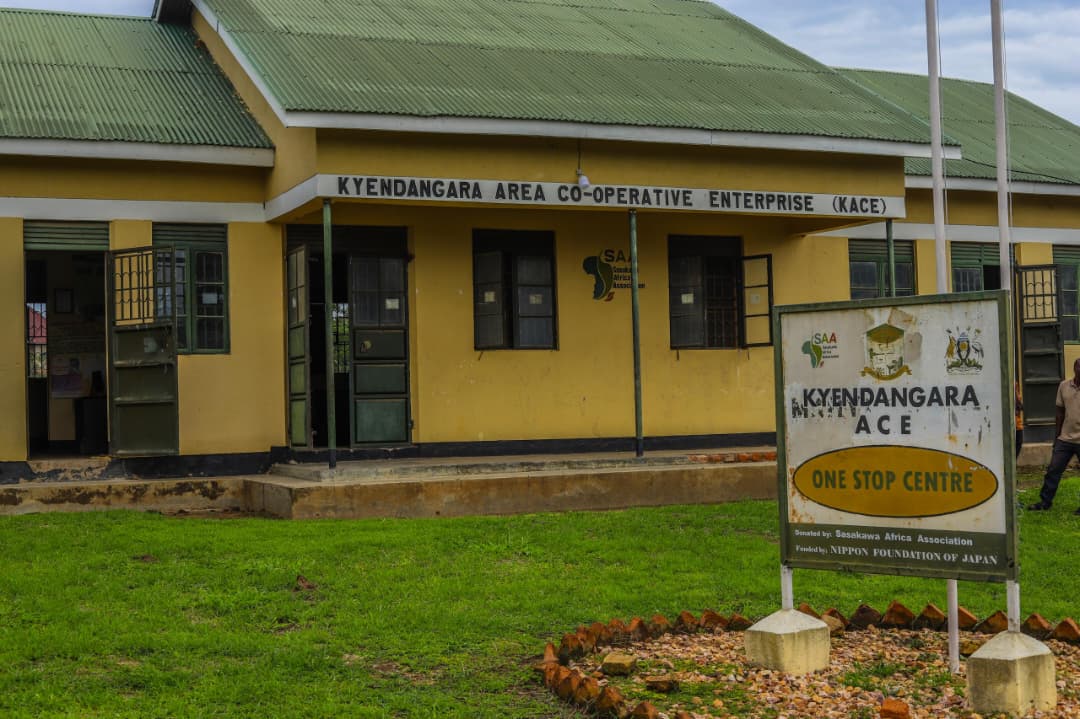
Smallholder farmers in Kitagwenda District are gaining improved access to markets, agricultural finance, processing facilities and other services through a One Stop Centre established by the Sasakawa Africa Association (SAA) in partnership with farmer groups.
The Kyendangara Area Cooperative Enterprise, located in Kyendangara Ward in Mahoro County, Kitagwenda District, has grown from a small farmers’ association of 30 members into a cooperative working with more than 1,200 farmers.
The cooperative currently brings together 1,296 farmers organised into 45 registered groups, four of which are registered as rural producer organisations under the cooperative registry.
Emmanuel Kamushobora, the chairperson of Kyendangara Area Cooperative Enterprise, said the centre has helped farmers move beyond production to accessing markets, financing and value-addition services.
“This cooperative started way back, around 15 years ago, as a very small association. It started with 30 members, and currently, as we speak, we are working with 1,296 farmers,” Kamushobora said.
He said the cooperative works with community-based facilitators trained in collaboration with Sasakawa to support farmers in production, particularly of crops such as coffee, maize and rice.
The cooperative also purchases produce from farmers, processes it and links it to markets, helping farmers reduce their dependence on middlemen.
“After purchasing, we pay them cash, then we take the produce for processing, package it and take it to the market, both for rice and maize,” Kamushobora said.
The cooperative has a rice-hulling and processing machine, storage facilities and a maize milling operation, enabling farmers to benefit from value addition rather than selling their produce immediately after harvest.
Kamushobora said access to finance remains one of the biggest challenges facing farmers. However, training provided through Sasakawa has helped the cooperative understand how to mobilise capital and engage with financial institutions.
The cooperative has since secured a Shs150 million credit facility from Uganda Development Bank to support produce purchases and other operations.
“We have already accessed a credit facility of Shs150 million. This is the capital we are talking about. As farmers invest, we purchase their produce, process it and find markets,” he said.
The cooperative has also invested in village savings and credit initiatives, working with several farmer groups to make affordable financing available to members.
Kamushobora said the cooperative has invested more than Shs50 million in savings and credit schemes, with the funds retained within farmer groups so members can access loans when needed.
“We give this money to the groups and ask them to manage it for the farmers. The money is repaid to the group, and we do not take it out. It remains within the group so that whoever needs it can go directly to the group and access credit,” he said.
For farmers in Mahoro and surrounding areas, the cooperative’s ability to purchase produce directly is intended to address a longstanding challenge: selling crops prematurely or at low prices to middlemen because of urgent cash needs.
Kamushobora said some farmers have previously been forced to sell their crops while they are still in the garden to meet immediate financial obligations.
With access to capital, however, the cooperative can encourage farmers to wait until their crops are ready, harvest them properly and deliver the produce to the centre.
“If we have capital as a cooperative, our farmers should not suffer by taking out loans at high interest rates or selling their produce before they have even harvested it,” he said.
The cooperative is also working to improve the quality of produce delivered by farmers.
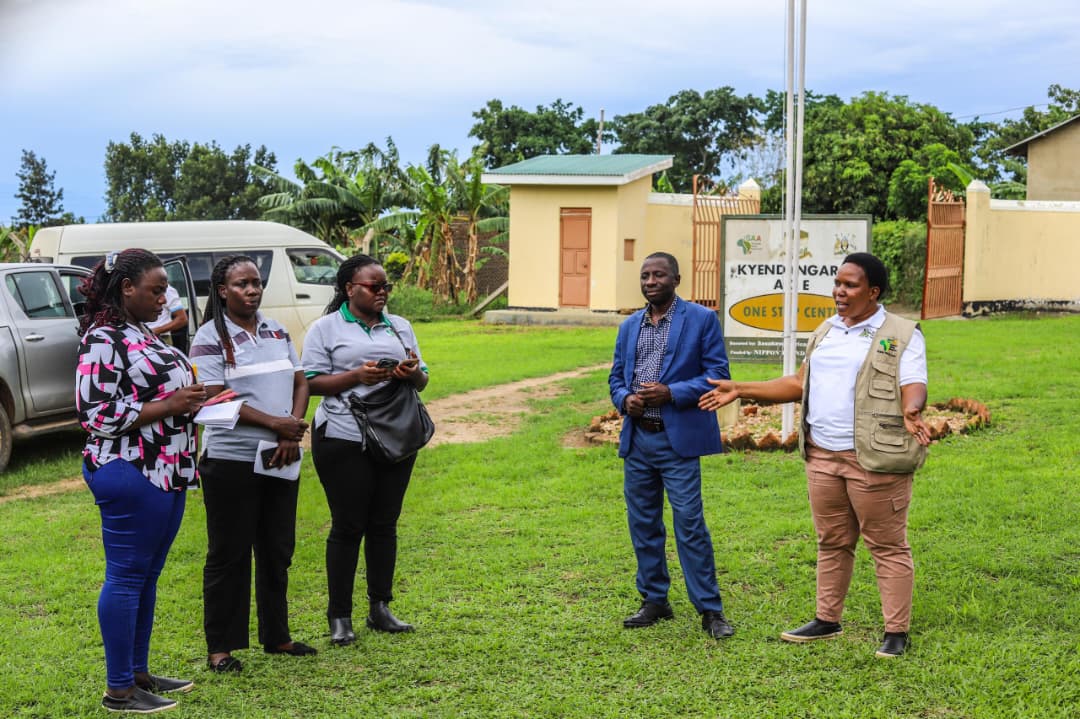
It provides threshers to help separate grain from dust and other impurities, while plans are underway to distribute tarpaulins to farmers so they can dry their crops off the ground and protect them from contamination.
Kamushobora said the cooperative plans to invest about Shs20 million in tarpaulins to improve post-harvest handling.
The cooperative also has a drying area where farmers’ produce can be inspected and properly handled before processing.
During the previous season, Kamushobora said the cooperative processed about 120 metric tonnes of maize, with plans to increase purchases as farmers prepare for the next harvest.
Christine Kyomugisha Kamubona, Sasakawa Africa Association’s programmes officer for climate resilience and agri-food systems, said the Kyendangara initiative is part of the organisation’s broader One Stop Centre Association (OSCA) model, which is designed to provide farmers with services across the agricultural value chain.
She said the model links production, post-harvest handling, agro-processing, value addition, marketing and access to finance.
“The One Stop Centre acts as a facility that offers a full value-chain intervention, from production and post-harvest handling to agro-processing, value addition, packaging and marketing,” Kyomugisha said.
According to her, the centres also serve as aggregation points where farmers can deliver their produce and wait for better market opportunities instead of being forced to sell individually when prices are low.
“Farmers bring all their produce to the OSCA, where it is bulked. At the right time, they can sell it, or the OSCA can identify the right off-taker,” she said.
The model also promotes collective marketing, which strengthens farmers’ bargaining power and makes it easier to connect them to larger buyers.
Kyomugisha said farmers receive training in financial literacy and marketing to help them make better business decisions.
“At the centre, farmers are taken through financial literacy and marketing skills, and they are encouraged to sell collectively rather than market their produce individually,” she said.
Sasakawa also promotes agro-processing and value addition at the centres, enabling farmers to earn more from their produce.
Kyomugisha said farmers can potentially earn significantly more by processing their produce instead of selling raw commodities at farm-gate prices.
“We believe that value addition is key, especially if farmers are to get higher prices for whatever they produce,” she said.
She added that the One Stop Centres also help farmers access financial institutions, noting that knowledge alone is not enough to transform agricultural production.
“Farmers need more than knowledge. They also need the capital to invest in their farming activities and acquire the right inputs at the right time,” Kyomugisha said.
Sasakawa therefore links farmer organisations and One Stop Centres to financial institutions while training farmers in financial management and loan repayment.
“Our role is to train them on how to manage their finances when they borrow money from banks and ensure that they are able to repay it,” she said.
The One Stop Centre model is supported by Sasakawa’s Commercial Community-Based Facilitators (CCBFs), who link farmers to the services available at the centres.
Kyomugisha said the facilitators are essential because they provide the last-mile support needed to ensure farmers not only receive inputs but also use them correctly.
“The OSCA cannot operate without the CCBFs, who provide last-mile services to farmers and mobilise them to come to the centre to access the various services,” she said.
The facilitators work with farmers throughout the production cycle, promoting climate-resilient and regenerative farming practices before helping them connect to markets.
Sasakawa says it has established 12 One Stop Centres across the country, providing platforms where farmers can access agricultural inputs, training, mechanisation, finance, processing facilities and markets.
For farmers in Kitagwenda, the model is gradually helping shift agriculture from subsistence production towards organised commercial farming, with the cooperative serving as a link between farmers, financial institutions and markets.