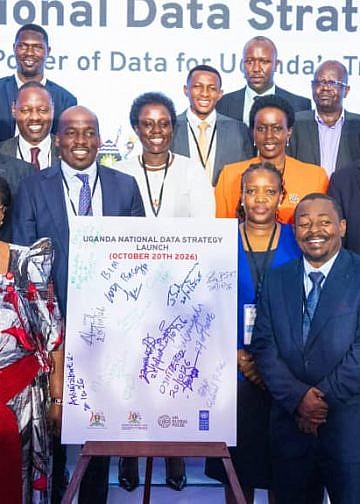









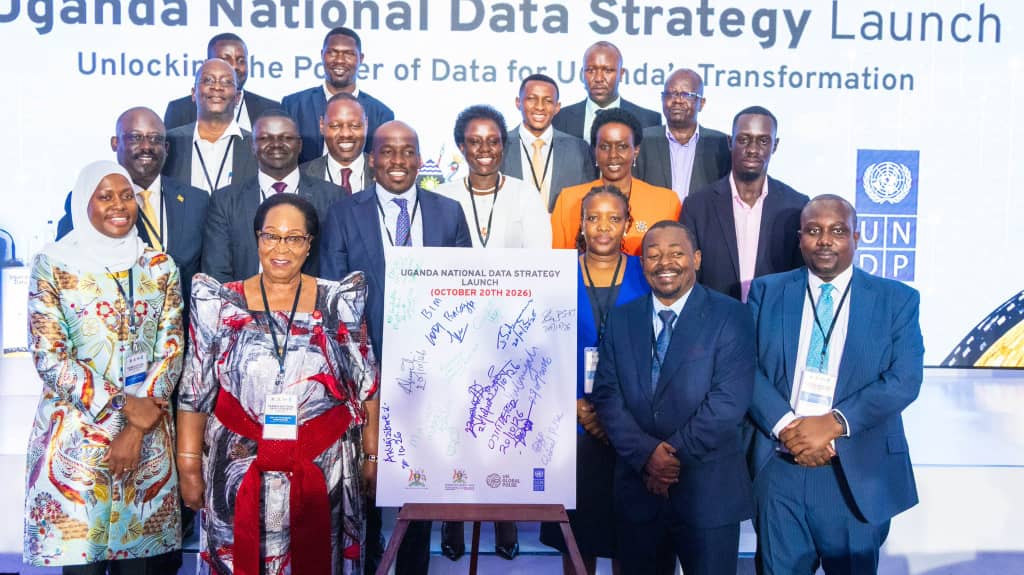
Government has launched Uganda’s National Data Strategy 2026/27–2030/31, a five-year framework aimed at strengthening data governance, improving public service delivery and accelerating the country’s digital transformation.
The strategy was officially launched on Wednesday at Mestil Hotel in Kampala by Joyce Nabbosa Ssebugwawo, Minister of State for ICT and National Guidance (Information), who described data as a strategic national asset capable of driving economic growth and improving government decision-making.
“Today, we are not simply launching a document. We are setting a shared direction for how Uganda can better manage, protect, share and use data to drive national development,” Ssebugwawo said.
The launch brought together government officials, development partners, private-sector representatives, academics and civil society organisations.
The strategy was developed by the Ministry of ICT and National Guidance, with technical support from UN Global Pulse and the United Nations Development Programme (UNDP). It is designed to establish a coordinated approach to collecting, managing, protecting, sharing and using data across government institutions and other sectors.
According to the minister, effective data governance can strengthen evidence-based policymaking, improve public services, encourage innovation and create opportunities for economic growth.
The framework is organised around three pillars: data governance, data infrastructure and strategic data utilisation. These are supported by two enablers: people and culture, and research, innovation and entrepreneurship.
It aligns with Uganda Vision 2040, the Digital Uganda Vision and the Digital Transformation Roadmap, while supporting the objectives of the Fourth National Development Plan (NDP IV).
Speaking at the launch, Ministry of ICT and National Guidance Permanent Secretary Dr Aminah Zawedde said the strategy marked a shift in how Uganda views and uses data, moving beyond its traditional role in administrative processes to recognising its economic and strategic value.
“Today marks a decisive milestone where Uganda shifts from treating data as a passive administrative byproduct to wielding it as a strategic national economic asset,” Zawedde said.
She said the strategy followed extensive national consultations, including peer reviews with the Forum of Permanent Secretaries and formal validation by 131 state and non-state organisations.
Zawedde also linked the framework to Uganda’s economic ambitions under NDP IV, which include growing the country’s gross domestic product from US$50 billion to US$500 billion over 15 years.
She emphasised that reliable and timely data would be important in guiding investment, planning and performance monitoring across the country’s priority sectors: agro-industrialisation, tourism, minerals, oil and gas, and science, technology and innovation.
The strategy outlines several targets for achievement by the 2030/31 financial year, including expanding the integration of government platforms through the Uganda Government Integration Hub (Ug-Hub) from 135 to 300.
It also seeks to increase the proportion of NDP IV indicators supported by verifiable data from 36 per cent to 80 per cent, a move intended to strengthen monitoring of government programmes and improve accountability for development outcomes.
Another key target is the establishment of two Tier IV data centres with a planned sovereign storage capacity of 10 petabytes. The strategy further seeks to improve operational efficiency through shared digital infrastructure and locally developed digital solutions.
Implementation is estimated to cost shs1,662.6 billion over five years. The government expects to finance the programme primarily through coordinated public-sector budgeting, supplemented by revenue from value-added data services, development-partner support and private-sector co-investment.
Ssebugwawo said achieving the strategy’s objectives would require coordinated action by ministries, departments and agencies, local governments, private businesses, academic institutions and civil society.
She identified fragmented data systems, inconsistent standards, limited information sharing and inadequate infrastructure as some of the challenges the strategy is intended to address.
The minister also stressed the importance of improving data literacy, ensuring that women, young people and persons with disabilities benefit from digital transformation, and promoting the responsible use of emerging technologies, particularly artificial intelligence (AI).
She thanked UN Global Pulse and UNDP for their technical assistance and acknowledged the contributions of stakeholders involved in developing the framework.
Zawedde said the strategy would also provide a foundation for Uganda’s planned National AI Strategy, noting that the quality and governance of data would be critical to the development and ethical application of artificial intelligence.
“Artificial Intelligence is only as intelligent and ethical as the data that feeds it,” she said.
Following the launch, government institutions are expected to incorporate the strategy’s priorities into their planning, budgeting and service delivery processes, with the Ministry of ICT and National Guidance coordinating implementation.
The effectiveness of the framework will ultimately depend on the government’s ability to translate its targets into practical measures, strengthen coordination across institutions and ensure that reliable data informs decisions on public investment and national development.