










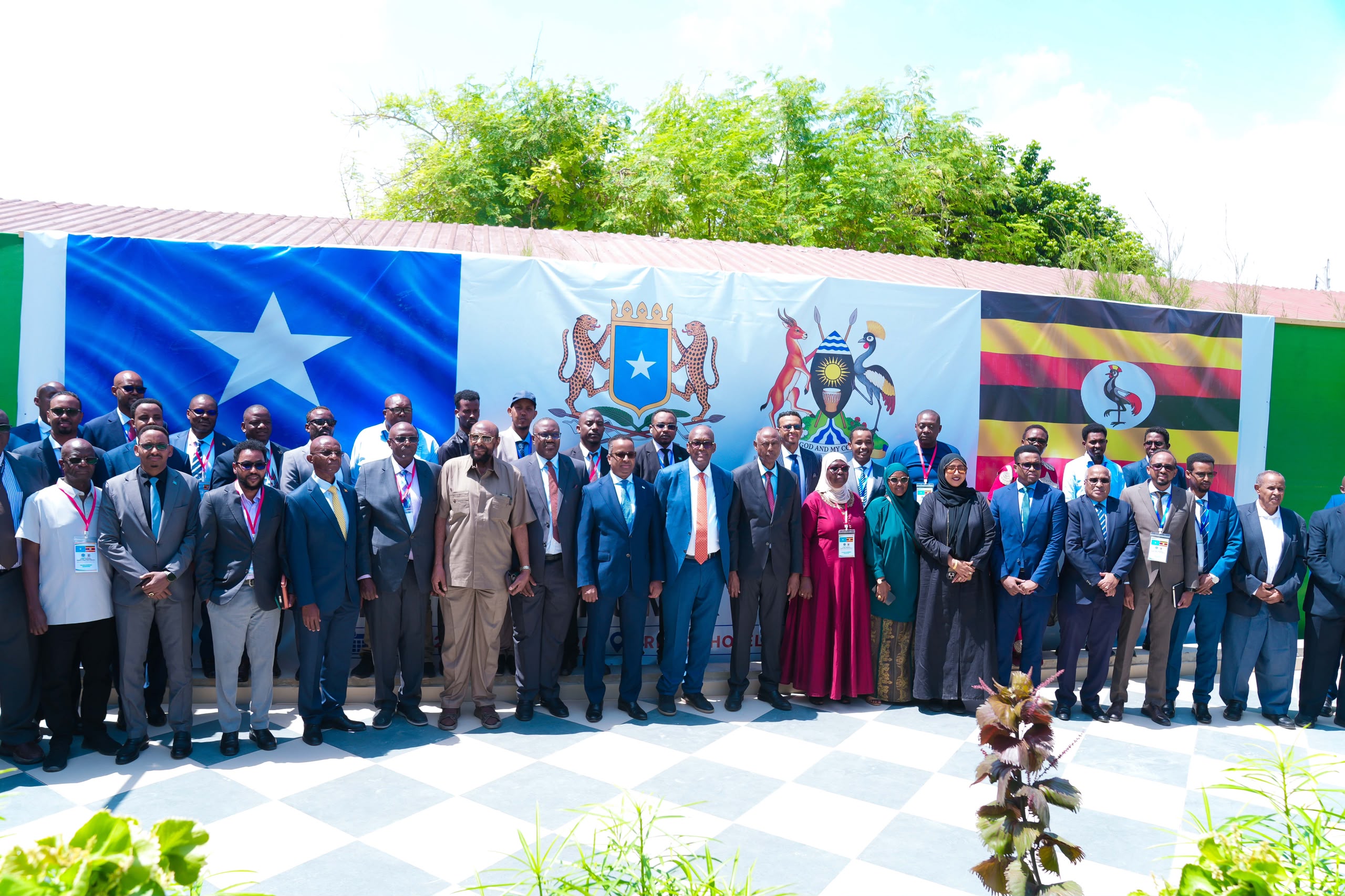
Uganda and Somalia are seeking to accelerate bilateral trade and investment by concluding an air services agreement and advancing proposed cooperation deals on customs, health, quality standards and statistics.
The push emerged during a mid-term review of the Uganda–Somalia Joint Permanent Commission (JPC) in Mogadishu, where officials from both countries assessed progress on commitments made at their previous meeting in Kampala in October 2025.
Vincent Bagiire Waiswa, Uganda’s Permanent Secretary in the Ministry of Foreign Affairs, called on both governments to conclude negotiations on the Bilateral Air Services Agreement as soon as possible to pave the way for its signing.
Bagiire was speaking at the opening of the review at the Airport Hotel in Mogadishu, held alongside an investment and business forum and a joint exhibition aimed at strengthening commercial ties between the two countries.
He said Uganda had submitted draft memoranda of understanding covering customs, standards and quality assurance, statistics, and health, urging both sides to translate the proposed agreements into practical cooperation.
The two countries also agreed during the October 2025 JPC meeting to address operational challenges affecting Uganda Airlines in Somalia and establish a Joint Permanent Investment and Business Council to tackle non-tariff barriers to trade. However, the council is yet to become operational.
“The signing of the Memoranda of Understanding and Agreements should translate into tangible results-oriented collaboration that drive economic growth and shared prosperity,” Bagiire said.
Uganda Airlines operates direct flights between Entebbe and Mogadishu, providing an important link for business, tourism and people-to-people exchanges. The proposed air services agreement is expected to provide a framework for further cooperation in aviation.
Hamza Adan Haadoow, Permanent Secretary in Somalia’s Ministry of Foreign Affairs and International Cooperation and co-chair of the review, identified three priorities: implementing existing commitments, assigning clear responsibilities and timelines, and establishing effective follow-up mechanisms.
“Let us ensure that our cooperation goes beyond agreements on paper and delivers tangible benefits to the people of Somalia and Uganda,” Haadoow said.
He said Somalia saw considerable potential to expand cooperation with Uganda in trade, investment, tourism, agriculture, education, health, labour and aviation.
Haadoow also urged businesses attending the forum to establish partnerships, explore new markets and identify commercially viable opportunities that could benefit both countries.
The talks come amid an increase in Uganda’s exports to Somalia, although trade remains relatively small and heavily skewed in Uganda’s favour.
United Nations Comtrade data show that Uganda’s exports to Somalia rose from approximately Sh11.4 billion ($2.75 million) in 2023 to Sh28 billion ($6.78 million) in 2024.
Tobacco products accounted for the largest share, valued at about Sh10.6 billion ($2.55 million), followed by aircraft and parts worth Sh5 billion ($1.2 million) and wood products valued at Sh2.2 billion ($528,470).
By comparison, Somalia’s exports to Uganda were valued at approximately Sh146 million ($35,400) in 2021, down from Sh2.8 billion ($671,000) in 2016, according to UN Comtrade figures.
Bagiire acknowledged the growth in trade but said businesses in both countries needed to do more to exploit available opportunities.
“Our imports and exports between Uganda and Somalia have exponentially grown. However, we believe that our private sector can do better than the current statistics,” he said.
He said the two governments had established platforms, including business forums and exhibitions, to connect companies and promote commercial partnerships. The next step, he added, was for the private sector to turn those opportunities into actual business.
Somali importers have expressed interest in sourcing fresh fruit, grains, maize, wheat and cassava flour, long-life milk, pharmaceuticals, medical devices, processed coffee and tea from Uganda, according to UG Standard’s preview of the forum.
Uganda eyes Somalia as gateway to regional and Gulf markets
Uganda is also seeking to leverage Somalia’s strategic position on the Indian Ocean to expand access to regional and international markets.
“Uganda is land linked, while Somalia has the longest coastline in Africa spanning a length of 3,333km along the Indian Ocean,” Bagiire said.
He described Somalia as a potential trade gateway connecting African markets with the Gulf states, while identifying Mogadishu as a city with the potential to become a major regional commercial hub.
He argued that shorter maritime routes, if fully developed and utilised, could reduce shipping costs and improve market access for businesses in both countries.
The opportunity is significant for Uganda, whose export trade is increasingly oriented towards the Middle East.
The Ministry of Finance’s Performance of the Economy report for May 2026 indicated that the Middle East accounted for 54.2 per cent of Uganda’s merchandise exports in April 2026, with nearly all exports to the region going to the United Arab Emirates. The East African Community (EAC) accounted for 20.8 per cent.
Bank of Uganda figures show that the country’s exports reached a record Sh46 trillion ($12.7 billion) in the 12 months to November 2025, representing a 33 per cent increase from Sh30 trillion ($8.5 billion) in the corresponding period a year earlier.
Somalia’s membership in the EAC, which took effect on March 4, 2024, adds another dimension to the trade relationship by creating opportunities for businesses to explore a wider regional market.
According to the EAC Quarterly Statistics Bulletin, intra-community exports rose by 33.2 per cent to Sh13.2 trillion ($3.2 billion) in the April–June 2026 quarter.
The Mogadishu engagement also forms part of Uganda’s broader economic and commercial diplomacy agenda.
The Ministry of Foreign Affairs is implementing its Economic and Commercial Diplomacy Strategy for 2025/26–2029/30, which assigns diplomatic missions a role in promoting exports, investment and tourism.
The strategy is aligned with the government’s tenfold growth ambition, which seeks to expand Uganda’s economy to approximately Sh2,069 trillion ($500 billion) by 2040.
Gen Henry Tumukunde, Uganda’s Minister of Gender, Labour and Social Development, called for stronger African economic integration, arguing that fragmented markets continued to limit the continent’s ability to benefit from its production capacity and natural resources.
“Africa had inherited fragmented markets that make us consumers of foreign goods and exporters of our raw wealth,” Tumukunde said.
“We watch our neighbours buy from distant continents what is grown or manufactured just a few miles away across a border line. This is a luxury we can no longer afford,” he added.
Tumukunde was scheduled to sign a bilateral labour agreement with his Somali counterpart on Wednesday afternoon, according to the programme.
The business forum is scheduled to continue on Thursday under the theme Harnessing Trade, Tourism and Investment Opportunities in Both Countries and Beyond.
The meeting is expected to conclude with the signing of a Mogadishu Declaration on trade and investment, setting out a further framework for cooperation between Uganda and Somalia.
The success of the engagement will depend on whether both governments can move beyond commitments and deliver the agreements, institutional mechanisms and private-sector partnerships needed to increase trade, diversify exports and attract investment.