








Uganda’s women peacebuilders need more than recognition and policy commitments to sustain their contribution to national stability, with government urged to increase domestic funding for initiatives promoting women’s participation in peacebuilding, conflict prevention and security decision-making.
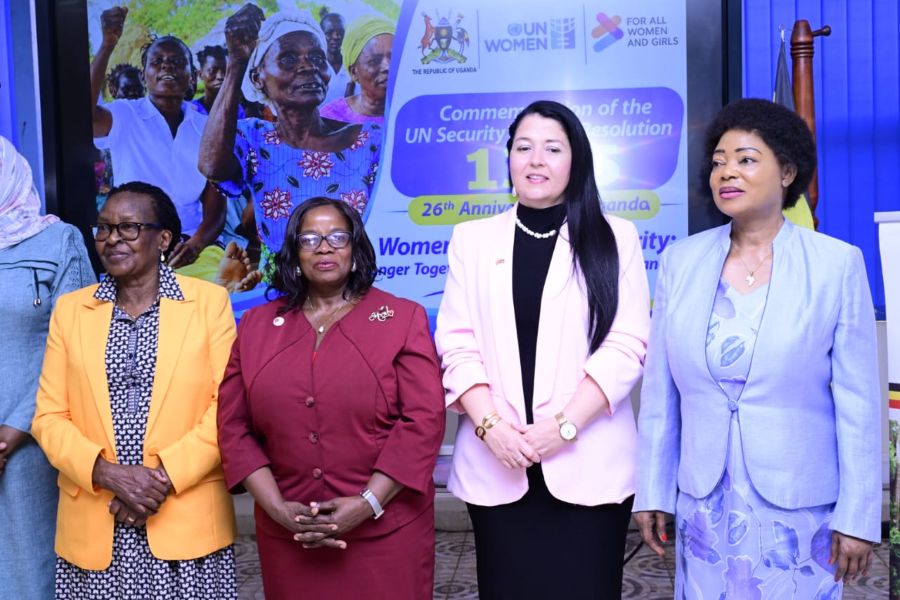
Government officials, development partners and civil society organisations made the call during the commemoration of the 26th anniversary of the United Nations Security Council Resolution 1325 (UNSCR 1325) on Women, Peace and Security, hosted by UN Women at its offices in Naguru, Kampala.
The stakeholders commended Uganda’s progress in implementing the Women, Peace and Security agenda but warned that inadequate financing, gender-based violence, climate-related insecurity, displacement and limited representation of women in decision-making continue to undermine efforts to achieve lasting peace.
Dr Angella Nakafeero, Commissioner for Gender and Women Affairs at the Ministry of Gender, Labour and Social Development, said the anniversary provided an opportunity for Uganda to reflect on its history of conflict, recognise progress in peacebuilding and renew its commitment to inclusive national development.
Delivering remarks on behalf of the State Minister for Gender and Culture Affairs, Mary Kamya, Nakafeero said Uganda’s experience with conflict and disasters made peace and security essential to its development aspirations.
“Uganda has been a country that has been marred by conflicts and disasters. It is of recent that we celebrate relative peace in our country. This resolution is very important to us in terms of acknowledging where we are coming from, the progress we have made as a country in peacebuilding and conflict resolution, but also in terms of indicating to us what the future presents,” Nakafeero said.
She emphasised that women must be central to peacebuilding and conflict resolution, noting that their participation was critical to achieving sustainable peace in Uganda, Africa and the wider world.
“It is very important that for us to achieve national development, total peace and security is important to us. Amidst that is the aspect of centring women in the struggle and in the agenda of peacebuilding in our country,” she added.
UN Women Country Representative Dr Pauline Chiwangu said the adoption of Resolution 1325 in 2000 marked a significant global recognition that sustainable peace depends on women’s meaningful participation.
“Twenty-six years ago, the world recognised a simple but very transformative truth: peace is stronger, more inclusive and more sustainable when women participate in building it. Without women, peace is weak. We need women. That message is as relevant today as it was 26 years ago,” Chiwangu said.
She observed that conflicts were becoming increasingly complex, with displacement, climate shocks, economic insecurity and humanitarian emergencies disproportionately affecting women and girls.
Chiwangu said Uganda had established itself as a regional and international leader in advancing the Women, Peace and Security agenda through successive National Action Plans and collaboration between government institutions, civil society organisations and local communities.
However, she said the country needed to accelerate implementation of its Third National Action Plan through stronger institutional accountability, meaningful participation of women in decision-making and integration of peace and security priorities into national and local government development plans and budgets.
Highlighting the impact of grassroots interventions, Chiwangu cited the example of women peace mediators in Yumbe District, including Gloria Ato, who have helped communities resolve disputes through dialogue and peaceful reconciliation.
She said the mediators had contributed to a significant reduction in mob justice incidents in a community that previously experienced multiple cases during market days.
“Now, they use their mediation skills to help neighbours resolve disputes peacefully before they escalate. Their community initiatives are promoting a culture of dialogue and reconciliation over violent confrontation. This is what the Women, Peace and Security agenda looks like in practice. It is not only about policies and plans. It is about ordinary women helping their communities become safer and more peaceful,” she said.
Chiwangu also highlighted the contribution of refugee women to peaceful coexistence and community leadership, noting that Uganda hosts more than two million refugees, the majority of whom are women and children.
She cited the example of Grace Nema Kemis, a South Sudanese refugee who became the first woman elected as a Refugee Welfare Council III leader in her settlement in Bidi Bidi Refugee Settlement after competing against two male candidates.
According to Chiwangu, Kemis has since used her leadership position to advocate for women and girls and ensure their voices are represented in decisions affecting their communities.
In Karamoja, she said women’s groups were also using savings groups, dialogue and collective action to address tensions arising from recurrent droughts, food insecurity and competition over natural resources.
She argued that peacebuilding could not be separated from broader development concerns.
“Peace, development, climate resilience, human security and broader economic prosperity and growth are deeply interconnected. We cannot address one without addressing the others,” Chiwangu said.
Despite the progress, the UN Women representative warned that shrinking development assistance threatened the sustainability of women-led peacebuilding initiatives and called for increased domestic resource mobilisation.
“Advancing Women, Peace and Security cannot depend only on external support. The time of depending on overseas development assistance alone is gone. Interests are shifting. We really have to come up with mechanisms to ensure that domestic financing and resource mobilisation are strengthened to fund the challenges we are facing,” she said.
Chiwangu particularly congratulated 13 districts that have committed at least one per cent of their annual budgets towards implementing local action plans on Women, Peace and Security.
She urged other local governments to follow suit, saying sustainable financing was necessary to expand successful interventions and strengthen women’s participation in peacebuilding across the country.
Austria’s Ambassador to Uganda, Dr Katja Kerschbaumer, also reaffirmed her country’s commitment to supporting women’s participation in peacebuilding, conflict prevention, humanitarian response and security-related decision-making.
She commended Uganda for its leadership through successive National Action Plans, particularly the Third National Action Plan, which seeks to ensure women are active contributors to peace and security rather than merely beneficiaries of interventions.
Kerschbaumer said women’s participation was not simply about representation but also about strengthening institutions, broadening perspectives and improving the quality of decision-making.
“This is not only a matter of representation. It strengthens decision-making, broadens perspectives and helps ensure that institutions are more responsive to the needs of all citizens,” she said.
She noted that research consistently showed that peace agreements were more likely to endure when women participated meaningfully in peace processes.
“For Austria, this principle lies at the heart of both our foreign policy and our development cooperation. We firmly believe that women are not merely beneficiaries of peace and security. Women are leaders, mediators, negotiators, community organisers, humanitarian responders, entrepreneurs and peacebuilders,” Kerschbaumer said.
The diplomat said Austria would continue prioritising the Women, Peace and Security agenda as it prepares to serve as a non-permanent member of the United Nations Security Council.
She outlined three areas of focus: strengthening international partnerships, promoting women’s participation in decision-making and improving protection for women and girls affected by armed conflict.
Kerschbaumer also highlighted Austria’s contribution of four million euros to the Women’s Peace and Humanitarian Fund since 2019, through which nearly one million people have reportedly been reached.
She said women peace observers, mediators and community leaders supported through the partnership had helped prevent, resolve or refer more than one million community-level conflicts.
In addition, Austria has partnered with UN Women and UNFPA since 2018 to improve access to justice for survivors of sexual and gender-based violence and strengthen access to sexual and reproductive health and rights services in Northern Uganda.
Through these partnerships, more than 4.2 million people have received information on gender-based violence and sexual and reproductive health and rights, while more than 8,300 survivors have accessed legal aid and shelter services.
Kerschbaumer stressed that gender-based violence should be understood beyond physical abuse, noting that emotional, psychological and economic abuse, social isolation and restrictions on access to healthcare also undermine women’s dignity and independence.
“Addressing gender-based violence therefore requires more than laws and enforcement alone. It requires changing attitudes and social norms. It requires engaging men and boys as partners,” she said.
She added that gender equality should be treated as a shared responsibility rather than an issue concerning women alone.
“When institutions create opportunities for women, men do not lose influence. Rather, societies gain stronger institutions, better decision-making and more inclusive development,” she said.
Meanwhile, Robinah Rubimbwa, Executive Director of the Coalition for Action on 1325 (CoACT), challenged government to move beyond policy commitments and provide adequate resources for implementing the Women, Peace and Security agenda.
Speaking on behalf of civil society organisations working to advance Resolution 1325, Rubimbwa said the past 26 years had witnessed significant grassroots progress, including training women mediators, establishing local peace committees and supporting districts to develop action plans addressing conflicts in their communities.
“For civil society, the past 26 years tell a story of relentless grassroots resilience. We have taken Resolution 1325 from the boardrooms and conference halls of Kampala and planted it firmly in villages. We have trained hundreds of women in peacebuilding work, established local women mediator networks and formed and trained local peace committees in villages, sub-counties and at district levels,” Rubimbwa said.
She revealed that civil society organisations had supported 22 districts to develop local action plans on Women, Peace and Security, describing the achievement as significant but insufficient given Uganda’s expanding number of districts.
Rubimbwa warned that many local peace committees and women-led mediation networks lacked basic operational resources, leaving unpaid grassroots women peacebuilders and local civil society organisations to shoulder much of the responsibility.
She called on the Ministry of Gender, the Ministry of Finance and district planning committees to prioritise funding for local peacebuilding initiatives.
“Financing our National Action Plan is critical. As a country, we must fund our own peacebuilding work. We have a model for the world, so let us fund it to ensure that our efforts and their impact remain a model for the world as well,” she said.
Rubimbwa welcomed the 13 districts that had committed at least one per cent of their annual budgets to implementing local action plans, noting that some local governments had allocated as much as three per cent.
However, she said the coverage remained inadequate, with only 22 out of Uganda’s 146 districts having developed local action plans with support from civil society organisations.
“Policies without budgets are merely good intentions, but true peace requires dedicated local government funding,” Rubimbwa said.
She also raised concern about emerging threats to women’s security, including technology-facilitated gender-based violence, climate-related insecurity, land disputes and competition over natural resources.
Rubimbwa particularly highlighted challenges facing women in oil-producing districts such as Buliisa and Hoima, where she said women, despite accounting for a significant proportion of agricultural labour, were often excluded from land compensation processes because they lacked formal land titles.
She called for stronger protection of women’s land rights and greater recognition of environmental protection as an essential component of peace and security.
The CoACT director further urged stakeholders to adopt an inclusive approach that addresses the needs of young women, girls, women with disabilities and other vulnerable groups.
She observed that some community peace meetings, public gatherings and police reporting desks remained inaccessible to women with disabilities because of inadequate infrastructure and limited resources.
Rubimbwa also called for the protection of civic space, arguing that women peacebuilders and civil society organisations needed an enabling environment to organise, document emerging risks and hold public institutions accountable.
She encouraged stronger partnerships with cultural leaders, religious institutions and elders to challenge harmful social practices and promote peaceful coexistence.
Addressing journalists, Rubimbwa urged the media to take a more active role in implementing the Women, Peace and Security agenda through responsible and conflict-sensitive reporting.
“How you tell Uganda’s story shapes how our nation responds to conflict. Go beyond the tragedy of violence and politicians’ headlines. Practise gender- and conflict-sensitive journalism. Amplify grassroots women resolving conflicts in our villages. Investigate why local peace plans lack funding. Tell the story of how land disputes affect women’s lives. Your reporting is an early warning system. Do not let us down,” she said.
She challenged journalists to give greater visibility to women mediators, investigate funding gaps in local peace plans and report on the challenges affecting women in conflict-prone and refugee-hosting communities.
As Uganda marks 26 years since the adoption of Resolution 1325, stakeholders say the next phase must focus on translating policy commitments into practical interventions supported by sustainable financing, institutional accountability and stronger community participation.
They emphasised that women should not merely be recognised for their contribution to peacebuilding but must also have the resources, opportunities and influence to shape decisions affecting their communities and the country.