











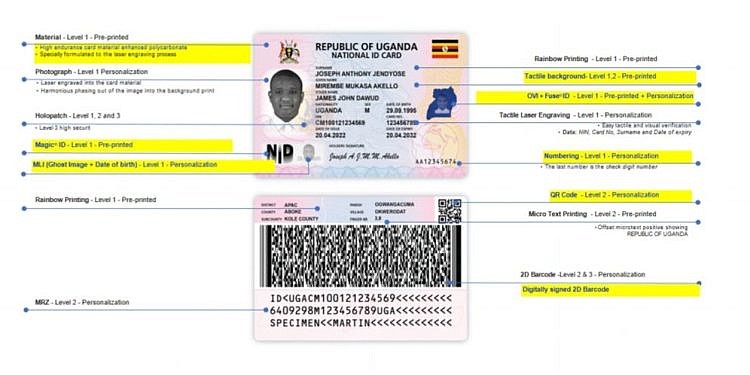
The National Identification and Registration Authority(NIRA) announced that the upgraded national IDs are ready for pickup after being renewed.
NIRA registrar, Claire Ollama said by the weekend, they had already printed 100,000 ID cards that she said have since been sent to various districts for pickup by owners.
“We however ask Ugandans to be patient as more people will receive notifications on where to pick their national ID cards,” Ollama said.
According to officials, the cards will be issued from the district or division office where one registered from.
For example, if a person registered for renewal at Kololo NIRA headquarters, they are expected to pick it from there since it is where it will be issued from.
For the organisations or companies which saw NIRA officials camp there for renewal, these will most likely pick their national ID cards from the nearby NIRA offices.
For example, the UBC or NTV staff who registered from their work stations, they will pick the cards from the NIRA offices for Kampala Central Division located at Lumumba Avenue.
However, NIRA says they are still exploring options of issuing the renewed cards at parish level.
Ugandans are urged to wait for notifications which will be sent in form of text messages to their phone numbers indicating where exactly to pick the renew national ID cards.
The ongoing mass registration exercise by NIRA aims to renew 15.8 million national ID cards that expired by June 2025.
During the ongoing exercise which kicked off in May, NIRA also seeks to register 17.2 million new applicants including children under 17 and those citizens who missed out in the previous registration exercise in 2014.
The new national IDs will have a security feature that uses laser engraving to embed multiple images within the card, visible at different angles, enhancing security against counterfeiting.
They will also have a Machine Readable Zone which is a standardized section on identity documents containing encoded data that can be quickly and reliably read by machines , just like passport readers.
The IDs will also have a two-dimensional barcode containing data readable by smartphones or specialized scanners, commonly used for storing URLs, text, or identification data, or encrypted date and also 2D barcode to decode information stored in barcodes (linear or 2D) printed on cards or documents, enabling rapid data retrieval and verification.