









Uganda is moving to reduce its dependence on imported fish feeds with the establishment of a Shs60 billion aquafeed manufacturing factory in Buyala, Mpigi District, in a major intervention expected to lower production costs and boost commercial fish farming.
The factory, being established by Masheda Feeds Limited with support from the Uganda Development Corporation (UDC), will have an installed production capacity of 33,600 tonnes of fish feeds annually, with the potential to expand to 58,000 tonnes as demand grows.
The investment is expected to address one of the biggest challenges facing Uganda’s aquaculture industry, where farmers have largely depended on imported feeds, particularly from Egypt, despite the availability of locally sourced raw materials that can be used in manufacturing.
Currently, fish feeds cost approximately Shs6,400 per kilogramme, making fish farming expensive and limiting farmers’ ability to expand production.
UDC has committed an additional Shs30 billion towards establishing the factory, bringing its total investment in the project to approximately Shs56 billion against an estimated completion cost of Shs60 billion.
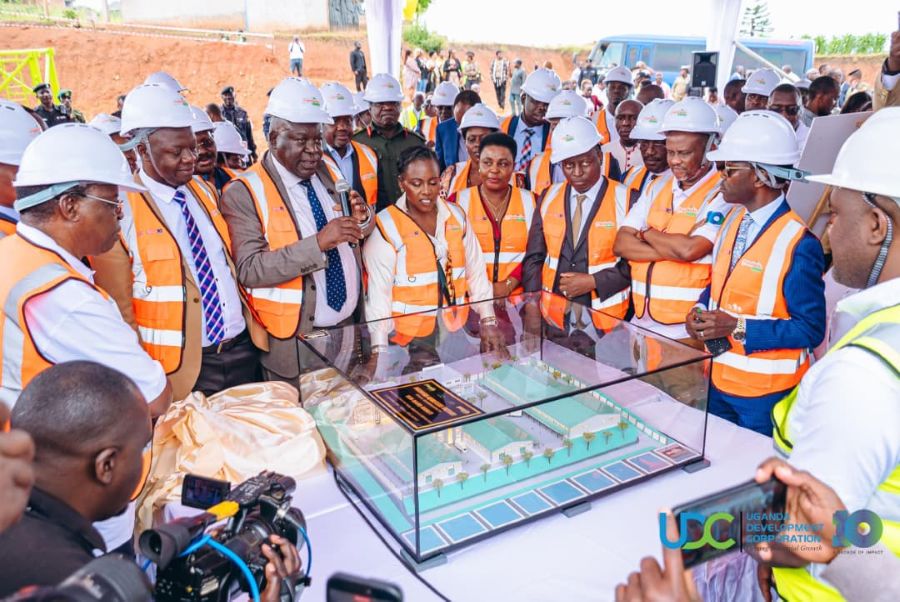
Speaking during the groundbreaking ceremony in Buyala, UDC Executive Director Patrick Birungi said the decision to establish the factory followed an assessment that identified the high cost and limited availability of quality feeds as major constraints to fish production.
Birungi explained that although Masheda had identified substantial demand for processed fish in regional markets, particularly the Democratic Republic of Congo (DRC), increasing production required addressing the shortage of affordable feeds.
“We noted that beyond the fish processing, there is actually need for fish itself. And the farmers and the nucleus farm here and in Kembogo were not enough to satisfy the demand in DRC. So it’s against that background we came in, we supported,” he said.
He added that Uganda had continued exporting agricultural raw materials to countries such as Egypt, where they are processed into fish feeds before being imported back into the country.
“Surprisingly, they were supplying inputs such as peas and others to the factory in Egypt to process fish feed and supply us fish feeds in Uganda. So we said no, that is not sustainable. We need to bring the equipment here so that we produce the feeds from here,” Birungi said.
Birungi said the investment was informed by its potential to transform the livelihoods of fish farmers, particularly small-scale producers who have struggled to access quality feeds.
“There are associations of fish producing farmers across the whole country. And those associations have also been suffering from a feed problem. And therefore, the way these associations are going to benefit, and therefore their farmers, is that they are going to be buying feeds from here and it will be quality feed that has been tested,” he said.
The factory will use locally available raw materials, including maize, soybean meal and cottonseed cake, creating a ready market for agricultural producers while reducing the country’s reliance on imported finished feeds.
Masheda Foods Managing Director Marvin Lwasa said the factory would manufacture feeds for tilapia and African catfish using modern processing technology supplied by Bühler.
He said feeds account for approximately 75 per cent of fish production costs, making their affordability critical to the success of commercial aquaculture.
“One of the biggest issues is that all our feeds have been imported until today, to a point where in any livestock feeds, fish feeds is the most expensive in the country,” Lwasa said.
He explained that producing one kilogramme of fish requires approximately 1.3 kilogrammes of feed, meaning farmers spend a significant proportion of their operational costs feeding their fish.
“Now this is not sustainable and this is not affordable for the common farmer. So one of the things that we’re trying to do is how can Masheda Feeds invest in industrial and commercialisation of fish feed production, which is what we’re here to do today,” he said.
Lwasa revealed that the company expects locally manufactured feeds to be more than 40 per cent cheaper than prevailing market prices, although the final selling price will depend on production costs.
“We’re going to look at our feed cost being nearly more than 40 per cent from the local market price,” he said.
He added that the factory would create a reliable market for farmers producing the raw materials used in feed manufacturing.
“Once we consolidate them, we give them a ready market. But also, as we produce with our black soldier fly protein in our feed to make a ready formulation, we’re going to look at our feed cost being nearly more than 40 per cent from the local market price,” Lwasa said.
The factory will also incorporate a Black Soldier Fly Larvae (BSFL) production facility capable of processing 30 tonnes of organic waste daily into protein ingredients for animal feeds and organic fertiliser.
The technology is expected to reduce reliance on conventional protein sources such as mukene, whose supply is increasingly under pressure from fishing activities.
At full capacity, the facility is expected to produce more than 2.5 tonnes of crude protein daily and approximately 4.5 tonnes of organic fertiliser while processing about 11,000 tonnes of organic waste annually.
Lwasa said producing protein locally would help reduce the cost of manufacturing feeds while addressing the challenge of expensive imported ingredients.
“The most expensive component, which is the protein, the crude protein, we are going to produce in one of our plants here because it’s an aquafeed factory as well as a black soldier fly insect protein factory,” he said.
He added that the project was designed to support the wider aquaculture industry rather than exclusively serving Masheda’s fish farms.
“What we have here at Masheda today is the whole value chain all in one. We have the fingerling production, we have the grow-out, we have the feeds that we are building, but then we also have the processing facility where we are guaranteeing our farmers that we have given fingerlings, feeds. We are guaranteeing you a market,” he said.
UDC Board Chairperson Godfrey Ruhurira said the project would strengthen the entire aquaculture value chain by connecting fingerling production, feed manufacturing, fish farming, processing and marketing.
He said Masheda’s existing network of nearly 800 fish farmers operating more than 2,000 ponds would provide an important foundation for the new manufacturing business.
“Fish farmers need good fingerlings. They need dependable feed supplies. They need the necessary technical support. And they need to access the buyers. When any of these links is weak, productivity and competitiveness would suffer,” Ruhurira said.
He added that the investment would improve access to quality feeds while creating opportunities for farmers, workers and surrounding communities.
“The objective is therefore to make quality fish feeds more affordable for farmers, improve their margins while the cost of production is reduced and strengthen the competitiveness of Uganda’s aquaculture industry,” he said.
The Minister of State for Fisheries, Robert Migadde Ndugwa, said the success of the factory would be measured by improvements in fish growth, harvests and farmers’ earnings rather than simply the availability of cheaper feeds.
“A low-price feed is only a benefit if it provides the right nutrients and produces good results. We therefore want farmers to see improvements in fish growth, survival, feed conversion efficiency and ultimately their net earnings,” Migadde said.
He cautioned that some farmers were losing money because of poor feeding practices and the use of inappropriate feeds.
“I’ve come across farmers who have fed fish for eight months, and that fish cannot raise 200 grams. But they have fed for eight months. So they are using the wrong feed,” he said.
Migadde added that the Ministry of Agriculture would work with Masheda to support farmers with quality fingerlings, feeds and technical guidance as the government expands aquaculture production.
He also welcomed the use of Black Soldier Fly protein as an alternative to conventional protein ingredients, noting that its nutritional performance and safety would need to be established through proper testing.
Investment to create jobs and boost local agriculture
Beyond aquaculture, the factory is expected to stimulate local agricultural production by creating demand for maize, soybeans and other raw materials while generating employment in manufacturing, transportation, logistics and agricultural supply chains.
Masheda management said the new facility was expected to directly employ at least 100 additional workers, on top of more than 300 people already employed across its businesses.
The Minister of State for Industry, David Bahati, said the investment would contribute to the government’s ambition of building an independent and self-sustaining economy through local manufacturing and value addition.
“What this factory is going to do is to add value and use local materials like maize, soya bean, which is a fulfilment of what General Saleh and His Excellency President Yoweri Museveni and all our heroes who fought in the bush actually fought for: building an independent, integrated and self-sustaining economy,” Bahati said.
He said the factory would also contribute to food security by increasing fish production and improving access to affordable protein.
Bahati urged Masheda to look beyond Uganda and take advantage of opportunities in the East African Community and African Continental Free Trade Area markets.
“Madam Esther, as you make this investment, don’t look at Uganda alone. We talk about Buy Uganda, Build Uganda. We want you also to talk about Buy East Africa, Build East Africa, but most importantly, Buy Africa, Build Africa,” he said.
The factory is expected to be completed and commissioned by February 2027.