










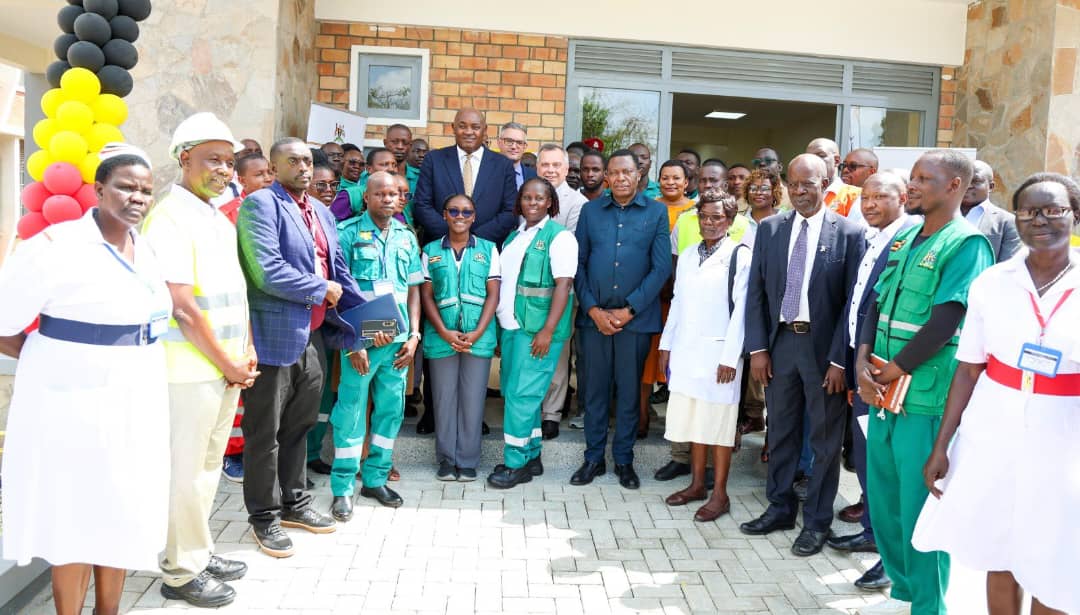
The Ministry of Health has commissioned a Shs2 billion regional ambulance call and dispatch centre at Arua Regional Referral Hospital to strengthen emergency medical response and reduce delays in accessing lifesaving care across the West Nile region, which serves more than 2.3 million people.
The centre was commissioned on Thursday, November 19, 2026, by Health Minister Dr Chris Baryomunsi. Its construction was funded by the Government of Belgium through its Embassy in Uganda and the Belgian development agency, Enabel.
The facility will receive emergency calls, coordinate ambulance deployments and facilitate referrals between communities, health facilities and referral hospitals, with the aim of ensuring patients receive timely medical attention.
Speaking at the commissioning ceremony, Baryomunsi highlighted the growing burden of medical emergencies in Uganda, noting that the country records 833 emergency conditions per 100,000 people.
“In the West Nile region, this challenge is particularly significant. Arua Regional Referral Hospital (ARRH) serves a catchment population of over 2.3 million people, including approximately 483,000 refugees,” Baryomunsi said.
He cited communicable diseases, maternal and child health emergencies, road traffic injuries and other critical medical conditions as some of the emergencies requiring prompt intervention in the region.
The centre is expected to improve the coordination of ambulance services by ensuring that the nearest available ambulance responds to an emergency, rather than relying on fixed ambulance allocations to particular areas.
Director General of Health Services Dr Henry Mwebesa Olaro said the Arua facility would serve as a prototype for similar centres being established across the country.
He revealed that the Government had planned to establish 12 regional ambulance call and dispatch centres under the Third National Development Plan (NDP III), with nine already initiated.
Dr Olaro commended the Belgian Government and Enabel for supporting the construction of the facility, noting that its design had undergone technical review and approval before being adopted as a model for other regions.
He explained that the centre has an integrated design that accommodates both ambulance call and dispatch services and a Public Health Emergency Operations Centre, enabling authorities to coordinate responses to medical emergencies and public health threats.
However, Dr Olaro acknowledged that Uganda’s ambulance fleet remains below the Ministry of Health’s planning standard of one ambulance per 100,000 people, adding that the Government would progressively address the shortage.
He identified staffing, operational systems and the establishment of the emergency access number 912 as key priorities before the centre becomes fully operational.
The Ministry will also put in place the necessary software and operational arrangements, while recruitment and deployment of personnel will be undertaken progressively.
Beyond emergency ambulance services, Dr Olaro cautioned health workers in West Nile against becoming complacent about Ebola preparedness, given the region’s proximity to neighbouring countries and continued movement of people across porous borders.
Although Uganda has no confirmed Ebola case, he warned that the risk of importation remains and urged health workers to strengthen infection prevention and control measures.
He called for effective fever surveillance, proper triage and prompt identification of suspected cases, emphasising that protecting health workers from infection is essential to preventing wider transmission.
Dr Olaro also urged health workers to demonstrate professionalism, commitment and accountability, warning against absenteeism, extortion and other practices that undermine public confidence in health facilities.
He said the value of the new infrastructure would ultimately depend on the quality of services delivered to patients.
Meanwhile, Belgium’s Ambassador to Uganda, Hugues Chantry, said the centre’s full potential would depend on its integration into a coordinated national emergency communication and ambulance dispatch system.
“The full potential of the ambulance call and dispatch centre will be realised when it becomes part of an integrated national emergency communication and ambulance dispatch architecture,” Chantry said.
He urged the Ministry of Health to expedite the integration of the Arua facility into the national system to ensure that the investment translates into reliable emergency health services for the population.
“We therefore encourage Ministry of Health to expedite the integration of the Arua centre into the national system so that investments made here can translate as quickly as possible into reliable health services for the population,” he added.
Dr Olaro also noted that Arua Regional Referral Hospital’s capacity was being strengthened through investments in an intensive care unit, radiology unit, certified laboratory and specialist services, although staffing gaps remain a challenge.
The establishment of the centre is part of broader efforts to strengthen Uganda’s emergency medical response system and improve access to timely referral services, particularly in regions where long distances, limited ambulance availability and poor coordination can delay lifesaving treatment.