











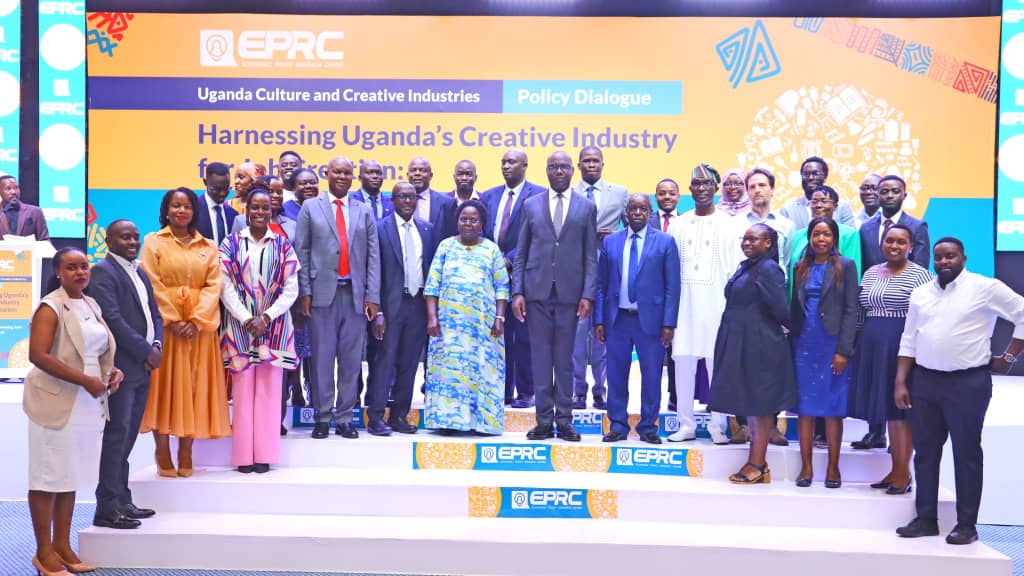
Government has urged commercial banks and other financial institutions to accept intellectual property as collateral for loans to artists and other players in Uganda’s creative industry, saying the move could unlock financing, stimulate investment and create jobs.
The call was made by the Minister of State for Finance, Planning and Economic Development, Henry Musasizi, while speaking at the Uganda Culture and Creative Industries Policy Dialogue organised by the Economic Policy Research Centre (EPRC) in Kampala.
Musasizi said existing legislation already provides for intellectual property to be used as security for credit, but reluctance among some financial institutions to implement the provision continues to limit access to financing for creatives.
He cited the Security Interest in Movable Property Act, 2019, which allows movable assets, including intellectual property, to be used as collateral for loans.
He urged banks to embrace the legal provision and develop lending arrangements that enable artists to use the value of their creative works and intellectual assets to secure financing.
Musasizi said the creative industry has significant potential to generate income, expand businesses and create employment opportunities if players can access affordable financing.
“Government prioritises the cultural and creative industries as a key for boosting the country’s domestic resource mobilisation,” he said.
He said Government had continued to support the sector through various financing interventions, including Shs66 billion allocated in the 2025/26 financial year, of which Shs10 billion was earmarked for a revolving fund for artists, with the remaining amount allocated to creative arts.
He added that a further Shs33 billion had been provided to the musicians’ revolving fund in the 2026/27 financial year to support enterprise growth and job creation.
Other interventions include a Shs500 million grant to filmmakers through the Uganda Communications Commission in 2021, Shs5 billion extended to the podcasters’ SACCO in 2026 and Shs7 billion allocated to support the event promoters’ SACCO.
However, Musasizi identified informality as one of the major challenges limiting the growth and economic visibility of Uganda’s creative industry.
He said much of the value generated within the sector comes from activities that are not captured by formally registered enterprises, making its actual contribution to the economy difficult to measure.
He noted that improving data collection systems, strengthening sector classification and supporting the formalisation of creative enterprises would help attract investment, improve economic measurement and broaden the tax base.
According to the 2024 National Population and Housing Census, Uganda had 353,115 people engaged in creative occupations, representing 3.7 per cent of the country’s total working population.
Government has set targets to double the creative sector’s contribution to Gross Domestic Product (GDP) from 3 per cent to 6 per cent, increase its share of employment from 1 per cent to 5 per cent, and grow its export earnings and domestic revenue contribution by 25 per cent.
EPRC Executive Director Dr Sarah Ssewanyana said the creative industry could play a significant role in addressing youth unemployment by providing productive and sustainable employment opportunities.
“According to the Bureau of Statistics, four in every ten young people in Uganda are not in employment, not in education or training,” she said.
Ssewanyana noted that approximately seven in every 10 people working in performing arts, music, film and fashion are young people, making the sector an important source of livelihoods and business opportunities.
She also observed that the creative industries could remain resilient amid rapid technological advancements and the growing use of artificial intelligence (AI), given their reliance on cultural sensitivity, social skills and individual creativity, which are not easily replicated by technology.
The proposed interventions form part of Government’s Tenfold Growth Strategy, which seeks to expand Uganda’s economy to US$500 billion by 2040.