










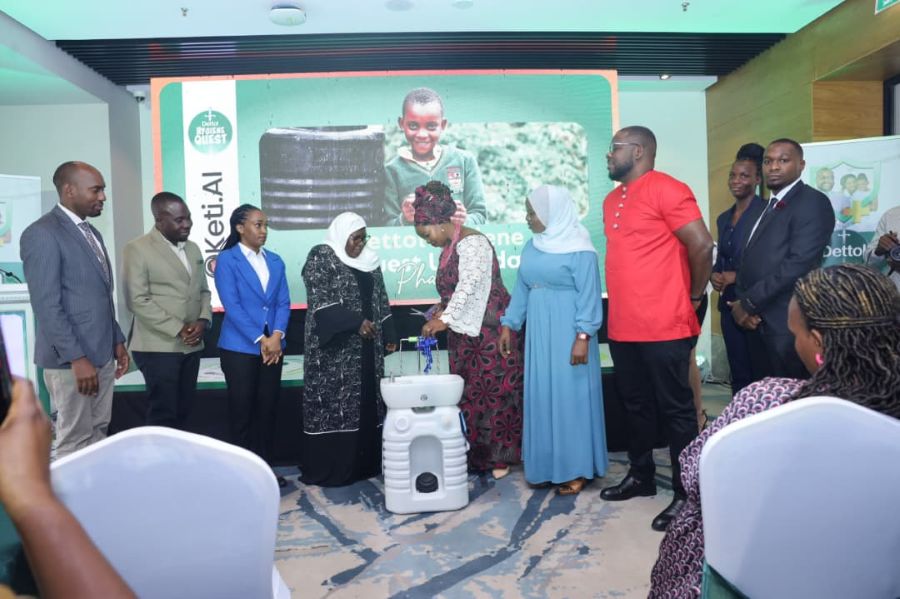
Uganda has marked Global Handwashing Day 2025 with a major boost to school hygiene efforts as the Dettol Hygiene Quest Program entered its second phase—introducing a digital chatbot to support hygiene compliance in Schools.
Backed by Reckitt, the global manufacturer of Dettol, Harpic, Jik and Durex, and executed by Chil Femtech Limited, the expanded initiative targets both behavioural change and data-driven hygiene monitoring in schools across several districts.
Addressing participants at the launch held at Four Points by Sheraton, Kampala, Dr. Shamim Nabuuma, CEO of Chil Femtech and focal person for the program, said the ambition goes beyond infrastructure and aims to shift mindsets among young learners.
“Today marks the beginning of the phase two of the Dettol Hygiene Quest Program that is changing how our children in school understand the practice of hygiene and hand washing,” she said.
She recalled how the pilot phase had already delivered significant impact across the country.
“In phase one, we reached 750 schools in Uganda and constructed 1,500 hand-washing facilities, one for girls and another for boys in each school,” Dr. Nabuuma stated.
Teachers, she said, were instrumental in making hygiene education practical in schools.
“We went ahead to train teachers on how to help children learn the right way to wash their hands,” she explained.
Looking ahead, she revealed the program’s latest innovation—a digital hygiene assistant.
“We have introduced the Dettol Hygiene Quest chatbot—teachers now have a digital assistant to help them plan lessons, track attendance and monitor hygiene practices,” she announced.
State Minister for Karamoja Affairs Florence Namboozo described hygiene as a cornerstone of national development.
“Hygiene and sanitation are not merely health issues—they are fundamental pillars of education, economic growth and national development,” she said.
She highlighted the direct link between school hygiene and learning outcomes.
“A child who is sick cannot learn, and a teacher who lacks hygiene facilities cannot maintain a healthy classroom,” Namboozo remarked.
The minister praised the collaboration between stakeholders.
“You have shown that when government and the private sector work together, we can deliver solutions that are inclusive, innovative and scalable,” she said.
Namboozo also urged local authorities to integrate technology into routine school oversight.
“We encourage district leaders to ensure that hand-washing facilities remain functional and that data collected through AI chatbots is used for effective decision-making,” she said.
Boniface Shaka, Reckitt Country Director, reaffirmed the company’s commitment to public health beyond commercial interests.
“As Reckitt, we believe that access to hygiene is not a privilege—it is a basic right for every child,” he declared.
He challenged communities to embrace handwashing as a national culture.
“As we mark this global hand washing day, we want to turn every child into a handwashing hero,” he said.
Shaka said their work is rooted in long-term social impact rather than short-term visibility. “Beyond business, our true purpose is to deliver hygiene education that makes a lasting difference in society,” Shaka emphasized.
He revealed the extent of the program’s reach this year were several washing stations were donated in various schools.
“The program has reached 450,000 children in 2025, and we have donated several hand washing stations to schools across Uganda,” he revealed.
Dr. Safinah Kisu Museene, Commissioner at the Ministry of Education and Sports, said the initiative aligns with the ministry’s goal of keeping learners healthy and consistently present in class.
“The ministry recognizes that hygiene and sanitation are fundamental pillars of child health, school attendance and academic performance,” she said.
She said the earlier phase had demonstrated the success of joint effort.
“The success of phase one demonstrated the massive value of collaboration between the public and private sector,” she noted.
Museene welcomed the shift towards using artificial intelligence in school hygiene monitoring.
“Most notably, the introduction of the Dettol Hygiene Quest chatbot has brought a new dimension of digital innovation to our education system,” Museene remarked.
She assured continued cooperation from the ministry. “The Ministry of Education, through the office of the Permanent Secretary, will remain committed to supporting this agenda,” she assured.
With rollout now extending to districts such as Gulu, Lira, Sironko and Kampala, stakeholders say technology will play a central role in tracking hygiene behaviours, supporting teachers and ensuring accountability at school and district level.