








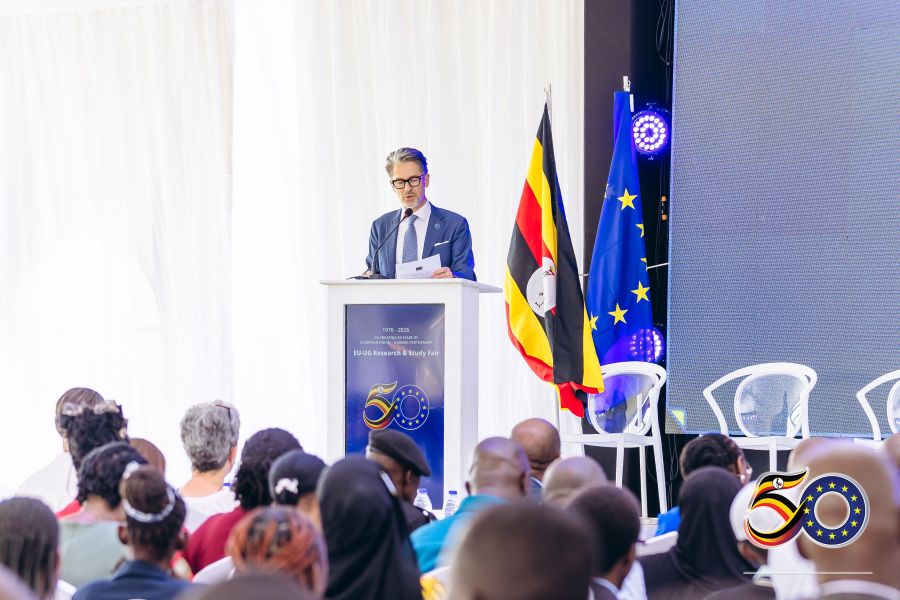
European Union Ambassador to Uganda Jan Sadek has said education and research will remain central to Uganda’s ability to address development challenges, urging young people, universities and researchers to make greater use of international partnerships and opportunities.
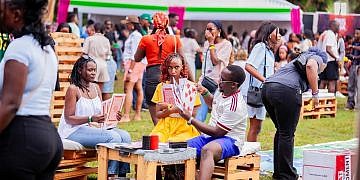
Speaking during the EU-Uganda Research and Study Fair at Makerere University’s Freedom Square, where students and researchers gathered to explore opportunities for study, scholarships, academic mobility and research cooperation with European institutions, Sadek said the growing importance of knowledge and skills was being driven by the complex challenges facing societies around the world.
“Around the world, education and research are becoming ever more central to how societies grow, innovate and respond to shared challenges. Whether we are speaking about climate change, public health, food systems, digital transformation, jobs or governance, knowledge matters everywhere, skills matter, research matters, and above all, young people matter,” he said.
He described Uganda’s youthful population as a tremendous asset, saying young people were already contributing to the country’s development.
“Young Ugandans are not only the leaders of tomorrow, they are already shaping the Uganda of today, in universities, in laboratories, in businesses, in communities and in public life,” Sadek said.
But he said potential had to be matched with opportunity.
“That is why events like this fair are so valuable. They make information more accessible. They connect students and researchers to concrete possibilities. They show that international cooperation is not an abstract idea; it can take the form of partnerships, academic mobility, institutional scholarships, joint research, innovation support and lasting professional networks,” he said.
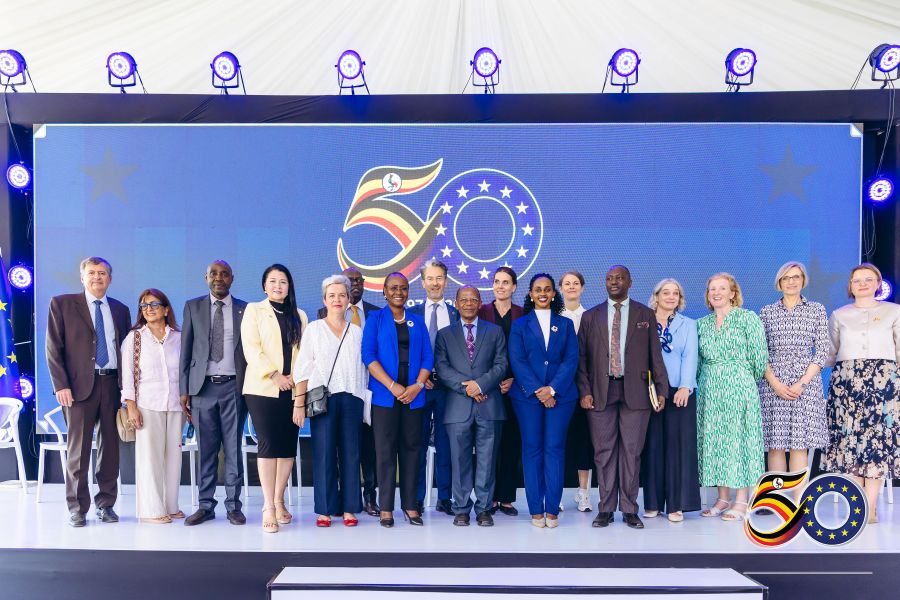
The acting Minister of Education and Sports Dr Chrysestom Muyingo said Uganda also needed to rethink the purpose of education so that young people could contribute to an economy that is changing rapidly.
“Our ambition must go beyond simply increasing access to education; we must also ensure that quality, relevance, equity and inclusion are provided for,” Muyingo said.
He said the country needs an education system that develops knowledge and competences while preparing young people to create jobs, establish enterprises and develop solutions.
“We need an education and training system that equips our young people with the knowledge and the competences required by a rapidly changing economy. A system that prepares our young people not only to seek employment, but also to create jobs, develop enterprises, innovate and provide solutions to the challenges facing our communities and our country,” he said.
Muyingo also emphasised the role of research in national development.
“Research must be recognized as an essential pillar of our national development,” he said, citing climate change, food security, public health, digital transformation, energy, environmental protection and employment among the areas requiring stronger research.
“Our researchers should not only produce knowledge for academic purposes. We must also ensure that research findings are translated into innovation, policies, technologies and practical solutions that improve the lives and livelihoods of our people,” Muyingo said.
Prof Sarah Ssali, Makerere University’s Deputy Vice Chancellor, said the institution’s relationship with European universities, governments, research institutions and development partners had contributed significantly to its academic and research mission.
“Makerere University is proud to be part of this partnership. As Uganda’s premier institution of higher learning, Makerere has for generations served as a centre for knowledge generation, human capital development, research and innovation,” Ssali said.
She said Makerere was now pursuing an ambitious research and innovation agenda designed to strengthen its contribution to national and global transformation.
“Our partnerships with institutions across Europe are an important part of this journey. We therefore see today’s fair, not merely as an event, but as an opportunity to strengthen existing partnerships and open doors to new partnerships,” she said.
She also said Makerere was keen to show European partners opportunities for collaboration with the university.
While the speakers highlighted opportunities created through international cooperation, Uganda National Students Association president Sheila Ainembabazi said access to information remained one of the biggest barriers for students.
“Too many talented young Ugandans have never heard of these scholarships, or do not know how to apply, or believe they are meant for some people. Information is the first barrier, and it is one that we can be able to remove,” she said.
She urged partners to take information about scholarships and international study opportunities to institutions outside Kampala.
“Let us reach students in every region, in every university and every tertiary institution, including those who rarely get invited to rooms like this,” Ainembabazi said.
She also called for more inclusive access.
“Let us make sure that the opportunity reaches young women, students with disabilities and students from disadvantaged backgrounds, because talent is evenly spread across Uganda, even if opportunity is not,” she said.
According to Ambassador Sadek, the EU’s experience with academic mobility demonstrated the value of such exchanges.
Over the past five years, he said, nearly 1,500 Ugandan students and staff had been selected for mobility to Europe, while more than 700 European students and staff had been selected for mobility to Uganda.
He said 61 Ugandans had also received Erasmus Mundus Joint Master scholarships.
“Exchange brings new perspectives, new methods, new networks and new confidence. It helps build bridges between countries, but also between ideas, disciplines and generations,” Sadek said.
He said international cooperation had become increasingly important because no country could address the world’s challenges alone.
“In a fast-changing world, no country can meet today’s challenges alone. Progress depends increasingly on cooperation, between countries, continents, institutions, between public and private actors, and between researchers and policymakers,” he said.
Sadek encouraged young Ugandans to view international study and research not simply as personal achievements but as opportunities to serve their communities.
“Study and research are not only personal achievements; they are also forms of service. When you gain knowledge, develop skills and expand your horizons, you also increase your capacity to contribute to your communities, your country and the wider world,” he said.
He said Uganda needed scientists, teachers, engineers, health professionals, social researchers, innovators and leaders capable of imagining and creating solutions to the country’s challenges.
The ambassador reaffirmed the EU’s commitment to working with Ugandan institutions and partners to expand access to education, research cooperation and youth opportunities.