








Uganda has unveiled an ambitious 10-year strategy to transform its cocoa industry, targeting annual production of 500,000 metric tonnes and export earnings of $3 billion by 2036.
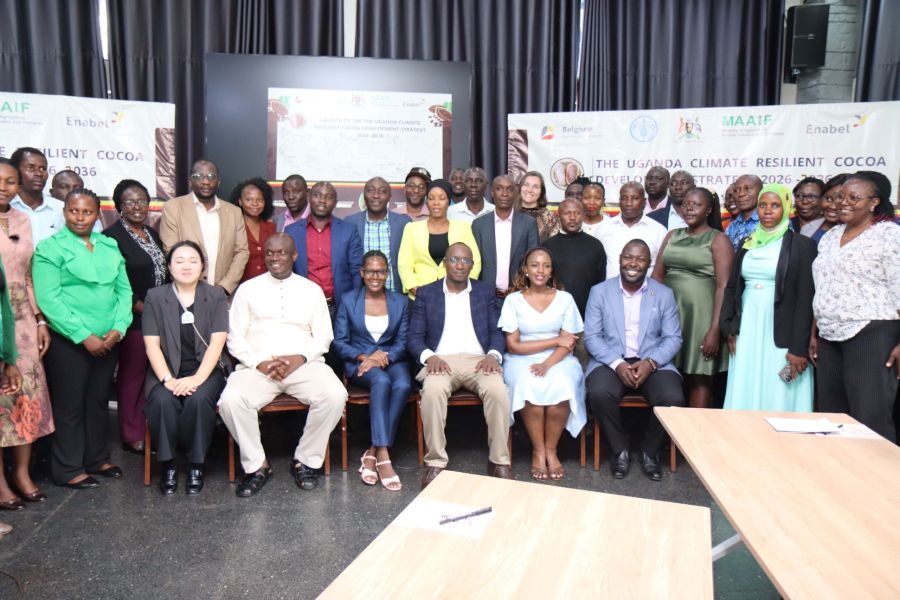
The Uganda Climate Resilient Cocoa Development Strategy (2026–2036), launched by the Ministry of Agriculture, Animal Industry and Fisheries (MAAIF) on Wednesday, November 18, 2026, seeks to strengthen the entire cocoa value chain through increased production, local processing, climate-smart farming and greater private sector investment.
Developed with support from the Food and Agriculture Organization of the United Nations (FAO), the Belgian Agency for International Cooperation (Enabel) and other sector partners, the strategy provides a framework for coordinated investment and interventions aimed at positioning cocoa as a major contributor to Uganda’s economic growth.
Cocoa has become an increasingly important source of foreign exchange for Uganda. Export earnings increased from $70.6 million in the 2015/2016 financial year to $620.4 million in 2024/2025, making it the country’s second-largest agricultural export and third-largest foreign exchange earner after gold and coffee.
The sector currently supports more than 100,000 cocoa-growing households, according to figures cited by the Ministry of Agriculture and the Bank of Uganda.
Under the new strategy, Uganda plans to increase annual cocoa production from approximately 72,000 metric tonnes to 500,000 metric tonnes by 2036. It also targets an increase in domestic processing from less than five per cent to 30 per cent of national production.
The government further intends to raise average cocoa productivity from 530 kilogrammes to 1,000 kilogrammes per hectare and increase the participation of women and young people in the value chain to at least 45 per cent.
Speaking at the launch, the Acting Commissioner for Crop Production and Protection at MAAIF, Dr John Lodungokol, said the strategy provides a clear roadmap for developing the sector over the next decade.
“The strategy sets out a clear direction for the development of Uganda’s cocoa sector over the next ten years. Our priority now is to strengthen coordination across the value chain, mobilise the necessary investment and ensure that farmers, processors and other stakeholders are equipped to contribute to and benefit from the sector’s growth,” Lodungokol said.
The government acknowledges that achieving the ambitious targets will require addressing persistent challenges, including low farm productivity, inadequate post-harvest handling, limited domestic processing, weak farmer organisation and restricted access to financing.
The strategy also responds to increasing climate risks and international market requirements for traceability and deforestation-free production.
It prioritises climate-smart cocoa farming, agroforestry, sustainable land management, improved planting materials and environmentally responsible production systems to strengthen the resilience of cocoa-growing communities.
The Food and Agriculture Organization reaffirmed its commitment to supporting Uganda’s ambition to become a competitive player in the global cocoa market.
The organisation emphasised the importance of sustained investment in research, innovation, climate resilience and value addition, alongside strengthening national institutions and systems to support the industry’s long-term growth.
“Uganda has a significant opportunity to become a competitive player in the global cocoa market. Realising this potential will require more than increasing production; it calls for sustained investment in research, innovation, climate resilience and value addition,” said Dr Joseph Mudiope, Crop Production Specialist at FAO’s Representation in Uganda.
Beyond increasing production and export earnings, the strategy seeks to retain more economic value within Uganda by expanding domestic processing and manufacturing.
Investment in fermentation, drying, aggregation and processing facilities, including cocoa liquor and chocolate manufacturing, is expected to create employment, strengthen local enterprises and improve returns to farmers.
The strategy estimates that public and catalytic investments of $221.19 million will be required over the 10-year implementation period.
It calls for substantial private sector investment, complemented by coordinated support from government, development partners, research institutions, financial institutions and farmer organisations.
Enabel said the strategy provides an opportunity to strengthen the relationship between agricultural development, private sector growth and employment creation.
Sylivia Natandula, an Agribusiness Expert representing Enabel, said the success of the strategy should be measured by its impact on households, businesses and communities rather than production and export figures alone.
“Ultimately, our success should not be measured only by the tonnes of cocoa produced or exported, but by the incomes improved, businesses strengthened, decent jobs created and communities transformed,” Natandula said.
FAO supported the development of the strategy through its Technical Cooperation Programme, titled Strengthening Uganda’s Capacity for Climate-Resilient Cocoa Value Chain Development.
The process involved technical reviews, expert consultations and engagements with stakeholders from government, the private sector, farmer organisations, academia and development partners.
Following the national launch, regional engagements are planned across Eastern, Western and Northern Uganda to raise awareness, strengthen local ownership and identify opportunities and priorities for implementation in existing and potential cocoa-growing areas.
Through the strategy, Uganda aims to position cocoa as a major driver of agro-industrialisation, export diversification, rural employment and improved household incomes.
However, achieving the 2036 targets will depend on sustained investment, effective coordination and the successful implementation of interventions that deliver tangible benefits to farmers and other participants across the cocoa value chain.