










The International University of East Africa (IUEA) has opened admissions for its January 2027 intake, emphasising practical skills, artificial intelligence (AI) and innovation as key pillars of its training approach ahead of Uganda’s planned transition to competency-based education in September 2027.
IUEA Vice-Chancellor, Prof. Emeka Akaezuwa, said the university was preparing students for a changing job market by combining classroom teaching with hands-on experience to ensure graduates can apply their knowledge, solve problems and contribute to the workplace.
He said the university’s approach was already aligned with the principles of competency-based education, which places emphasis on what learners can do with the knowledge they acquire rather than focusing primarily on theoretical understanding and examination performance.
“The International University of East Africa is ready for competency-based education. In fact, we have been doing that for a while now because we have always paired classroom teaching with practical experience, which is what our mission is. Our mission is to provide an excellent education that includes practical experience and skills,” Prof. Akaezuwa said.
He noted that students joining IUEA in January 2027 would be introduced to a programme designed to ease their transition into the competency-based learning approach.
“The January intake of 2027 will be the last intake before competency-based education, but you will have a soft landing here at IUEA. When you come to IUEA, we have a programme that will begin to ease you into competency-based education,” he said.
Prof. Akaezuwa said the university was focused on equipping learners with competencies that employers need, enabling graduates to demonstrate their abilities in real working environments.
He explained that the traditional knowledge-based approach largely measures what students remember and reproduce in examinations, while competency-based education combines theoretical knowledge with the practical ability to perform tasks.
“What we had before is what they call knowledge-based education. You read your books, you understand the theory, you sit an examination, you pass the examination and that is it. It is largely about what you can remember and repeat,” he said.
“But in the competency-based education system, we pair what you know, that theory, with what you can do. If you are an accountant, you have to be a very good accountant. When a company employs you, you must be able to do the job that the company has employed you to do.”
The Vice-Chancellor said the institution aimed to produce graduates capable of adding value to organisations from the beginning of their employment by applying critical thinking, problem-solving and practical skills.
“If a company employs you, you have to be able to add value from day one because you can think and you can solve problems. That is what we do here at IUEA,” Prof. Akaezuwa said.
He added that practical learning was also intended to encourage students to consider entrepreneurship and business creation rather than relying exclusively on formal employment.
“I am sure that by the time you finish, you will be ready to go out there and create businesses, not stand in line to look for a job. For those of you who are willing to succeed and want to succeed, you come to the International University of East Africa,” he said.
The Vice-Chancellor said IUEA was incorporating AI into its teaching and learning activities across different academic disciplines, reflecting the growing role of technology in professional practice.
He said students studying business, law, mass communication, engineering, science and technology would be encouraged to understand how AI could be applied in their respective fields.
“We are known as a technological university of choice because we encourage you to innovate from day one, regardless of what you are studying. Whether you are doing business, mass communication, law, engineering, science and technology, we incorporate AI into everything we do,” he said.
Prof. Akaezuwa stressed that AI education was not limited to students pursuing computer science, noting that the technology could support a range of professional activities across different sectors.
“AI is not just for computer science. When you start, we know it is new to you, and we do not force you to understand it immediately. We coach you, we show you how it works and how you can use it in law, how you can use it in business, and how you can use it in mass communication,” he said.
He explained that the university guides students through the learning process, helping them understand and apply technological tools as they progress through their studies.
The approach, he said, is intended to prepare graduates for a workplace in which technological knowledge, innovation and the ability to adapt to new tools are increasingly important.
Beyond its emphasis on AI across academic programmes, IUEA is also highlighting practical training in specialised areas, including smart agriculture and mining.
Prof. Akaezuwa said the university’s smart agriculture programme was designed to address changing weather patterns, climate change and the need for modern farming techniques.
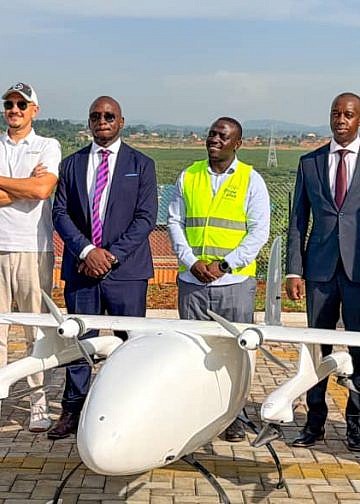
“We are not doing traditional agriculture because the world has changed. There is climate change, weather patterns have changed, farmers lose money, and we have new technologies. We have drones to help with a lot of things in agriculture. We also have different types of seeds, including climate-resistant seeds,” he said.
He said the university had a large smart agriculture farm in Karamoja where students would undertake practical training using drones, farm rovers, tractors and other modern agricultural technologies.
“What makes IUEA unique in this area is that we have a very big farm for smart agriculture. Our students will be able to undertake real, practical, hands-on agricultural training using drones, farm rovers, tractors that we have built, and new processes,” Prof. Akaezuwa said.
The university is also developing practical competencies in mining, drawing on Uganda’s mineral resources and the growing use of technology in the sector.
“For mining, Uganda is rich in minerals, so we have a mining school, and we also have mines that belong to IUEA where our students can go and practise how to mine in the age of AI,” he said.
He added that both programmes incorporate smart technologies, including AI, drones and sensors, to expose learners to modern methods of agricultural production and mining operations.
“For smart agriculture and mining, we use smart technologies. We use AI, drones, sensors and all the things that will make our students competent in the modern ways of doing these things,” he said.
Prof. Akaezuwa said IUEA had also invested in facilities to support practical training in hospitality, including a hotel resort where students gain experience relevant to the sector.
He said the university’s training model was built around ensuring that students have opportunities to put classroom lessons into practice through access to relevant facilities and learning environments.
“At IUEA, whatever we do, we have the infrastructure to deliver for competency-based education,” he said.
As the university opens admissions for January 2027, Prof. Akaezuwa invited prospective students to join an institution that, he said, places practical experience, technological innovation and skills development at the centre of its academic mission.
The intake comes ahead of Uganda’s planned September 2027 transition to competency-based education, with IUEA positioning its programmes and practical training facilities as part of its preparation for the evolving education landscape.