











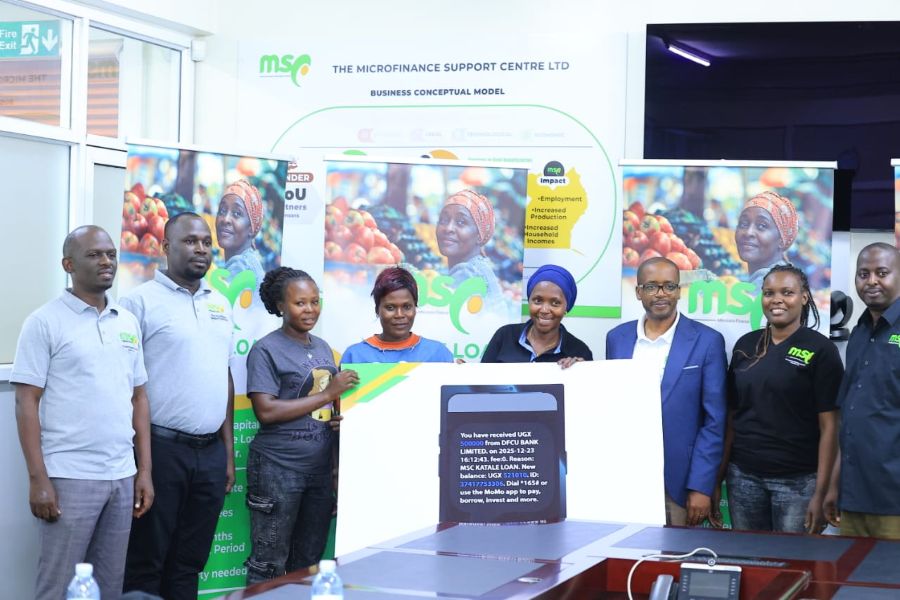
Market vendors and small-scale traders across selected urban markets are set to benefit from a newly introduced government financing facility dubbed the Katale Loan, aimed at easing access to affordable credit and stimulating business growth in the informal sector.
The loan has been rolled out by the Microfinance Support Centre (MSC) on behalf of the Government of Uganda and targets traders who have long struggled with high-interest loans and strict collateral requirements from commercial banks.
Speaking about the new product, Tadeo Atuhura, the Communications Manager at MSC, said the Katale Loan is designed to directly respond to the realities faced by market vendors.
“The Katale Affordable Loan is a transformative financing solution designed to empower market vendors and small-scale traders with quick, affordable and accessible credit,” Atuhura said, adding that the loan attracts an interest rate of 8% per year.
According to Atuhura, the product will initially cover nine major markets, including Owino, Nakasero, Kalerwe, Busega, Gaba and Nakawa in Kampala, as well as Iganga, Soroti and Arua City markets.
He noted that the facility seeks to help traders grow their businesses and stabilise incomes while shielding them from exploitative lending practices.
“This product is a practical response to the financing challenges faced by our market vendors. By providing affordable credit through organised groups, the government is unlocking enterprise growth, protecting livelihoods and strengthening the informal economy,” he said.
Under the Katale Loan arrangement, traders access funds through group lending, where applicants form groups of ten members who guarantee each other. The loan is collateral-free, requiring no land titles or physical assets, and allows individuals to borrow between Shs 50,000 and Shs 2 million, depending on their repayment capacity.
Atuhura described the Katale Loan as more than just financial support.
“It is a pathway to dignity, stability and growth for market vendors. It protects traders from predatory lending while strengthening savings discipline and enterprise sustainability,” he said.
Some traders have already begun benefiting from the loan, with Nakasero Market among the first to access the funds.
Market leaders have welcomed the initiative. Ritah Nandutu, the Chairperson of the Onion Department at Nakasero Market, said the loan has unlocked capital for traders who previously lacked access to financing.
“We have the market but lacked capital. This loan is going to help our businesses grow,” Nandutu said, thanking the Microfinance Support Centre and the government for the intervention.
Faridah Nakabuye, an onion vendor at Nakasero Market, said the loan has simplified access to capital for traders.
“I have received a Shs 1,000,000 loan directly on my account without the movements we usually make when dealing with banks,” Nakabuye said.
She welcomed the collateral-free nature of the product, noting that it is tailored to traders operating in markets.
“For this Katale Loan, they only need a national ID and your group. It is going to boost my business, and I will pay it on time so that I can access another one,” she added.
Joan Katisi, Secretary of the Onion Department at Nakasero Market, praised the smooth loan application process.
“I’m impressed that this money doesn’t give us any headache. The fact that we were first taken through training about this loan package means we can use it wisely, pay it back and access more in the future,” she said.
MSC officials say the Katale Loan builds on the institution’s 25-year role in promoting financial inclusion and aligns with its 2025–2030 Strategic Plan, which focuses on expanding access to finance, enterprise development, job creation and last-mile service delivery.
The Katale Loan is expected to provide traders with accessible capital, helping them grow their enterprises, reduce reliance on high-interest lenders and strengthen Uganda’s informal economy.