










Members of Parliament’s Committee on Physical Infrastructure have confirmed that Uganda’s Digital Number Plate System can track vehicles in real time after testing the technology at the Police Command Centre in Naguru, Kampala.
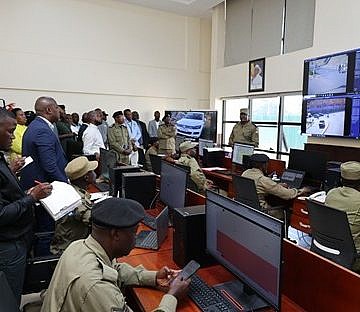
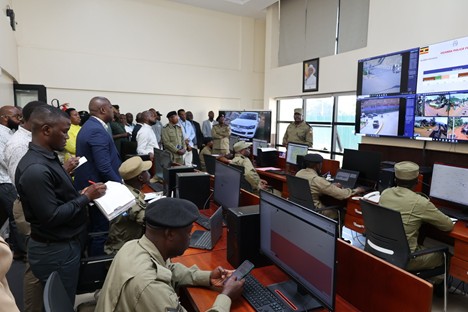
The committee, led by chairperson Mwine Mpaka, visited the Police facility to establish first-hand how the system identifies and tracks vehicles, following questions raised about its security functions and effectiveness.
The MPs arrived with vehicles from Parliament and asked Police Information Technology and Management System (ITMS) operatives to demonstrate whether the vehicles could be located using the digital number plate system.
During the demonstration, Police successfully identified the vehicles and displayed their live locations and coordinates to the committee.
The exercise gave the legislators an opportunity to assess the system outside the formal committee hearings, where Police and government officials had presented information on its performance.
“Yes, indeed, we have established that cars and motorbikes can be tracked. The issue of digital number plates is clearly important. We just need to see how we can improve the system,” Mr Mpaka said.
Inspector General of Police Abas Byakagaba said the technology was already supporting Police investigations.
“As far as I am concerned, the system is working, and it is giving us solutions in our investigation,” Mr Byakagaba said.
The visit came days after the committee questioned the security and vehicle-tracking components of the Digital Number Plate Project during its September 28 hearing.
On September 30, Police Director of ICT, AIGP Felix Baryamwisaki, told the committee that Police had tracked and recovered 337 of 375 stolen motor vehicles reported, representing a 90 per cent recovery rate.
The committee subsequently resolved to visit the Police Command Centre to observe the technology in operation rather than rely solely on figures and explanations presented during the hearings.
Alert response
While the live demonstration confirmed the tracking capability, MPs raised concerns about the speed at which Police respond to alerts generated by the system.
The system is designed to send an alert to the Command Centre when a digital number plate is tampered with. According to information presented to the committee, such an alert includes the vehicle’s location, coordinates and the time the tampering occurred.
The MPs said the effectiveness of the security system would also depend on how quickly Police respond once such alerts are received.
They called for alerts to be categorised according to their level of urgency, allowing incidents involving suspected theft or deliberate tampering to receive immediate attention.
Officials told the committee that work is already under way to strengthen this part of the system.
The Ministry of Works and Transport is developing an integrated system that is expected to link vehicle registration information with owners’ telephone numbers, email addresses and other contact details.
The proposed arrangement would enable the Command Centre to contact a vehicle owner promptly to establish whether reported tampering was authorised or could be linked to attempted theft or vandalism.
The legislators also sought clarification on the management and storage of information generated by the Digital Number Plate System.
Gen Samuel Okiding, Deputy Chief of Defence Forces and the UPDF representative in Parliament, expressed confidence that the data generated by the system is stored in Uganda.
The issue of data management is among the concerns being examined by the committee as it scrutinises the broader implementation of the project.
Mr Mpaka said the committee’s scrutiny should not be interpreted as opposition to digital number plates, but rather as an effort to establish whether the project is delivering value and whether areas of implementation require improvement.
“One thing for sure is, the whole country needs the digital number plate system. As a committee, we are looking at the cost and the contractor’s capacity. Other than that, no one is against the project,” he said.
The Naguru visit followed the committee’s inspection of the digital number plate production facility, where MPs examined the manufacturing process, stocks of production materials and ongoing production and installation operations.
The facility currently has a reported production capacity of 2,500 number plate kits a day, equivalent to about 50,000 kits a month.
More than 300 Ugandans are employed directly at the facility, while the project is reported to support more than 900 additional jobs in related industries. Localisation has reportedly reached 80 per cent.
The inspection allowed MPs to assess concerns previously raised over production capacity, availability of number plates and delays in issuance.
The committee has also been examining the cost of the project, the contractor’s capacity and communication with motorists.
The two inspections — at the production facility and the Police Command Centre — gave the committee an opportunity to examine both the manufacturing and security components of the Digital Number Plate Project.
While MPs established through the live demonstration that the system can identify and track vehicles, they also highlighted the need to strengthen the response to security alerts, improve coordination among institutions and enhance communication with motorists.
The committee is expected to continue scrutinising the project as Parliament assesses its implementation, cost and performance.