









President Museveni has commissioned a $53 million mechanised military repair facility in Jinja District as Uganda deepens defence cooperation with Russia.
The facility, located at Magamaga Cantonment, was among several military installations and equipment commissioned during a two-day programme held on October 21 and 22, 2026, involving a Russian delegation led by Lieutenant General Aleksandr Kshimovskii.
The programme covered military training, marine security, modern warfare technology and equipment maintenance, with the stated aim of strengthening the operational capabilities of the Uganda People’s Defence Forces (UPDF).
Museveni, who is also the Commander-in-Chief of the UPDF, began the activities on Wednesday at the Mechanised Warfare College in Kalama, Mubende District, before proceeding to the 15 Marine Brigade Pier in Entebbe.
On Thursday, he visited the 154 Marine Battalion School at Kalangalo before concluding the programme at Magamaga Cantonment, where he commissioned the repair facility donated by the Russian government under the two countries’ bilateral defence cooperation framework.
The Magamaga facility is expected to improve the UPDF’s capacity to maintain and repair military vehicles and other equipment, helping address the technical challenges associated with servicing complex military machinery.
Museveni thanked Russian President Vladimir Putin and the visiting delegation for the contribution, describing the $53 million equipment package as a significant addition to Uganda’s military capabilities.
“First of all, I really want to thank His Excellency President Putin and the Russian delegation for this gift of $53 million worth of equipment,” Museveni said.
He noted that Russian support extended beyond Magamaga to include military training infrastructure in Kalama, marine security installations in Entebbe and facilities at Kalangalo.
However, the President said Uganda’s military modernisation efforts should go beyond acquiring equipment to developing the technical skills required to operate, maintain and eventually manufacture such equipment locally.
“We should not only get the good equipment but also learn from them,” he said during the commissioning of the marine facilities in Entebbe.
At Magamaga, Museveni called for consideration of joint production arrangements involving Ugandan and Russian technical experts, arguing that such cooperation could help build domestic defence manufacturing capacity.
“But these materials, I think, were made in Russia. What if we made them here with the Russians?” he asked.
At the 154 Marine Battalion School in Kalangalo, Museveni urged the military to adopt emerging technologies, including artificial intelligence (AI) and automation, to improve its ability to respond to evolving security threats.
“Advance on the issue of technology, embrace new technology, more automation, more AI, more range because we need to upgrade it overall,” he said.
He stressed that technological upgrades must be accompanied by investment in technical skills and operational capacity to ensure that military personnel can effectively use and maintain modern equipment.
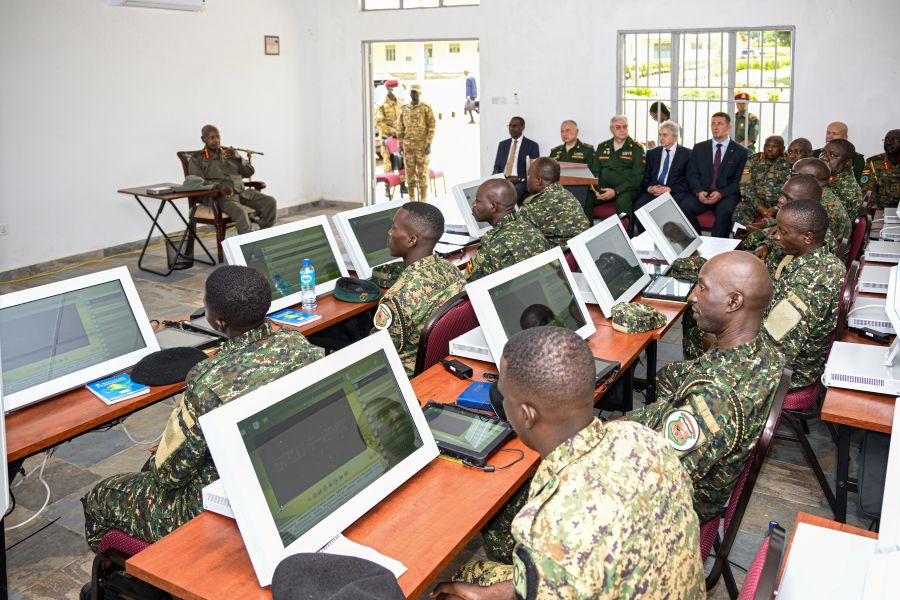
Earlier, at the Mechanised Warfare College in Kalama, Museveni launched a digital multimedia training classroom designed to prepare military crews to operate the BRDM-2MS armoured reconnaissance vehicle.
The classroom will allow personnel to familiarise themselves with the vehicle’s capabilities and operating systems before undertaking practical training.
In Entebbe, Museveni commissioned marine operational assets and supporting infrastructure intended to strengthen the UPDF’s maritime capabilities.
The equipment and facilities included surveillance radar, eight boats, a floating dock, protective barriers, marine workshops, firefighting equipment, specialised vehicles, a field ambulance and training facilities.
The installations are expected to support marine surveillance, equipment maintenance, personnel training and operational readiness.
Museveni said the investments should help the armed forces improve their ability to detect threats, protect personnel and operate effectively in different environments.
The Minister of Defence and Veteran Affairs, Kiryowa Kiwanuka, commended Museveni for maintaining relations with Russia and thanked the Russian technical experts for their contribution to the military installations.
Kiwanuka said the President’s engagement with Russian leaders had sustained diplomatic relations and opened opportunities for cooperation, particularly in defence and military technical assistance.
“Your continued engagement with the Russian leadership has sustained the cordial diplomatic relations between our two countries and opened avenues for mutually beneficial cooperation, particularly in defence and military technical assistance. We thank you most sincerely,” Kiwanuka said.
He added that the Russian government’s support had contributed to the development and equipping of several defence installations in Uganda.
The Ministry of Defence and Veteran Affairs and the UPDF leadership pledged to ensure the facilities were properly utilised and maintained.
Kshimovskii reaffirmed Russia’s commitment to continued military technical cooperation with Uganda, saying Moscow was prepared to supply equipment needed to strengthen the country’s defence capabilities.
“We shall continue to develop mutual cooperation between Uganda and Russia. Russia is ready to supply the necessary equipment,” he said.
The two-day programme highlighted the scope of defence cooperation between the two countries, including military training, marine operations, equipment maintenance and the adoption of modern military technologies.
The events were attended by UPDF brigade commanders, junior officers, representatives of other security agencies and local leaders.
The commissioning also brought renewed attention to Uganda’s stated ambition to develop local technical expertise and manufacturing capacity alongside the acquisition of military equipment from international partners.