


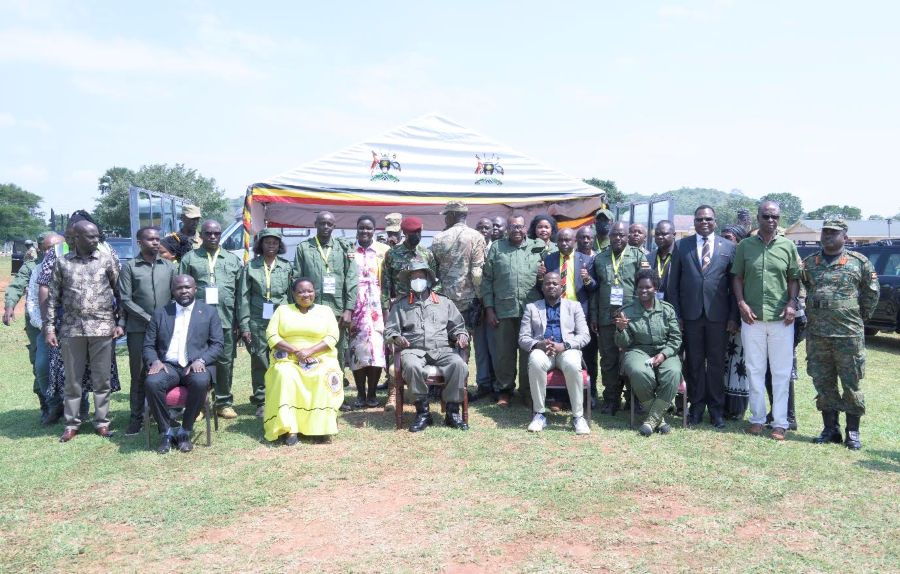
President Museveni has urged Ugandans repatriated from South Africa to abandon the belief that prosperity can only be found abroad, encouraging them instead to take advantage of the economic opportunities available within Uganda.
Speaking during the pass-out ceremony of 1,030 Ugandan returnees at the National Leadership Institute (NALI) in Kyankwanzi on Monday, the President said Uganda has the resources and opportunities needed for wealth creation, warning that many young people are risking their lives in search of uncertain prospects overseas.
The returnees spent 15 days at the institute undergoing rehabilitation, counselling and ideological orientation under a programme coordinated by the National Secretariat for Patriotism Corps (NSPC) following their evacuation from South Africa after violent xenophobic attacks targeted foreign African nationals.
“I welcome you from danger, and I thank God that you have returned safely,” President Museveni said. “I also condole with the families who lost their loved ones during the attacks.”
Using the Luganda proverb “Nantabuuliririrwa yasaabala bwa bbumba,” the President questioned why many Ugandans continue to leave a resource-rich country in search of opportunities abroad.
“Why would Ugandans leave such a beautiful country to go roaming around looking for jobs elsewhere?” he asked.
Museveni said Uganda’s economy presents opportunities in commercial agriculture, manufacturing, services, artisan work and the rapidly growing digital economy.
To demonstrate the potential for wealth creation, he cited several Ugandans who have built successful enterprises through commercial farming and government-supported programmes.
Among them was Richard Nyakana of Rwengaju Village in Fort Portal, whose intensive farming on 1.2 acres reportedly generates more than Shs200 million annually through zero-grazing dairy farming and poultry production while employing between 12 and 15 workers.
“If all Uganda’s 40 million acres of arable land were utilised as efficiently as Nyakana’s farm, the country could create about 150 million jobs,” the President said.
He also highlighted Johnson Basangwa of Kamuli District, whose poultry enterprise keeps approximately 110,000 birds and reportedly earns nearly Shs20 million daily from egg sales.
Another example was Vicky Apio of Lira District, who turned Shs907,000 received under the Parish Development Model (PDM) into a successful farming enterprise by renting land, growing maize, expanding into livestock farming and eventually purchasing her own land.
“I feel pity for many of you because some people deceive you with promises of jobs abroad, yet they are misleading you,” Museveni said.
He added that Uganda is increasingly producing many of the goods it previously imported, including vehicles, and argued that the country’s future lies in industrialisation, value addition and modern agriculture.
President Museveni revealed that he had personally engaged South African President Cyril Ramaphosa following the xenophobic attacks.
“I told President Ramaphosa that what is happening is dangerous for Africa,” he said.
According to Museveni, President Ramaphosa explained that those responsible for the attacks were opponents of South Africa’s governing African National Congress (ANC).
“I urged him to deal decisively with xenophobia because welcoming fellow Africans is the right thing to do. If countries begin retaliating against one another, it will be dangerous for the entire continent,” Museveni said.
The President also appealed to Ugandans not to retaliate against South Africans living or investing in Uganda.
To support the returnees’ reintegration, President Museveni announced Shs2 billion in financial assistance for the group, in addition to Shs2 million for each household head to facilitate transport back to their respective home districts.
He encouraged beneficiaries to utilise the support alongside existing government programmes, including the Parish Development Model (PDM), Emyooga and other livelihood initiatives.
Museveni also directed the returnees to document property and businesses lost during the violence in South Africa to enable government to assess possible interventions.
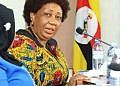
Prime Minister Robinah Nabbanja described the evacuation as one of Uganda’s largest humanitarian interventions involving citizens abroad.
She confirmed that Uganda Airlines repatriated all 1,030 Ugandans free of charge.
“The government remains committed to protecting Ugandans wherever they may be,” Nabbanja said.
She disclosed that another 525 Ugandans stranded in Cambodia had also appealed to the government for assistance to return home.
Nabbanja commended the National Secretariat for Patriotism Corps, NALI and all government agencies involved in the rehabilitation programme.
The acting Minister of State for Foreign Affairs, Haruna Kyeyune Kasolo, said Uganda had initiated diplomatic engagement with the South African government to establish the full extent of losses suffered by Ugandan businesses.
He confirmed that three Ugandans were killed during the attacks.
“I appreciate Your Excellency for the condolence contribution of Shs10 million to each of the bereaved families,” Kasolo said.
He added that Uganda’s High Commission in Pretoria had registered more than 600 Ugandans who remain in South Africa.
Kasolo also called for stricter regulation of labour externalisation agencies, arguing that many Ugandans facing exploitation abroad had travelled through labour recruitment companies.
The Commissioner of the National Secretariat for Patriotism Corps, Hellen Seku, said the rehabilitation programme was designed to restore hope, confidence and patriotism among traumatised citizens.
She said NALI hosted 738 adults and 292 children, bringing the total number of returnees to 1,030.
During the programme, four adults and six children were referred to Mulago National Referral Hospital for specialised medical care.
Given the large number of children, organisers established a temporary nursery school within the institute to care for more than 290 children while their parents attended training sessions.
“These people arrived traumatised. The peaceful environment at NALI allowed them to reflect, heal and begin planning productive lives back home,” Seku said.
She commended instructors for adapting to the needs of young children and pregnant mothers throughout the programme.
Government agencies also used the rehabilitation exercise to provide public services.
NIRA deployed mobile registration teams, enabling 650 adults to receive National Identity Cards while 239 children were issued National Identification Numbers (NINs).
Participants also renewed driving permits, registered businesses through the Uganda Registration Services Bureau, and received health screening and treatment from the Ministry of Health.
Facilitators delivered lectures on patriotism, leadership, wealth creation, agriculture, health, security, responsible social media use and government development programmes.
NALI Director Col. Okei Rukogota attributed the programme’s success to collaboration between State House, the Office of the Prime Minister, the National Secretariat for Patriotism Corps and several government ministries and agencies.
“NALI remains committed to supporting Your Excellency’s vision of building patriotic, productive and resilient citizens,” he said.
Speaking on behalf of the returnees, Felix Mugabi thanked the government for rescuing them and providing rehabilitation.
He said the programme had transformed their understanding of patriotism, leadership and Uganda’s economic potential.
“Many of us left believing success could only be found abroad. Today, we have discovered that Uganda offers enormous opportunities if we embrace hard work and government programmes,” Mugabi said.
Despite losing businesses, employment and property during the attacks, he said the returnees were determined to rebuild their lives through agriculture, manufacturing, vocational skills and entrepreneurship.
Mugabi noted that many returnees possess technical skills in automotive engineering, construction, carpentry, tailoring, metal fabrication, leather works, information technology and real estate.
He appealed for financial support to enable productive investment and requested government assistance in establishing a national association of returnees to coordinate development initiatives and improve access to government programmes.
The ceremony marked the conclusion of a two-week rehabilitation programme for Ugandans who returned home after experiencing trauma, displacement and uncertainty in South Africa.