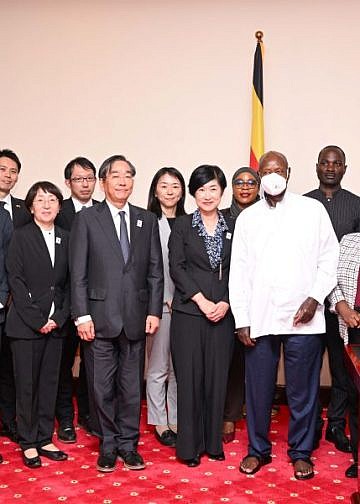


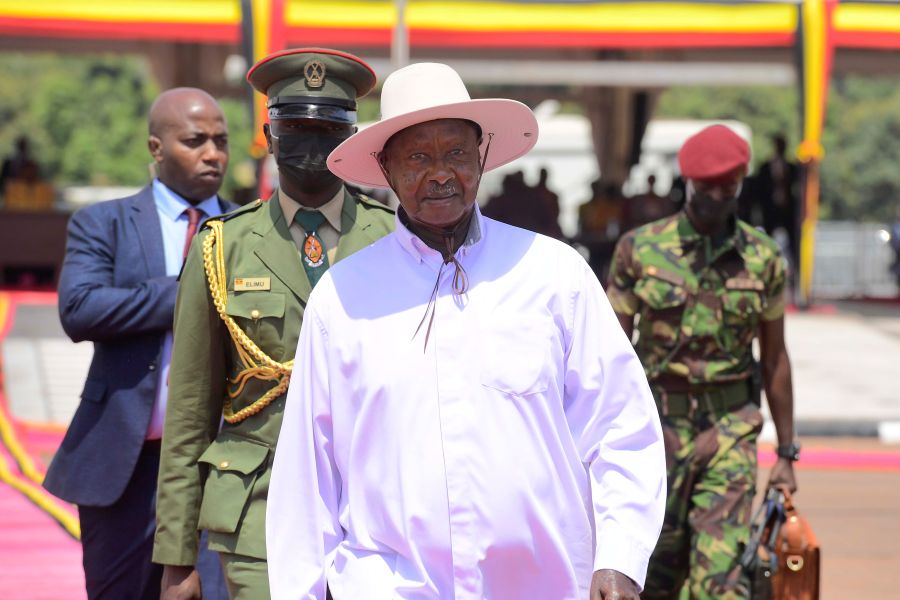
President Museveni has in a landmark moment during the 63rd independence celebrations welcomed former comrade Col. Samson Mande back to Uganda after years in exile.
Mande had fallen out with the government and had been associated with rebel activities while abroad.
“Even today, I am happy to welcome back into peaceful Uganda, Col. Samson Mande, who had fled into exile on account of, apparently, some internal intrigue,” the president said.
“While in exile, he tried to engage in some rebel activities. When, however, our cadres contacted him in Sweden, he happily agreed to come back and disconnect himself from the rebel activities.”
Museveni praised Col. Mande’s earlier contributions to the liberation struggle, noting his role as a volunteer scout for the Task Force Division of the TPDF under Major General Silas Mayunga in 1979, and later as commander of the 15th Battalion during the Siege of Masaka in 1985.
“I remember Samson Mande in 1979 operating as a volunteer scout… Later, Mande did a good job as commander of the 15th Battalion in the Siege of Masaka in 1985 and in subsequent assignments. We welcome him.”
Col. Mande, in return, expressed gratitude for the warm reception and pledged to work with the government to promote peace and national unity.
The president commended peace-loving Ugandans and the UPDF for ensuring sustained stability across the country, describing peace as the bedrock of Uganda’s ongoing progress.
He emphasized that all of Uganda’s achievements to date are primarily driven by the prevailing peace and security.
“I need to salute the peace-loving Ugandans and the UPDF for ensuring peace in Uganda. All that is happening is, first and foremost, on account of the peace that is available,” President Museveni stated. “This peace is lubricated by the long-standing NRM policy of reconciliation and forgiveness, on top of our firm stand against crime.”
The President highlighted the National Resistance Movement’s (NRM) long-standing policy of forgiveness and reconciliation as instrumental in uniting Ugandans, rebuilding broken relationships, and fostering national stability.
President Museveni reflected on Uganda’s turbulent post-independence history, recalling how by the 10th anniversary, the country was under dictatorship, and by the 20th, its economy — once reliant on three Cs and three Ts (coffee, cotton, copper, tobacco, tea, tourism) — had collapsed.
“Ugandans were surviving on magendo (black-market trading) and forex rackets before the NRM came in to rescue the country,” he said.
He shared optimistic projections for the economy. By June 2026, Uganda’s economy is expected to grow to USD 66.9 billion using the foreign exchange method or USD 197.9 billion using the purchasing power parity method. In the current financial year, economic growth is expected to reach seven percent. With the inflow of oil revenues, growth is projected to reach double digits.
“With the rise of many factories and the production of goods within the country, Uganda is now unstoppable,” the President declared. “No one will stand in our way to development.”
President Museveni outlined five key phases of national transformation under the NRM: minimum recovery, expansion, diversification, value addition, and now, a move into technology-driven advancement. He cited institutions like Kiira Motors as evidence of the country’s movement into a technology-driven industrial future.
The president called for regional unity, emphasizing the urgency of both economic and political integration within the East African Community (EAC).
“What we need to work on now are two issues — economic integration of East Africa to ensure a big market, and political integration resulting in a political federation of our region and the whole of Africa.”
He reaffirmed Uganda’s commitment to work with regional partners including Tanzania, Rwanda, Kenya, South Sudan, Burundi, Congo, and Somalia to strengthen trade and political unity.
Rewrite as as credible media house, get several headline suggestions, keywords