








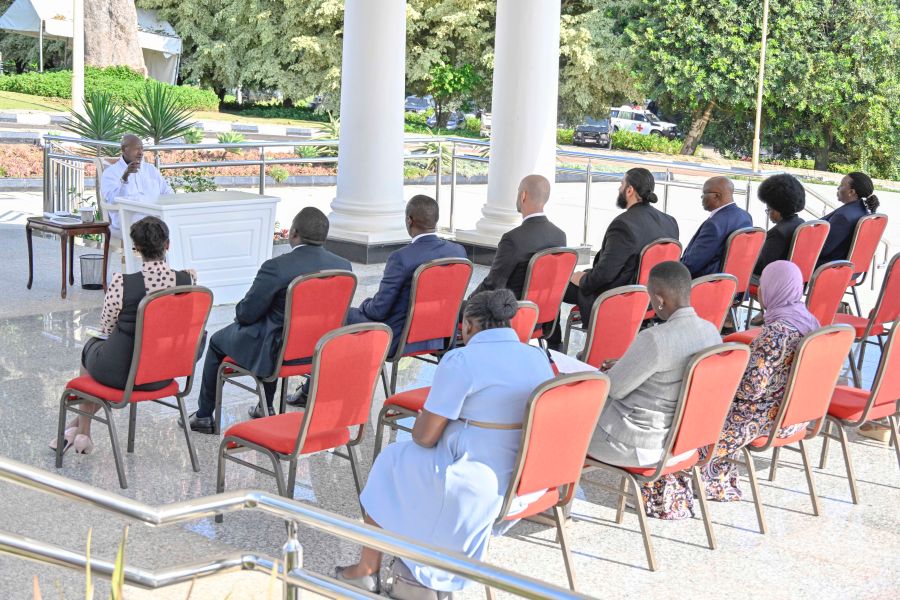
President Museveni has welcomed plans by investors from Qatar to partner with Uganda in key sectors, including food processing, energy, logistics, and manufacturing, saying such collaborations are essential for transforming Africa’s resources into wealth.
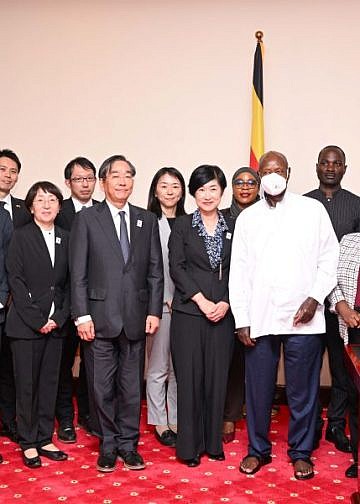
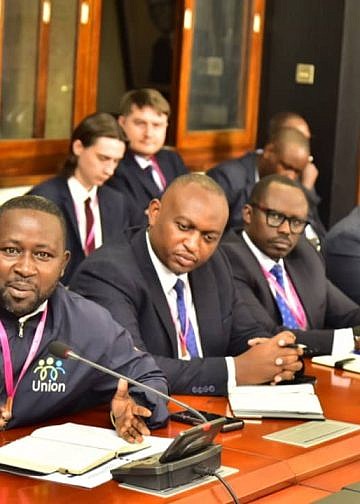
The President made the remarks on Friday at State House, Entebbe, during a meeting with a delegation from Al Mansour Holding led by Omar Bchinnati, Chief of Staff to Sheikh Mansour bin Jabor bin Jassim Al Thani, Chairman of Al Mansour Holding-Qatar.
Museveni said Uganda’s relationship with the Arab world has grown over time, tracing its roots to Egypt’s support during Africa’s liberation struggles before expanding to other Arab countries.
“We started with Nasser of Egypt. He helped us in the struggle for independence. We wanted to work with the Arab world, but at that time we did not know much about the Gulf,” Museveni said.
He said Uganda’s engagement with Gulf countries increased after changes in the region during the 1980s, leading to stronger relations with countries such as Qatar.
“Later, we linked up with Dubai. Many Arabs had oil, and we thought we could work together because here in Africa we have many resources. Africa is 12 times the size of India and our population is now about 1.5 billion people. When the Arab world is near us, we can do many things together,” he said.
The President said Uganda is ready to partner with investors in areas where the country has a comparative advantage, particularly value addition and industrial development.
He highlighted opportunities in fruit processing, starch production, coffee processing, and pharmaceuticals, saying investment in these sectors would help reduce dependence on imported products.
“For food processing, we are ready. For instance, we have a lot of needs in starch. We have people who can partner with you, including cooperatives, individuals, and government bodies, and we can start immediately because the market is there,” he said.
Museveni explained that locally produced starch would support industries such as pharmaceuticals and reduce production costs.
“If we produce pharmaceuticals using imported starch from India and Turkey, those costs are added, yet we have the capacity here. If we use our own starch, medicine would become cheaper,” he said.
He said Uganda has the raw materials, skilled manpower, and utilities needed for industrialisation, adding that investment capital remains a key requirement.
Museveni said he would share a list of priority projects that could benefit from immediate collaboration, including the Soroti Fruit Factory, a starch processing facility in Pallisa, coffee processing, and pharmaceutical manufacturing.
“I propose we start with fruits, starch, coffee, and pharmaceuticals,” he said.
Speaking on behalf of Al Mansour Holding, Bchinnati said the delegation was inspired by Museveni’s vision for Africa’s economic transformation and had come to explore long-term investment partnerships with Uganda.
“Your vision for Africa is very inspiring. We are here because you have a lot of knowledge and experience. There have been many people promising what they can do, but I believe in the unity of Africa, the trade, and the business opportunities that Africa offers,” he said.
Bchinnati said Sheikh Mansour was interested in working with Uganda in sectors including energy, gas, logistics, and industrial development.
“He is ready to work with Uganda and further the collaboration. We appreciate your direction on how we can move forward in this partnership,” he said.
He added that the delegation’s visit was intended to prepare the ground for Sheikh Mansour’s future engagement with Uganda and showcase the company’s investment capacity.
“We want to show what we have accomplished before his visit. He wants to come and open this partnership,” Bchinnati said.
He said Al Mansour Holding has a 10-year plan focused on partnerships and investment opportunities.
The delegation also included Matteo Scappucci, Head of Operations at Al Mansour Holding.
The meeting was attended by Energy and Mineral Development Minister Dr. Monica Musenero, Permanent Secretary in the Ministry of Energy and Mineral Development Eng. Irene Pauline Batebe, Capt. Mike Mukula, among other officials.