








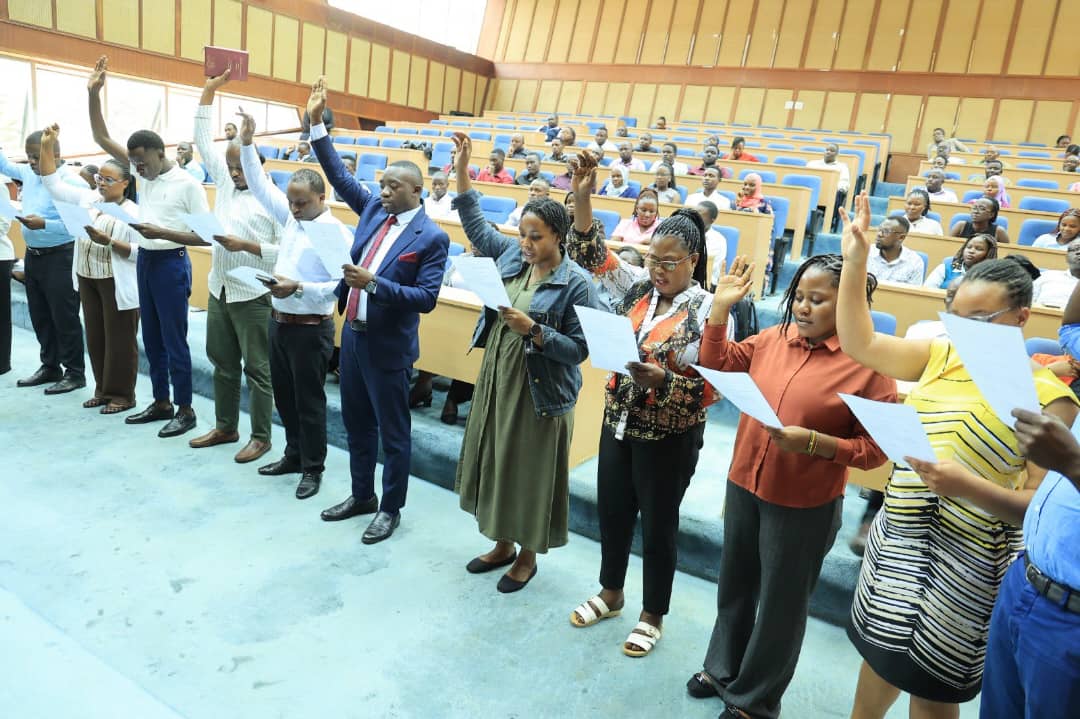
The Uganda Bureau of Statistics (UBOS) has commissioned 80 Data Collectors to begin the 9th Round of the Uganda National Household Survey (UNHS) 2026/27.
The deployment follows the successful completion of a 15-day training programme on survey implementation and data collection.
The officers have been deployed into 16 field teams, each headed by a Field Supervisor, to carry out the nationwide exercise, which is expected to run for 12 months to ensure comprehensive coverage of sampled households and communities across Uganda.
While commissioning the officers, UBOS Executive Director Chris Mukiza urged them to strictly uphold the Oath of Office and Oath of Secrecy they took before undertaking the assignment, emphasizing the importance of protecting respondents’ information.
“You must ensure that the information you are going to collect remains confidential and therefore, you shouldn’t disclose the source,” Dr. Mukiza said,.
He said the requirement is provided for under the Uganda Bureau of Statistics Act, 1998, which guarantees the protection of data sources and the independence of official statistics.
He also cautioned the data collectors against altering information provided by respondents, stressing that the credibility of the survey depends on the accuracy of the data collected.
“Record the information as provided and do not change anything. The data you are going to collect is important to planners and policymakers in making decisions aimed at improving the livelihoods of Ugandans,” he emphasized.
The Uganda National Household Survey is one of the country’s flagship statistical exercises and provides vital data on key socio-economic indicators, including education, health, housing and housing conditions, food security, and household welfare.
The findings are used to assess poverty levels, monitor socio-economic trends, and guide government interventions and development programmes.
Building on the findings of the 8th Round of the Uganda National Household Survey, which was published in May 2025, the 9th Round of the UNHS 2026/27 is expected to generate updated and reliable statistics to support evidence-based planning, policy formulation, monitoring and evaluation, informed decision-making, and public debate.