






Religious leaders across Uganda have been urged to use their pulpits, places of worship and influence within communities to champion the fight against gender-based violence (GBV), protect survivors and promote access to justice for women and girls.
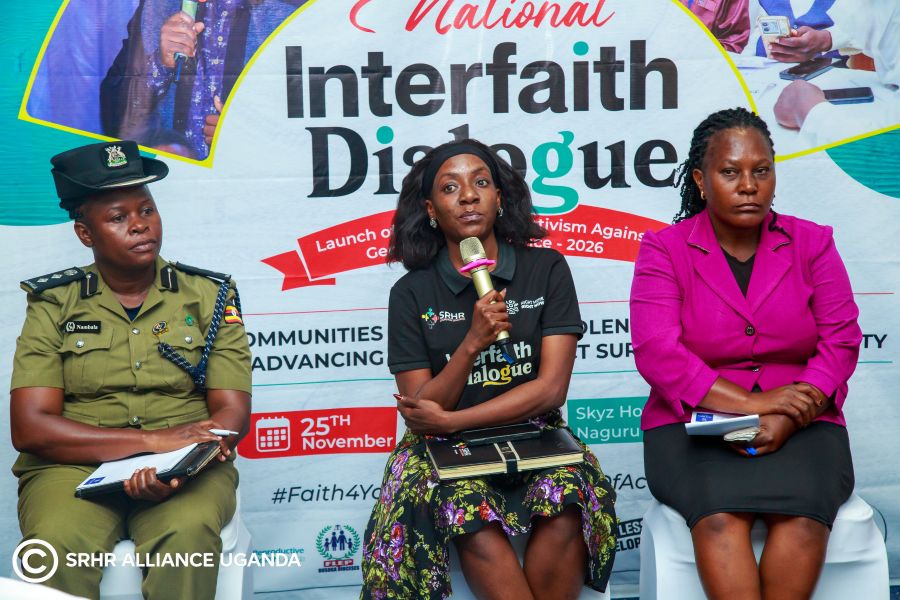
The call was made on Wednesday, November 25, 2026, during the eighth National Interfaith Dialogue organised by the Sexual and Reproductive Health and Rights (SRHR) Alliance Uganda at Skyz Hotel, Naguru, Kampala, to officially launch the 2026 16 Days of Activism Against Gender-Based Violence campaign.
The dialogue brought together religious leaders from different faith denominations, government representatives, civil society organisations and human rights advocates to explore how faith institutions can contribute to preventing sexual and gender-based violence, particularly against women, girls and young people.
The global campaign, running from November 25, the International Day for the Elimination of Violence Against Women, to December 10, Human Rights Day, is being held under the theme: “UNiTE to End Violence Against Women and Girls: Ensure Justice, Protect Survivors, End Impunity.”
Speaking at the engagement, SRHR Alliance Uganda Country Director Olgah Daphynne Namukuza said religious leaders were critical partners in addressing human rights challenges because religious and moral beliefs significantly influence people’s attitudes, decisions and behaviour.
She explained that the organisation had sustained the annual interfaith dialogue because sexual and reproductive health and rights issues could not be effectively addressed without engaging the religious and cultural institutions that shape community values.
“This is our eighth edition of the Interfaith Dialogue. The reason we continue having these conversations is that we have realised that human rights issues in Uganda are also intertwined with moral issues. You cannot discuss human rights in Uganda without discussing the moral perspective of the same,” Namukuza said.
She noted that while civil society organisations engage Parliament and other government institutions on human rights advocacy, there was an equally important need to engage religious and cultural leaders whose influence extends directly into families and communities.
“We realised that we cannot continue going to Parliament and talking about human rights when we are not talking to each other and engaging the people who influence the way we think, the people who influence how we look at life and those who actually determine how we act,” she said.
Namukuza emphasised that the dialogue was intended to create an environment where religious and cultural leaders could openly discuss challenges affecting their communities and collectively identify practical solutions rather than simply being instructed on what to do.
“We brought religious leaders and also engaged cultural leaders, not necessarily to tell them what to do, but to have conversations like the one we are having today. The issues are real, the numbers are there, and young people are actually suffering,” she added.
She particularly highlighted the importance of addressing gender-based violence affecting both women and men, challenging traditional expectations that discourage men from speaking about their experiences of abuse.
“Now we have men speaking up for themselves and saying, ‘Here we are, we are also struggling with gender-based violence.’ So the question is, do we bury our heads in the sand and keep saying you have to be strong, just like the Bible says, you have to be a man, or do we realistically find solutions to these problems and see how we can build a better Uganda for ourselves?” Namukuza asked.
She described religious leaders as major influencers of young people’s decisions, identities and understanding of life, urging them to use their platforms to champion sexual and reproductive health and rights, meaningful youth engagement and the prevention of sexual and gender-based violence.
Senior Superintendent of Police Sophie Nambala, the Regional Child and Family Protection Officer for Kampala Metropolitan North, said the police continued to undertake prevention, awareness creation and case management interventions to address violence against children and families.
However, she identified inadequate awareness of rights, community pressure, harmful cultural practices and logistical challenges as some of the obstacles affecting efforts to prevent and respond to gender-based violence.
Nambala said some survivors were discouraged from pursuing justice by community members, while others encountered difficulties accessing police services and other institutions responsible for handling their cases.
She explained that the police had introduced several mechanisms to improve access to reporting and protection services, including online reporting platforms, toll-free telephone lines and the deployment of officers closer to communities.
“We have toll-free lines where people can report cases. We also have police stations and the police sub-county model, which has enabled the deployment of officers at sub-county level,” she said.
She added that specialised personnel, including child and family protection officers and gender desk officers, had been deployed to make reporting and access to support services easier for survivors.
Milly Kayanga, a Senior Probation and Social Welfare Officer in Mayuge District, raised concern over teenage pregnancies and sexual violence in the Busoga and wider Eastern Uganda region, citing an alarming case of a 23-year-old woman who had become a grandmother after two generations of girls gave birth at approximately 11 years of age.
She said the situation demonstrated the urgent need for stronger sexual and reproductive health education, child protection and community awareness, particularly among parents and religious leaders.
Using religious teachings to reinforce the importance of protecting children, Kayanga referenced Jeremiah 1:5 in the Bible, which speaks about God’s knowledge of a person before birth, arguing that every child deserves dignity, protection and an opportunity to fulfil their potential.
“Before I formed you in the womb, I knew you. That means the Lord Almighty knew us before we were formed, and that means we are all precious. But how are we being handled? If a 15-year-old is being defiled, if an 11-year-old is having a baby, that means we are not treasuring the gift that is before us,” she said.
Kayanga identified harmful cultural norms, poverty, inadequate supervision and limited access to information as some of the factors contributing to violence against women and girls.
She also criticised the practice of resolving sexual abuse cases through informal community arrangements, warning that such interventions deny survivors justice and allow perpetrators to escape accountability.
“Can we please not blame the girls, but instead blame the acts that are happening to them? When we look at protection, can we make the churches, the mosques, the homes and the schools safe places so that we protect this young girl and enable her to exploit her full potential?” she asked.
She urged religious leaders to stop settling defilement cases within churches, mosques, homes and offices, insisting that criminal cases should be reported to the relevant authorities.
“Let us not settle defilement cases in churches, at home or in offices. Because when we do that, justice will not prevail. If we continue doing it, then we are, in one way or another, promoting impunity among our children,” Kayanga warned.
She further called on religious leaders to make discussions about teenage pregnancy, sexual violence and child protection part of their regular sermons and community engagements.
Rose Wakikona, Deputy Executive Director of the Women’s Probono Initiative, said Uganda had several laws intended to protect women and children, but weaknesses in implementation continued to undermine access to justice for survivors.
She identified inadequate funding, delays in the justice system, limited access to legal aid and insufficient training of frontline officers as some of the challenges affecting the handling of gender-based violence cases.
Wakikona revealed that some survivors encountered situations where police officers lacked fuel to travel and arrest suspects, forcing victims or their families to facilitate the process.
“We have cases where someone goes to report the defilement of a child, and they are told that there is no fuel for the police car to go and arrest the perpetrator. They ask you to facilitate that process. So there is that issue of logistics,” she said.
She also expressed concern over families that negotiate with perpetrators of child sexual abuse and accept material compensation instead of reporting the offences to the authorities.
“When a child has been defiled, the family sits down, gathers and says, ‘Now let’s just do the ceremony. You bring the things, we eat them, you take the girl.’ They believe that the matter has been settled. But this is a young child who is supposed to be in school, and instead someone has settled a criminal case because they do not know that this is an offence that needs to be reported,” Wakikona said.
She stressed that under Ugandan law, children below 18 cannot legally consent to sex and that sexual activity involving a child constitutes defilement.
Wakikona called on Parliament and government to prioritise the Legal Aid Bill and the Marriage Bill, arguing that progressive legislation, supported by adequate funding and effective implementation, would strengthen protection and access to justice.
She also urged authorities to train all police officers who interact with survivors, noting that victims sometimes encounter insensitive questioning and victim-blaming when reporting cases.
Charles Serwanja, a representative of the Inter-Religious Council of Uganda, challenged religious institutions to confront harmful interpretations of religious teachings that have sometimes been used to justify violence against women.
He said the family, traditionally regarded as the primary safe environment for children, was facing growing challenges due to failures in parenting, weakening community support systems and inadequate law enforcement.
Serwanja called on religious leaders to reclaim the true meaning of their scriptures and ensure that religious teachings promote dignity, equality, love and mutual respect.
“We know that there has been misuse of religious texts in some institutions. You find someone is being battered, and then you are told that a woman must endure. But every day they are battered. They are being battered every single day,” he said.
He also challenged men to recognise the changing roles of women in society and support their professional and personal ambitions rather than expecting them to remain confined to traditional domestic responsibilities.
“Most men in this room are still stuck in the past. We are not appreciating the changing role of the woman of today. A woman can be someone’s wife, a mother to her children and also a career woman. How prepared are the men of today to connect and associate with an empowered woman?” he asked.
Habiba Luma, Secretary for the West Nile Region at the Uganda Muslim Supreme Council, called for stronger collaboration among religious institutions in addressing violence within families and communities.
She said gender-based violence remained a challenge even in communities with significant religious populations, emphasising that faith must translate into practical action to protect vulnerable people.
“Islam is simply peace. The word Islam means peace. Now, if we embrace such faith, why do we have violence, first of all, in our homes and in our communities?” she asked.
Referencing Quran 5:2, which encourages cooperation in righteousness and good deeds, Luma said religious leaders from different denominations had a responsibility to work together to address common challenges affecting society.
She also cited Quran 16:90, which calls for justice and good conduct, arguing that promoting justice was a religious obligation rather than a favour extended to survivors.
“Advancing justice should not actually be spoken of as a favour. According to Quran 16:90, it is a command upon every believing man and woman. It is not a favour. And therefore, we shall be accountable: how did we accomplish this command?” she said.
Luma further urged religious leaders to use their influence over families and marriages to promote love, mercy, peaceful coexistence and the protection of children.
The dialogue highlighted the importance of stronger partnerships between religious institutions, law enforcement agencies, government and civil society organisations in tackling gender-based violence.
Through the eighth National Interfaith Dialogue, SRHR Alliance Uganda is seeking to turn religious influence into practical community action, ensuring that churches, mosques and other faith institutions become safe spaces where survivors are supported, perpetrators are held accountable and women and girls can live free from violence.
The 2026 16 Days of Activism campaign will run until December 10, Human Rights Day, with stakeholders expected to renew their commitment to advancing justice, protecting survivors and ending impunity.