



President Museveni has said that NRM does not chase after cheap popularity, but instead focuses on delivering tangible results that transform the lives of Ugandans.
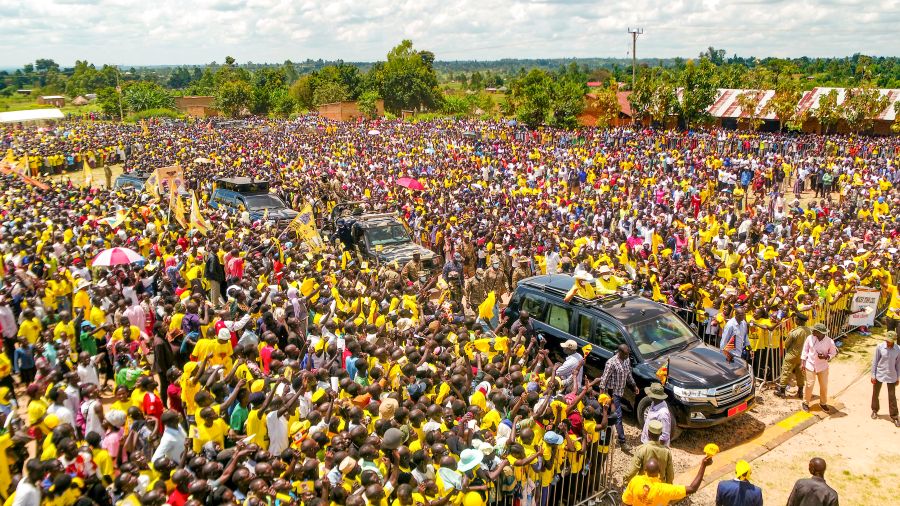
Speaking to thousands of jubilant supporters at his presidential campaign rally held at Nyadri Urban Secondary School Grounds in Maracha District, President Museveni emphasized that the recent connection of West Nile to the national electricity grid was not just symbolic but a strategic move by the NRM to industrialize and modernize Uganda.
“For us in the NRM, we don’t just do things to please people, especially when something is wrong. That’s dangerous. That’s cheap popularity. We were telling people that power will come here in West Nile — but according to plan. Now, powerful electricity has come. The next step is to distribute it to the sub-counties — and that will also be done,” Museveni said.
He highlighted the 132KV power line from Karuma to Arua as one of the biggest energy investments in Northern Uganda, poised to drive industrialization and agro-processing in the region.
“Now that the strong electricity has arrived, the next task is to distribute it to sub-counties and households so that everyone benefits.”
The president noted that Maracha District currently has 62 government primary schools and 7 government secondary schools, alongside private institutions.
“Maracha has 91 parishes, with 34 hosting at least one government primary school. Our target is to ensure that the remaining parishes without schools are also covered.”
“Maracha has 7 government secondary schools but 19 sub-counties. We still owe the 12 remaining sub-counties a government secondary school each. You remember when we introduced free education, some school authorities started reintroducing charges, making it hard for the poor to access education. I decided to demonstrate that free education is possible.”
He explained that under his direct supervision through State House, he established Presidential Skilling Hubs across the country — one per zone — as models for free, practical skills training.
“In the State House-controlled education area, there are no PTAs, DEOs, foundation bodies, or head teachers — just proper management and commitment.”
On infrastructure, the president said the government had to make significant efforts to tarmac the road from Karuma to Koboko, even at a time when funds were limited.
He confirmed that work would also be done on the road from Atiak to Adjumani to Moyo. Additionally, he mentioned upcoming work on roads from Panyimur to Pakwach to Rhino Camp to Wanyara, and the road from Terego to Moyo.
President Museveni reaffirmed that the NRM’s work has always been guided by four core principles — patriotism, Pan-Africanism, socio-economic transformation, and democracy. These principles, he said, have delivered peace and stability across the country. Uganda, he added, is now peaceful from Karamoja to West Nile, from Acholi to Buganda — something that hasn’t been seen in 500 years. This peace, he said, was not bought with words but built through sacrifice and a clear ideology.
The president praised West Nile for its strategic location and business potential, stating that it is now a vital commercial corridor for trade with South Sudan and the Democratic Republic of Congo. He noted that West Nilers are earning money due to their position connecting Uganda to two major markets, which is why he urges all citizens to love and appreciate Uganda’s unity.
Encouraging economic transformation, the president highlighted the Parish Development Model (PDM) as a key tool. In Maracha alone, Shs. 27.9 billion has been distributed under the PDM, reaching more than 30,000 households. The next goal, he said, is to ensure that every family has a sustainable source of income.
He cautioned Ugandans to safeguard the peace and progress the NRM has brought, warning against leaders who use divisive or populist politics to gain relevance. He compared politics to medicine, stressing the importance of correct diagnosis — that Uganda’s problems were never tribal or religious, but rather about lack of income and development. The national focus, he said, must remain on wealth creation.
President Museveni concluded his address by thanking the people of West Nile for their unwavering support.
He pledged continued investment in infrastructure, education, and agriculture to consolidate Uganda’s progress. He said the country began with peace, followed by roads and electricity, and the next phase will be household prosperity. Together, he said, Ugandans will build a stronger nation.
The First Lady and Minister of Education and Sports, Janet Kataaha Museveni, also addressed the rally.
She thanked the people of Maracha and the entire West Nile region for their loyalty and strong turnout, adding that the development they are witnessing is a result of their long-standing support for the NRM government.
She emphasized that the connection to the national grid, the PDM programme, and the construction of new schools are all proof that the government works for all Ugandans.
The First Lady reaffirmed the government’s commitment to improving education standards, particularly in rural areas, and ensuring that Universal Primary and Secondary Education programmes remain free of illegal charges.
No child, she said, should be sent away from school because of fees. Education is a right, and the government is determined to enforce that.
Speaker of Parliament and NRM 2nd National Vice Chairperson (Female), . Anita Among, commended President Museveni for steering Uganda toward peace and progress.
She stated that the NRM’s track record speaks for itself, pointing to visible achievements such as roads, electricity, PDM funding, and schools in West Nile. That, she said, is why the people have pledged 99% of their votes to the NRM.
NRM Vice Chairperson for Northern Uganda, Denis Hamson Obua, praised the President for transforming West Nile from a war-torn area into one of Uganda’s fastest-growing regions.
He noted that while the region was once known for insecurity and displacement, it now stands tall — peaceful, productive, and well connected. That, he concluded, is the NRM difference.