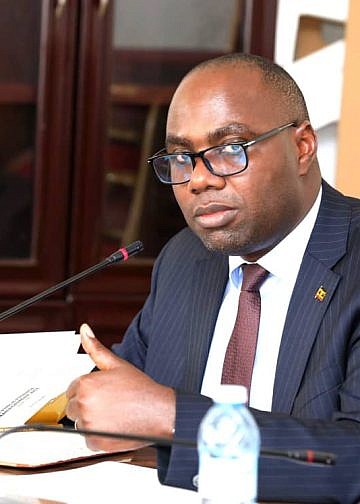












Finance Minister Henry Musasizi has said government will gradually reduce its fiscal deficit and reliance on commercial borrowing over the next five years, while warning that any revenue shortfalls will be handled through spending cuts and additional revenue measures rather than increased borrowing.
Musasizi made the remarks while appearing before Parliament’s Budget Committee to respond to concerns raised during scrutiny of the new Charter for Fiscal Responsibility for the financial years 2026/27 to 2030/31.
The Charter sets fiscal rules that will guide government’s borrowing, budgeting and expenditure decisions over the five-year period.
Under the framework, the fiscal deficit excluding oil revenue is expected to fall from 6.6% of non-oil GDP in FY2026/27 to 1.5% by FY2030/31.
Musasizi said the gradual reduction is deliberate, with the adjustment weighted towards the later years as government expects revenue collections to improve through the Domestic Revenue Mobilisation Strategy.
He explained that expenditure pressures linked to the start of oil production are expected to be concentrated in the earlier years.
“If the assumptions are not realised, shortfalls will be addressed through expenditure reprioritisation, containment of non-priority recurrent spending and where necessary, additional revenue measures rather than additional borrowing,” Musasizi said.
The Minister also said government intends to reduce commercial borrowing relative to domestic non-oil revenue from 33.7% in FY2026/27 to 19.3% by FY2030/31.
At the same time, total interest payments are projected to decline from 32.5% to 20% over the same period.
The Charter projects public debt to peak at 55.1% of non-oil GDP in FY2027/28 before declining to 50% by FY2030/31.
Musasizi also addressed a discrepancy between the Ministry of Finance’s projected public debt ratio of 54.7% of non-oil GDP for FY2026/27 and a 57.7% figure attributed to the Bank of Uganda.
He said the Ministry, Bank of Uganda and Uganda Bureau of Statistics harmonise their debt measurements during the annual Debt Sustainability Analysis, normally undertaken after final GDP figures for the completed financial year become available.
“The Ministry, however, remains the authority mandated with debt reporting and projection through the Annual Debt Sustainability Analysis (DSA) and reporting framework,” he said.
Musasizi said the Ministry would engage the central bank to establish the reason for the difference, adding that the treatment of domestic arrears could be one factor.
“One reason could be that they included the stock of domestic arrears, which we do not include in the DSA in line with international practice,” he said.
He explained that government’s international debt definition covers central Government, with external debt valued at the nominal amount disbursed and outstanding and domestic debt valued at cost.
Domestic arrears and temporary Bank of Uganda advances are not included in the international definition of public debt, although their associated risks are captured in the annual Fiscal Risk Statement.
On petroleum revenues, Musasizi said the new fiscal rule does not replace provisions of the Public Finance Management Act but establishes the annual amount of petroleum revenue that can be transferred for budget operations.
Under the rule, transfers from the Petroleum Fund to the Consolidated Fund cannot exceed 0.8% of the preceding year’s estimated non-oil GDP outturn provided by UBOS.
“The remainder of the petroleum revenue shall be transferred to the Petroleum Revenue Investment Reserve,” Musasizi said.
He said the arrangement is intended to ensure that petroleum revenues are managed within a defined fiscal framework rather than being used without limits to finance Government operations.
Musasizi said the Charter will be monitored through the budget process, macroeconomic modelling and forecasting.
The Ministry of Finance will report implementation to Parliament through the Half-year Fiscal Performance Report by the end of February and the Annual Fiscal Performance Report by the end of October every year.
The five-year framework therefore sets targets for reducing Uganda’s fiscal deficit, commercial borrowing and interest burden while allowing Government to manage the expenditure pressures expected from the country’s transition into oil production.