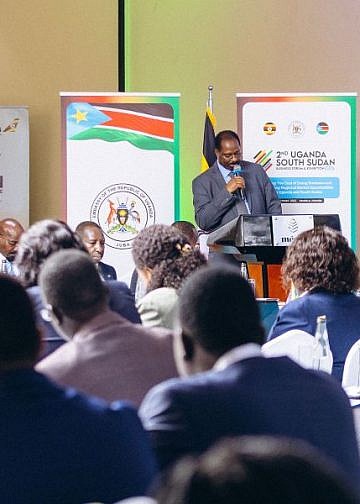











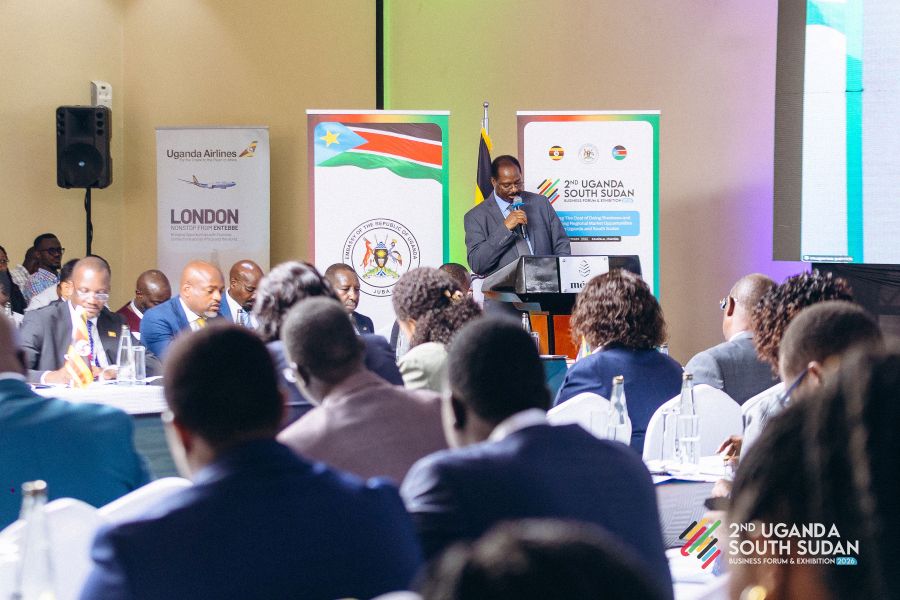
Uganda and South Sudan are seeking to expand bilateral trade, improve cross-border movement of goods and attract investment as the second Uganda-South Sudan Business Forum and Expo opens in Kampala.
The three-day event, running from October 13 to 15 at Mestil Hotel, brings together government officials, diplomats and private sector representatives to identify business opportunities, address trade barriers and strengthen economic cooperation between the two neighbouring countries.
Discussions are expected to focus on market access, customs procedures, border security, product standards and investment, with participants seeking practical solutions to challenges affecting traders operating between the two markets.
Uganda’s Ambassador to South Sudan, Brig. Ronnie Barya, said the forum offered an opportunity for both countries to assess progress in their economic relations and identify areas requiring renewed attention.
“I am extremely happy that it is happening again today in Kampala. This is a good opportunity to evaluate ourselves and plan well. Where are we? Are we progressing? Are we degenerating? Are we stagnating? Where are we as the South Sudan and Uganda business community?” Barya said.
He said the forum should go beyond discussions and provide a platform for businesses to identify opportunities, share experiences and develop partnerships that can contribute to economic growth in both countries.
“The forum will enable the private sector in Uganda and South Sudan to examine achievements and challenges, but also identify opportunities that can be explored to expand their businesses and our economies,” he said.
Barya noted that Uganda and South Sudan shared longstanding historical ties, diplomatic relations and growing commercial links, which provide a foundation for deeper economic cooperation.
Both countries are members of the East African Community (EAC), a regional bloc that seeks to promote economic integration and facilitate the movement of goods, services, capital and people across member states.
He said the two governments needed to translate their diplomatic relationship into practical economic gains by strengthening cooperation among businesses and addressing barriers that constrain cross-border commerce.
“Therefore, the geopolitical, strategic value and significance of the Uganda-South Sudan cooperation is absolute,” Barya said.
Trade barriers remain a concern
A key priority for the forum is to identify and address tariff and non-tariff barriers affecting trade between the two countries.
Barya said improved coordination among government agencies was necessary to reduce delays at border points, facilitate the movement of goods and services, and create a more predictable environment for traders and investors.
He said the two countries should strengthen business-to-business networks, raise awareness about investment opportunities and establish a joint Uganda-South Sudan business forum that would meet regularly to discuss emerging issues.
The proposed platform would enable private sector representatives to engage with government officials on challenges affecting their operations and follow up on agreed solutions.
Barya also linked the discussions to broader bilateral efforts to improve border management, noting that previous engagements between the two governments had emphasised cooperation on trade, security and immigration.
He said joint border meetings, the proposed business forum and the anticipated Joint Permanent Commission meeting should help address challenges affecting border communities and commercial activity.
The priorities include promoting peaceful coexistence, improving border security, harmonising customs and immigration procedures, and strengthening coordination to combat cross-border and transnational crime.
Barya said the meetings should produce clear commitments, including a joint communiqué outlining agreed resolutions, technical committees to oversee implementation and a roadmap with timelines for addressing outstanding border challenges.
He added that more efficient border procedures would benefit traders by reducing delays and improving the movement of goods, while stronger security coordination would help protect businesses and investors.
South Sudan seeks better access to Ugandan suppliers
South Sudan’s Ambassador to Uganda, Paul Malong, said the two countries had an opportunity to deepen commercial ties by improving market access and strengthening cooperation across regional supply chains.
He noted that South Sudan’s admission to the EAC in 2016 had marked an important step towards regional integration and opened further opportunities for trade with neighbouring countries.
“South Sudan has one of Uganda’s leading export destinations over the years. Ugandan traders are among those doing business in South Sudan, especially in the five major markets in Juba, with the majority of commodities such as construction materials used in Juba originating from Uganda,” Malong said.
He said the economic relationship between the two countries formed part of a wider regional effort to promote industrialisation, investment and economic transformation.
Referring to the third annual Regional Industrialisation Conference held in Kampala in August, Malong said the meeting had highlighted the need for East African countries to view the region as a shared production and investment space.
“Eastern African countries increasingly regard the region as a single production and investment space, rather than a separate national market. Regional integration must move beyond policy commitment towards implementation, investment, and measurement of economic outcomes,” he said.
Malong identified regional value chains, industrial finance, trade facilitation, infrastructure and energy as important areas for cooperation, adding that businesses had a central role to play in driving economic transformation.
“The private sector is not an expected expert in this area. You are the engine of economic transformation,” he said, assuring investors that South Sudan remained open for business.
However, he said some challenges continued to affect traders and called for greater collaboration between the two governments to address them.
One concern relates to the movement of South Sudanese exports, including fish destined for the Democratic Republic of Congo through Uganda. Malong urged the trade ministries and standards agencies in both countries to resolve issues involving quality assurance, certificates of origin and border clearance.
He said closer cooperation between the South Sudan Bureau of Standards and the Uganda National Bureau of Standards would help improve compliance, build traders’ confidence and strengthen the competitiveness of products in regional markets.
Malong also called for improved access for South Sudanese traders seeking to purchase goods directly from Ugandan manufacturers and distributors.
“Our traders don’t have access to manufacturing to buy goods from Uganda,” he said, arguing that businesses with the financial capacity to purchase goods directly should be able to access suppliers without unnecessary restrictions.
He said the matter had already been raised with Uganda’s Ministry of Trade and urged the relevant authorities to address the concerns.
“We really need to address this issue so that South Sudanese who have got the capacity should be able to buy goods and services from Uganda,” Malong said.
Improved access to manufacturers could help South Sudanese traders strengthen their supply chains, while creating opportunities for Ugandan producers to expand their customer base in the neighbouring market.
The two countries are also seeking to improve revenue collection and border efficiency through digital systems.
Malong said the South Sudan Revenue Authority had introduced a digital tax and levy system to strengthen revenue collection and address tax evasion.
He also pointed to the electronic permit system launched jointly by the South Sudan Revenue Authority and the Uganda Revenue Authority last year, saying it had contributed positively to revenue generation and border clearance.
He called for continued cooperation between the two authorities to address emerging challenges and ensure that digitalisation supports legitimate trade.
“I want to emphasise that South Sudan’s approach to digitalisation is in the spirit of partnership, mutual respect and shared economic interest,” Malong said.
He added that existing cooperation mechanisms should be used to resolve concerns and improve coordination between the two countries’ revenue authorities.
Beyond identifying opportunities, the forum is expected to develop practical measures for addressing persistent trade and border challenges.
Barya said the expected outcomes include a joint communiqué, technical committees to monitor implementation, a roadmap for resolving border-related concerns and stronger coordination among authorities in both countries.
The agenda also covers customs and revenue management, security and stability, migration, refugee management and the provision of social services in border communities.
Regular follow-up meetings are expected to help assess progress and ensure that commitments made during the forum translate into improvements for businesses.
Malong said the two countries’ close economic and social ties provided a strong basis for further cooperation, but stressed the importance of addressing practical concerns affecting traders.
“Uganda and South Sudan are not mere neighbours. We are brothers and sisters. Brothers and sisters, our economies are intertwined,” he said.
As the forum continues through October 15, its success will depend on the ability of government agencies and private sector representatives to agree on workable solutions that improve market access, reduce trade costs and encourage investment across the Uganda-South Sudan corridor.