










A new report has indicated that approximately 700,000 Ugandans enter the labour market every year, but only between 200,000 and 238,000 secure employment, highlighting the growing challenge of job creation in an economy struggling to absorb its expanding workforce.
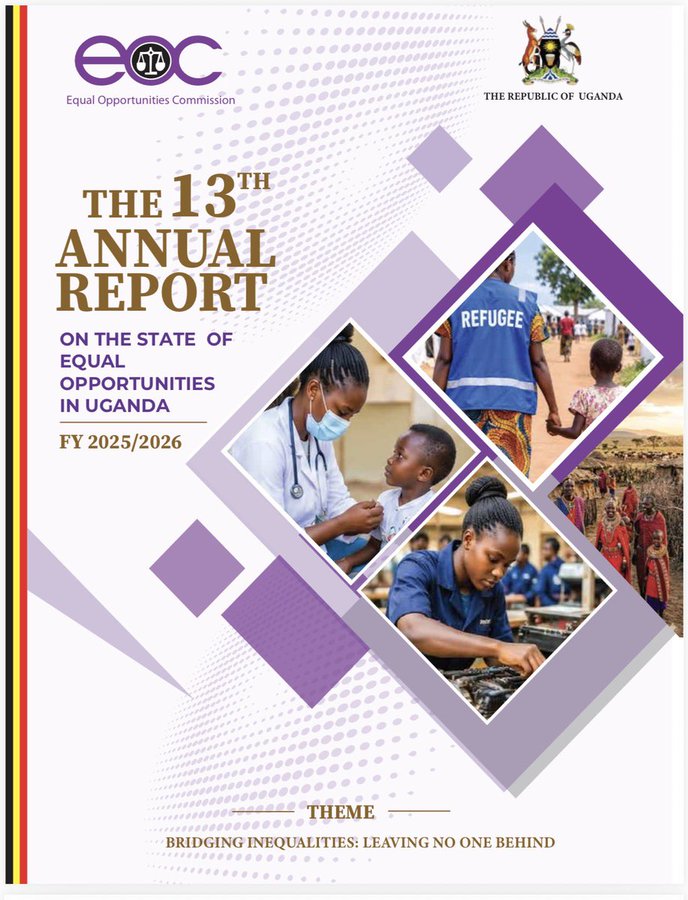
The findings, contained in the Equal Opportunities Commission’s (EOC) 13th Annual Report on the State of Equal Opportunities in Uganda released today at Kampala Sheraton Hotel raise concerns about the country’s ability to translate economic growth into meaningful employment opportunities.
According to the report, although Uganda’s economy expanded by 6.4 per cent in the 2025/2026 financial year, employment creation remains insufficient to accommodate the growing number of people seeking work.
The report observes that the country’s economic expansion has not necessarily translated into sufficient employment opportunities, leaving hundreds of thousands of new labour market entrants without jobs every year.
It attributes the employment gap to structural challenges, including capital-intensive investments, limited industrial absorption, skills mismatches and constraints affecting private-sector growth.
Growth concentrated in sectors such as oil and gas, large-scale infrastructure and some industrial activities increases economic output but does not necessarily create employment for large numbers of Ugandans.
At the same time, millions remain engaged in small-scale agriculture and informal businesses, which often have limited capacity to provide stable, adequately remunerated employment.
The report further explains that private enterprises, which are expected to drive much of the country’s job creation, face high borrowing costs, inadequate infrastructure, expensive business operations and frequent business closures, limiting their capacity to expand and recruit more workers.
Skills mismatches and increasing adoption of automation and digital technologies also affect businesses’ ability to recruit and retain workers, particularly where job seekers lack the competencies demanded by employers.
Consequently, many Ugandans, especially young people, remain unemployed or are forced into low-productivity and informal work, where earnings are often insufficient to guarantee economic security.
The report reveals that Uganda’s labour market remains heavily dependent on informal businesses, which employ approximately 7.35 million people compared with 2.37 million in formal businesses.
Informal businesses account for 75.6 per cent of employment across the two categories, highlighting their importance as a source of livelihoods for millions of Ugandans.
Trade accounts for the largest share of informal business employment at 53.1 per cent, followed by accommodation and food services at 17.2 per cent and manufacturing at 15.7 per cent.
In contrast, formal business employment is concentrated in education, which accounts for 28.3 per cent, and trade at 22.3 per cent.
The report notes that the concentration of employment in informal economic activities raises concerns about the quality, security and sustainability of jobs available to Ugandans.
It further identifies significant gender disparities, with women accounting for only 35.8 per cent of formal business employment compared with 46.2 per cent in informal businesses.
This suggests that women face additional barriers to accessing formal employment, where workers are more likely to benefit from structured employment arrangements and social protection.
The Commission argues that expanding access to formal and more secure employment should be an important part of Uganda’s economic transformation agenda.
The employment crisis is particularly severe among young people, with the report indicating that 50.9 per cent of Uganda’s youth population, representing approximately 5.2 million people, are neither in employment, education nor training.
Out of the country’s 10,769,151 young people, only 5,072,834, representing 49.1 per cent, are engaged in employment, education or a combination of both.
Susan Atukunda, the Principal Research Officer at the Equal Opportunities Commission, said the situation was considerably worse among young women.
“The situation is considerably worse among young women. They accounted for 3,277,019 (57.5%) of young people compared to 1,973,749 (42.7%) among young men. This means that approximately 1.3 million more young women than young men were outside employment, education and training,” Atukunda said.
The report attributes youth exclusion to challenges that begin within households and the education system before extending into the labour market.
It explains that poverty forces some young people out of school before completing their education, while skills mismatches, limited practical experience and inadequate employment opportunities make the transition into work difficult, even for graduates.
For young women, these challenges are compounded by early pregnancies, marriage and disproportionate care responsibilities.
“Poverty pushes young people out of school before completing their education, while skills mismatches, limited practical experience and inadequate employment opportunities make the transition into work difficult even for those who graduate. For young women, these challenges are compounded by early pregnancies, marriage and disproportionate care responsibilities,” Atukunda added.
she noted that rural young people face additional disadvantages arising from limited access to electricity, internet connectivity and employment information.
“These experiences demonstrate that being outside employment, education and training is not merely an individual circumstance but a reflection of broader barriers to accessing equal opportunities,” the report observes.
Gender disparities are also evident in access to employment and education. Nationally, 39.7 per cent of young men are exclusively engaged in employment compared with 31.1 per cent of young women. Similarly, 14.6 per cent of young men are exclusively in education, compared with 9.6 per cent of young women.
Bukedi recorded the highest proportion of young people outside employment, education and training at 62.4 per cent, followed by Lango at 62.3 per cent. Busoga and Karamoja each recorded 60.9 per cent, while West Nile stood at 60.6 per cent.
Kampala Capital City recorded the lowest rate at 34.1 per cent, followed by Kigezi at 39.4 per cent and Ankole at 39.8 per cent.
Buganda, meanwhile, recorded the largest absolute number of young people in this category, at 1,071,391.
These differences demonstrate how geographical location, infrastructure, investment and access to education influence young people’s chances of securing productive opportunities.
Youth programmes reach only a fraction of beneficiaries
The report also raises concerns about the limited reach of government livelihood and economic empowerment programmes targeting young people.
The Youth Livelihood Programme (YLP), introduced in 2013, has benefited 277,457 young people, representing approximately 2.6 per cent of the country’s 10.7 million youths, over 13 years.
Meanwhile, the Parish Development Model (PDM), launched in 2022, has reached approximately 1.1 million young people, representing 10.2 per cent, over four years.
These figures raise questions about the scale, reach and effectiveness of interventions intended to improve young people’s access to capital, skills development and sustainable livelihoods.
The Commission further highlights gaps in social protection, noting that although 827,998 young people are registered with the National Social Security Fund (NSSF), only 349,140 are actively contributing.
This means that a substantial proportion of registered young people are not actively building social security savings, leaving them more vulnerable to financial difficulties during unemployment, illness and old age.
The report also questioned whether Uganda’s official unemployment rate of 16.1 per cent adequately captures the extent of employment vulnerability in the country.
Atukunda argued that conventional unemployment statistics may overlook people who engage in occasional or irregular work but remain economically insecure.
“We found that this figure does not fully reflect the extent of youth unemployment rates. Take an example of someone who works one day in a week and he saves Shs20,000. This person is counted as employed. So, the statistics mask the true extent of youth employment vulnerability, as many Ugandans are statistically employed but still remain economically insecure and trapped in poverty,” Atukunda said.
The Commission argues that employment statistics should be examined alongside the quality, regularity and financial returns of available work to provide a more accurate picture of people’s livelihoods.
It further notes that unemployment affects young people across different educational and skills backgrounds, including both skilled and unskilled, educated and uneducated youths.
The report also indicates that only 65,915 young people are formally employed in the public sector, out of approximately 500,000 public-sector employees.
The Commission identified low economic growth and jobless economic growth as major contributors to unemployment, warning that continued economic expansion without sufficient employment creation could leave more Ugandans trapped in poverty, dependency and exclusion from national development.
It argued that unless economic growth translates into meaningful and sustainable job opportunities, the country risks widening inequalities and leaving a significant proportion of its population unable to benefit from national development.
The report called for deliberate interventions to expand productive sectors, strengthen private enterprises, address skills mismatches and improve access to decent employment.