










Road safety advocates have urged the government to expedite the review and reintroduction of the automated Express Penalty Scheme (EPS), including speed cameras and automated traffic ticketing systems, as part of efforts to curb rising road crashes and improve accountability among motorists.
The advocates said technology-driven enforcement would minimise human bias, strengthen compliance with traffic regulations and ensure round-the-clock monitoring of road users, particularly ahead of the busy festive season.
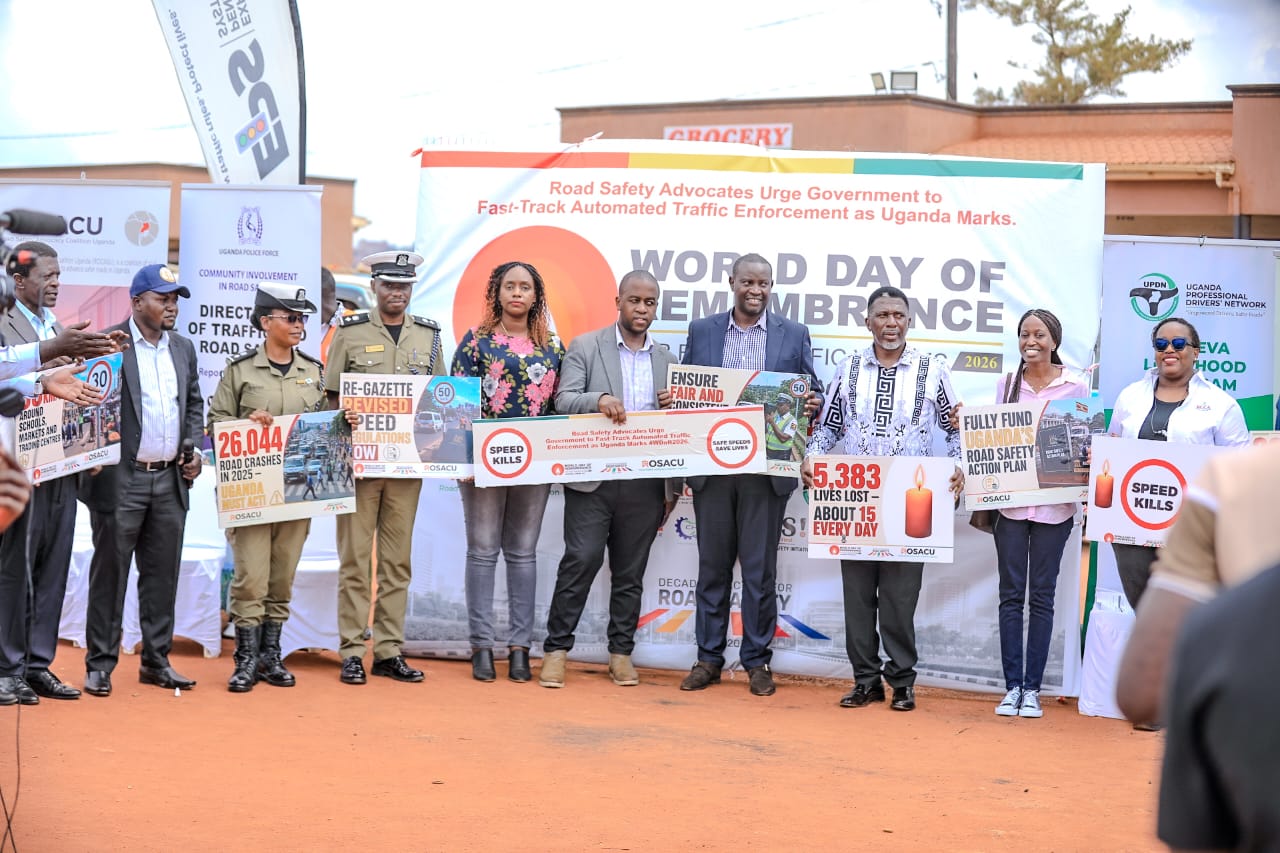
The call was made on Sunday during the commemoration of the World Day of Remembrance for Road Traffic Victims at Bwaise Bus Terminal in Kampala. The event brought together road crash survivors, bereaved families, drivers, religious leaders, government officials and road safety stakeholders to remember those who have lost their lives and renew calls for safer roads.
The commemoration was spearheaded by the Road Safety Advocacy Coalition Uganda (ROSACU), in partnership with the Ministry of Works and Transport, the Uganda Professional Drivers Network (UPDN) and other stakeholders.
Fred Tumwiine, the Executive Director of ROSACU, said Uganda needed to move beyond mourning road crash victims and take deliberate action to prevent further loss of lives, noting that technology could significantly improve traffic enforcement.
“We shouldn’t only lament, we should act in the sense that the government and non-government actors should act to reduce the damage. Research has shown that the moment governments and non-government actors sit together and put up measures, the rate of road crashes is reduced,” Tumwiine said.
He supported the introduction of automated traffic enforcement systems, arguing that technology would minimise unnecessary interactions between traffic officers and motorists while making it harder for drivers to evade accountability for traffic violations.
“We should introduce more and more technologies so that people, drivers and others don’t interact with the police, with other people, and this will help in the reduction of road crashes,” he added.
Tumwiine also warned drivers against reckless behaviour, saying the consequences of road crashes extend beyond victims to affect families, communities and the national economy.
“My message to drivers is that please remember that when you drive poorly, you drive recklessly, you are going to cause death and injuries, and the injury can be your son, your sibling, your mother or your father,” he said.
He noted that Uganda loses more than three per cent of its Gross Domestic Product (GDP) annually to road crashes, calling on government and non-government actors to work together to address the problem.
The Minister of Works and Transport, Fred Byamukama, in a speech read by Apollo Kashanku, the Assistant Commissioner in charge of Road Safety at the ministry, said more than 80 per cent of road crashes were linked to human behaviour and could therefore be prevented.
“Remembrance without resolve is not enough. If we truly wish to honour the dead, we must stop calling these tragedies accidents. An accident implies something unavoidable, an act of fate. The truth of the matter is that over 80 per cent of the crashes on our roads are caused by human behaviour. They are avoidable,” Byamukama said.
He identified reckless speeding, dangerous overtaking, drink-driving, drug use, distracted driving and disregard for pedestrians as some of the leading behaviours contributing to road crashes.
Byamukama also announced that the government was preparing to reintroduce the Express Penalty Scheme (EPS) as part of efforts to strengthen traffic law enforcement.
“We are reintroducing the Express Penalty Scheme. If you drive poorly, pay for it. If you are careless, pay. We don’t penalise the person; we penalise bad behaviour,” he said.
The planned reintroduction of the scheme is expected to include automated enforcement mechanisms, such as speed cameras and digital ticketing, aimed at detecting traffic violations and holding offenders accountable.
He added that the government had introduced mandatory motor vehicle inspections, was strengthening driver testing systems and planned to establish road safety committees at district level to extend awareness and enforcement efforts across the country.
The minister challenged motorists to respect speed limits, wear helmets and fasten seat belts, while urging passengers to speak up whenever drivers engage in reckless behaviour.
Uganda introduced the Express Penalty Scheme in 2025, but its implementation faced backlash from motorists and transport operators who accused the government of prioritising revenue collection over changing road users’ behaviour. The criticism forced the government to suspend the scheme pending a review.
The Uganda Professional Drivers Network (UPDN) Chief Executive Officer, Ndugu Omondo, said sustained technology-driven enforcement, combined with responsible road use, was critical to saving lives.
“Sustained, technology-driven enforcement combined with responsible road use will save thousands of Ugandan lives. Remember those we have lost. Support those affected. Act to save lives,” Omondo said.
Meanwhile, Hannington Kiwanuka, the Vice Chairman of the Bus Drivers Association, welcomed the planned reintroduction of EPS but challenged the government to ensure that penalties were enforced immediately rather than allowing offenders 28 days to pay.
Kiwanuka argued that the scheme would lose its deterrent effect if drivers were given time to settle penalties after committing traffic offences.
“We have been lamenting road safety for years and decades. Nothing can be achieved without enforcement. We, the bus drivers, came up with the vision of the Express Penalty Scheme in 1998,” Kiwanuka said.
He argued that the word “express” should mean motorists are required to pay immediately after committing an offence.
“If you give him 28 days, he will say, ‘Let me violate the traffic laws, then I will repay within 28 days.’ But if you tell him to pay today, the drivers will fear to violate traffic laws,” he said.
Kiwanuka urged the government to ensure that the scheme delivers timely and effective consequences for offenders if it is to deter reckless driving.
The commemoration also featured personal accounts from road crash survivors, highlighting the devastating consequences of reckless driving.
Doreen Nyakato, a survivor who now relies on crutches to walk, recounted how she was knocked down by a speeding boda boda along the Entebbe Expressway after becoming caught up in a confrontation involving two taxi conductors who were fighting over her as she resisted entering a taxi.
Nyakato said the boda boda struck her at high speed, leaving her with a broken leg. She was pregnant at the time of the crash.
She called for increased sensitisation of taxi conductors, saying their conduct and disregard for road safety also contribute to crashes.
Kampala Lord Mayor Ronald Balimwezo, who also survived a road crash that left him without a leg, urged the government and road users to treat road safety as an emergency.
Balimwezo recounted how he was knocked off his motorcycle by a speeding vehicle at Lugogo Junction after the driver attempted to swerve around a pothole. The crash left him without a leg and forced him to adapt to life with an artificial limb.
“I did not know that I would get involved in an accident. I rode my motorcycle from Luwero on a Saturday, returning from work. When I reached the Lugogo junction, I was involved in a hit-and-run accident. A speeding car was coming from Lugogo Bypass and tried to swerve around a pothole. The driver hit me, sending me into the air. When I came down, my leg was off,” Balimwezo said.
He said the experience inspired him to join politics and advocate for better roads, warning that dangerous road conditions, including potholes, can have devastating consequences.
Balimwezo further revealed that Uganda loses more than 5,000 people annually to road crashes, with boda boda riders and passengers accounting for a significant proportion of the fatalities.
“If it were another disease, government would have imposed a lockdown. I am telling you, it would be treated as an emergency. But I don’t know why people do not recognise that accidents have killed many of our people,” he said.
The Directorate of Traffic and Road Safety Police spokesperson, SP Michael Kananura, said Uganda recorded 5,383 road crash fatalities in 2025, translating into an average of 15 deaths every day.
He added that another 18,444 people were injured during the year, representing approximately 50 injuries daily.
“Behind every statistic is a family and a life forever changed. Many road crashes are preventable. Speeding, reckless overtaking, drink-driving, distracted driving and disregard for traffic regulations continue to claim innocent lives,” Kananura said.
He called for collective responsibility in addressing the crisis, noting that police alone could not reverse the trend without behavioural change among motorists and other road users.
“Seventy-five per cent of these road crashes can be prevented if we change our behaviour on the road. Why would you have to first see a traffic officer to tighten your seat belt? Let’s change our behaviour on the road,” he said.
Sheikh Hamid Sserwadda Busungu, the Regional Assistant Mufti for Kampala, also urged motorists to take personal responsibility, particularly when operating vehicles that were not roadworthy.
“Why would you drive a car to Masaka knowing very well that its brakes are not functioning properly? Such a decision puts your life and the lives of other road users at risk,” he said.
He called on drivers, passengers, pedestrians and cyclists to exercise caution, emphasising that road safety was a shared responsibility.