










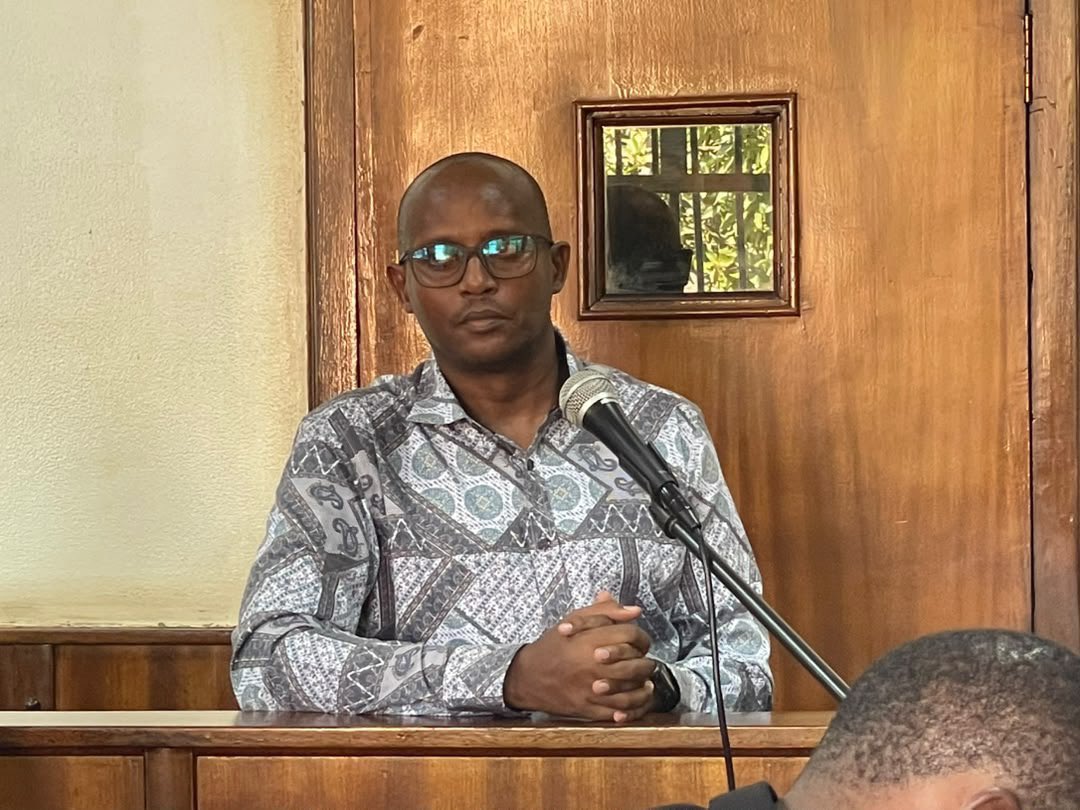
Buganda Road Chief Magistrate Ritah Neumbe has cleared Michael Katungi Mpeirwe’s extradition to the United States, where he is wanted to face trial on charges involving cocaine trafficking, firearms and provision of material support to a designated foreign terrorist organisation.
In her ruling delivered on Friday, Chief Magistrate Neumbe found that the Ugandan authorities had satisfied the requirements of the Extradition Act and ordered Katungi committed to prison to await the Minister’s order for his surrender.
Katungi is wanted before the United States District Court for the Eastern District of Virginia on three counts: conspiracy to distribute and possess with intent to distribute five kilograms or more of cocaine; conspiracy to possess firearms, including a machine gun and destructive device, in furtherance of a drug-trafficking crime; and conspiracy to provide material support or resources to a designated foreign terrorist organisation.
The extradition request identifies the organisation as Cartel de Jalisco Nueva Generación and alleges that Katungi and his co-conspirators attempted to supply military-grade weapons in connection with narcotics trafficking.
One of the major preliminary objections before Chief Magistrate Neumbe was whether the Director of Public Prosecutions had the legal authority to institute and conduct extradition proceedings.
Katungi’s lawyers relied on comparative authority from Kenya, arguing that extradition proceedings should not necessarily be treated as ordinary criminal proceedings.
Neumbe rejected the argument, finding that the Kenyan decision relied upon by the defence was itself divided and arose from a constitutional framework different from Uganda’s.
“I do not think a divided decision of a foreign court, resting on a differently structured constitutional text, should be treated as directly dispositive of a question that must, in the first instance, be resolved from the text and structure of Uganda’s own law.”
She noted that Article 120(3) of Uganda’s Constitution gives the DPP responsibility for directing police investigations of information of a criminal nature and instituting and conducting criminal proceedings.
She also relied on section 10(1) of the Extradition Act, which requires a magistrate hearing a fugitive to exercise, as nearly as possible, the same jurisdiction and powers as in criminal proceedings.
Chief Magistrate Neumbe noted that Parliament had deliberately located the judicial stage of extradition within the criminal process.
“I accept the Applicant’s submission that this reflects a deliberate legislative choice to locate the judicial phase of extradition within the ordinary criminal process of this Court.”
She found that the Republic of Uganda remained the true applicant, with the DPP acting as the constitutionally designated organ through which the State conducted the proceedings.
The objection to the DPP’s standing was consequently overruled.
Chief Magistrate Neumbe also considered the significance of the fact that no Ugandan police file, Station Diary reference or Crime Report Book number had been opened against Katungi concerning the alleged offences.
D/SSP Kule Yona of the Criminal Investigations Directorate admitted during cross-examination that he had not participated in the United States investigation and had no personal knowledge of the alleged conspiracies involving drugs, firearms or the organisation identified in the indictment.
Neumbe nevertheless held that the absence of a domestic Ugandan investigation did not invalidate the extradition request.
She observed that extradition proceedings are fundamentally concerned with alleged conduct occurring outside Uganda and that the requesting State is expected to prosecute the accused on the basis of its own evidence.
“An extradition proceeding is, by definition, concerned with conduct alleged to have occurred substantially outside Uganda, in aid of a prosecution to be conducted by the requesting State upon its own evidence.”
She warned that requiring a parallel Ugandan investigation would undermine Parliament’s statutory framework for receiving foreign evidence.
“It would frustrate the object of the Extradition Act, and render sections 24 and 25 largely otiose, were this Court to insist upon a parallel, domestically generated Ugandan investigative file.”
Neumbe also considered an affidavit by Michael D. Stanton that had initially been filed in support of the extradition application.
The affidavit had been expunged from the record on August 13, 2026 after Stanton failed to avail himself for cross-examination and the prosecution elected to dispense with him as a witness.
The Chief Magistrate said she placed no reliance on the affidavit.
However, she ruled that its removal did not undermine the entire extradition application because the US documents had an independent statutory basis for admission under sections 24 and 25 of the Extradition Act.
“The striking out of Mr Stanton’s affidavit removes the one document that narrated, in first-person terms, the course of the alleged United States investigation. It does not, however, extinguish the independent statutory footing of the authenticated foreign documents under sections 24 and 25.”
The court then considered whether the alleged US offences corresponded to offences under Ugandan law, applying the principle of dual criminality.
Chief Magistrate Neumbe found that the cocaine conspiracy corresponded to offences under Uganda’s narcotics legislation.
The firearms conspiracy was found to correspond to Ugandan offences involving unlawful acquisition, possession or dealing in firearms, together with relevant conspiracy and narcotics laws.
The court also found a corresponding offence under Uganda’s anti-terrorism legislation in relation to the material-support allegation.
“I am satisfied that, on the substance of the conduct alleged, and absent any serious contest that such conduct, if proved, would fail to correspond to Ugandan criminal law, dual criminality is established as to all three counts.”
Case not political
While Katungi’s lawyers had argued that the offences were political in character. Chief Magistrate Neumbe rejected the argument sayign no evidence had been presented to prove this.
“No credible evidentiary basis has been advanced for treating the three counts of narcotics trafficking, firearms trafficking, and material support to a prescribed organisation as anything other than offences of an ordinary criminal character.”
“The bare invocation of political character, unsupported by any fact going to motive or context, cannot displace the objective character of the offences charged.”
Katungi’s lawyers also argued that Uganda was the more appropriate forum for trying the allegations.
Chief Magistrate Neumbe rejected the submission, noting that Uganda’s Extradition Act does not contain a general forum-bar provision.
She found that where conduct is alleged to have occurred substantially in, or been directed at, the requesting State, and the evidence and alleged co-conspirators are said to be located there, the requesting State is the appropriate forum for trial.
“The appropriate forum for the trial of conduct substantially alleged to have occurred in, or to have been directed at, the requesting State, where the evidence and the alleged coconspirators are said to be located, is the requesting State.”
The Chief Magistrate acknowledged the defence argument that the absence of a Ugandan police file and Kule Yona’s lack of first-hand knowledge left what would have been a thin domestic prosecution.
But she emphasised that the extradition hearing was not a criminal trial at which the court was required to determine Katungi’s guilt.
“Section 11(1) does not require this Court to be satisfied of the Respondent’s guilt, nor to weigh competing narratives to the standard familiar from a criminal trial.”
Neumbe said the court instead had to determine whether the evidence met the statutory threshold for committal.
She noted that the authenticated US extradition request, indictment and arrest warrant, together with the admissible portions of Kule Yona’s evidence, were sufficient.
“The duly authenticated extradition request, indictment and warrant, read together with the surviving evidence of D/SSP Kule Yona going to the identity of the Respondent, the official processing of the request within Uganda, and his arrest and production before this Court, in my judgment together meet that threshold.”
“It is hereby ordered that the respondent, Michael Katungi Mpeirwe, is committed to prison to await the Minister’s order for his 15 surrender to the United States of America, to stand trial before the United States District Court for the Eastern District of Virginia on the three counts identified in the indictment accompanying the extradition request,” Chief Magistrate Neumbe ruled.
She however warned that the committal is limited to the three counts contained in the US indictment but also noted that Katungi shall remain on remand pending the Minister’s order for surrender.