











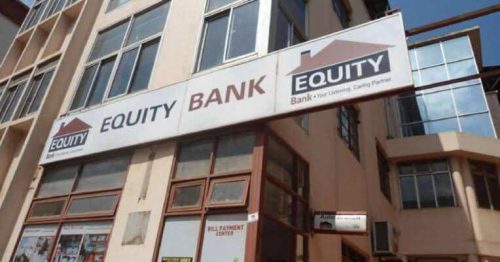
The High Court Commercial Division has ruled that Equity Bank Uganda breached a Shs17.8 billion loan agreement with Gombe Educational Services Limited after the lender refused to disburse the approved facility during the COVID-19 pandemic.
Justice Patience T. E. Rubagumya, in a judgment delivered electronically on August 27, 2026, declared that the bank unlawfully rescinded the loan agreement and ordered it to pay Gombe Educational Services a total of Shs233.748 million in special and general damages, in addition to interest and costs of the suit.
The dispute arose from a loan application made by Gombe Educational Services in November 2019 for a combined facility of Shs18.5 billion.
Following due diligence, valuation of the proposed securities and an assessment of the company’s financial position, Equity Bank offered the school operator a combined facility of Shs17.8 billion in February 2020. The offer was subsequently varied in March 2020 and accepted by the plaintiff.
The facility comprised a Shs17.2 billion term loan intended to finance the acquisition of East High School Ntinda, repay outstanding loans with KCB Bank Uganda and Tropical Bank, and renovate the school. It also included a Shs600 million facility for termly overheads.
However, the COVID-19 pandemic and the subsequent closure of schools disrupted the transaction. Equity Bank halted disbursement and eventually rescinded the facility in March 2021, citing the unfavourable operating environment in the education sector.
Gombe Educational Services sued the bank, arguing that it had fulfilled the conditions required for disbursement and had incurred substantial costs in preparation for the facility.
The bank, however, argued that the loan remained subject to conditions precedent, including personal guarantees from directors of several corporate guarantors. It also relied on the COVID-19 pandemic as a material adverse change, force majeure and frustration of the contract.
Justice Rubagumya rejected the bank’s defence, finding that a binding contract existed once the loan offer and its subsequent variation had been accepted.
The judge relied on an earlier Court of Appeal decision in Uganda Development Bank Limited v Afro-Kai Ltd, which held that conditions attached to a loan offer regulate performance and disbursement but do not prevent a contract from coming into existence after acceptance.
“I take the view that a binding contract existed between the parties and the conditions the Plaintiff was obligated to fulfil were to be performed during the pendency of the contract,” Justice Rubagumya held.
The court also found that Equity Bank’s reliance on missing personal guarantees was an afterthought because the bank had not cited the alleged missing documents when it rescinded the agreement.
“Therefore, as per the undisputed evidence on Court record, the Facility Agreement was not rescinded due to the fact that the Plaintiff had not availed some documents as was required under the variation of terms,” the judge said.
“In the premises, I find that this claim was an afterthought.”
The judge further rejected the bank’s argument that the pandemic amounted to a material adverse change in Gombe Educational Services’ financial position.
Although the loan agreement allowed the bank to determine whether a material adverse change had occurred in the borrower’s financial condition or operations, Justice Rubagumya said this did not give the lender unlimited discretion to cancel the facility without evidence.
“It is also my considered opinion, that such Material Adverse Change clauses are not intended to bestow unfettered unilateral discretion on the bank to decide whether a Material Adverse Change has occurred without any cogent evidence or investigation,” she held.
According to the judge, the bank should have undertaken a proper assessment of the school’s financial position, operations and ability to repay before relying on the pandemic to terminate the agreement.
The court noted that Equity Bank had not conducted such an assessment.
“Therefore, apart from the bank statements, DEX 6, no financial assessment of the Plaintiff’s financial condition or business operations as well as its ability to repay was conducted to justify the Defendant’s reliance on the pandemic before rescinding the contract,” Justice Rubagumya said.
She consequently found that the bank had failed to prove that a material adverse change had occurred.
The court also rejected the bank’s reliance on frustration of contract, noting that by March 2020, when the loan agreement was varied, the bank was already aware that schools had been ordered to close because of COVID-19.
“It is also undisputed that the Defendant offered the combined facility on 21st February, 2020 and this was varied on 19th March, 2020. It is also within public knowledge that the Presidential directive to close the schools was made due to the pandemic … on 18th March, 2020,” the judge observed.
“From the foregoing, I find that the Defendant has failed to demonstrate how the effects of the pandemic and the Government lockdown frustrated its contract with the Plaintiff.”
Justice Rubagumya similarly dismissed the force majeure defence, holding that Equity Bank had not demonstrated that the pandemic or government restrictions actually prevented it from disbursing the loan.
“The Defendant did not adduce any evidence to prove that the pandemic and the lock down prevented, hindered or delayed it from performing its obligation of disbursing the facility,” she ruled.
“Therefore, I find that the Defendant has not adduced sufficient evidence to invoke the defence of force majeure.”
The judge consequently concluded that Equity Bank breached the agreement by failing to provide the facility and arbitrarily rescinding the contract.
However, the court rejected most of Gombe Educational Services’ claim for Shs2.423 billion in expenses.
The school operator had sought compensation for renovation works, a Shs2.1 billion commitment fee relating to the intended acquisition of East High School Ntinda, loan-related expenses and other costs.
The court found that several of the claimed expenses had either been incurred before Equity Bank made the loan offer or had not been sufficiently proved.
Justice Rubagumya also rejected claims relating to construction and painting works after witnesses confirmed that some of the contracted services had never actually been performed.
The Shs2.1 billion claimed as a commitment fee for the purchase of East High School Ntinda was also rejected because no evidence was produced to support the claim.
However, the court awarded Gombe Educational Services Shs122.248 million for valuation fees and Shs31.5 million for audit fees.
The judge found that the valuation reports had been prepared and delivered to the bank and that the audit work was directly connected to the loan application.
“I therefore associate myself with the above reasoning to find that the Plaintiff is entitled to recover the above expense, upon proving the same,” Justice Rubagumya said, referring to the Court of Appeal’s reasoning in the Afro-Kai case.
The court further awarded the plaintiff Shs80 million in general damages for the financial loss and inconvenience caused by the bank’s breach.
“In the case at hand, the Plaintiff pleaded that due to the Defendant’s failure to fulfil its obligations, it suffered financial loss, inconvenience, lost out on other business opportunities and the chance to procure the loan facility from other banks,” the judge said.
“Having considered the financial loss and inconvenience occasioned to the Plaintiff, I hereby award the Plaintiff general damages of Shs80,000,000/=.”
The total monetary award therefore stands at Shs233.748 million, excluding interest and legal costs.
The court ordered Equity Bank to pay 10% annual interest on the Shs153.748 million in special damages from the date of judgment until payment in full, and 6% annual interest on the Shs80 million in general damages over the same period.
The bank was also ordered to meet the costs of the suit.
In the final orders, Justice Rubagumya formally declared that Equity Bank had breached the February 21, 2020 Loan Facility Agreement, as varied on March 19, 2020.