








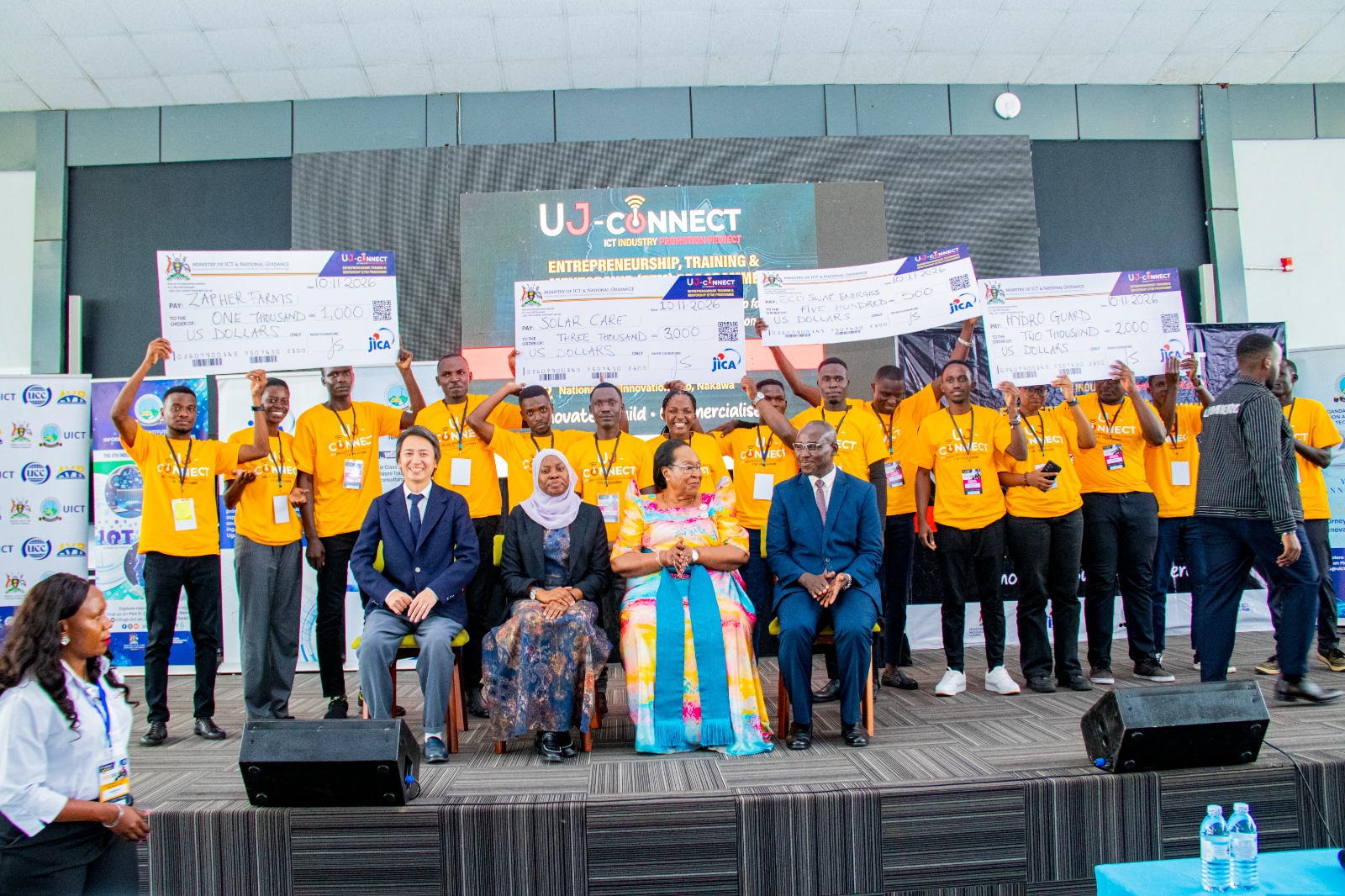
Four teams of Ugandan innovators have won a combined $6,500 (approximately Shs26.5 million) in grants for developing locally designed technological solutions to challenges in agriculture, energy, emergency response and transportation.
The innovators were recognised during the fourth batch of the UJ-CONNECT Entrepreneurship Training and Mentorship Programme, a five-year partnership between the governments of Uganda and Japan aimed at strengthening the country’s ICT industry and nurturing young technology entrepreneurs.
Solar Care, which developed an automated solar panel cleaning system, emerged the overall winner, receiving $3,000. HydroGuard, a firefighting robot designed to support emergency responders, came first runner-up and received $2,000.
Zapher Farm secured $1,000 for its offline artificial intelligence-powered crop disease detection application, while EcoSwap Energies received $500 for developing solar-powered battery-swapping stations for electric motorcycles.
The awards were presented during the Entrepreneurs Demo Day held under the theme, “From Ideas to Enterprises – Empowering Uganda’s Next Generation of Technology Entrepreneurs.”
The event marked the culmination of three months of intensive entrepreneurship training and mentorship undertaken by 56 students at the Uganda Institute of Information and Communications Technology (UICT) between August and October 2026.
The training equipped participants with practical skills in business development, market validation, prototype refinement and investment readiness, enabling them to transform innovative ideas into products with commercial potential.
Speaking at the event, Minister Joyce Ssebuggwawo commended the young innovators for identifying challenges within their communities and developing practical solutions, saying the programme had demonstrated the importance of connecting academic knowledge with real-world problems.
“We have witnessed the work of young Ugandans who went into the field, listened to real people, identified real problems and returned to develop solutions. Today, after three months of intensive training, we are seeing the results of the hard work these young people have put in,” Ssebuggwawo said.
She challenged the innovators to remain committed to improving their products, noting that winning an award was only one step in the much longer journey of building sustainable businesses.
She said the experience, discipline and confidence acquired during the training would be critical as the young entrepreneurs prepare to engage investors, business partners and potential customers.
“Whether or not your team has won an award today, you leave this hub with something much more lasting. You leave with the discipline to continue working on your products and the confidence to present your innovations to investors, partners and customers. What matters now is how you build on what you have learned and turn your ideas into solutions that people are willing to use,” she said.
Ssebuggwawo also applauded the partnership between Uganda and Japan, saying it had established an important pathway for nurturing local talent and connecting young innovators to business opportunities.
“This project has demonstrated that a well-structured partnership can create a pipeline that moves talent from the lecture room to the workplace and from the local market to the global stage. We need to continue creating opportunities through which our young people can develop their talents, build businesses and compete internationally,” she said.
She observed that Uganda’s decision to place the digital economy at the centre of its development strategy was informed by the sector’s potential to create jobs and deliver innovative solutions across agriculture, healthcare, education, financial services and public administration.
The minister urged the innovators to remain engaged with their mentors, innovation hubs and industry partners to strengthen their products and improve their chances of succeeding in the marketplace.
Dr Aminah Zawedde, Permanent Secretary in the Ministry of ICT and National Guidance, urged young entrepreneurs to embrace resilience, discipline and commitment when pursuing their business ambitions.
She cautioned that entrepreneurship was not always easy, noting that some participants could become discouraged when confronted with challenges during product development and business establishment.
“My advice to young people is to always be resilient and remain interested, especially when you receive an opportunity to access training free of charge. Such training is not easy to obtain, and if you were to pay for it, it would come at a cost. Therefore, when you get such an opportunity, put in the effort and energy required to benefit from it,” Zawedde said.
She revealed that 56 participants had completed the latest training cycle, with four finalist teams proceeding to pitch their innovations before judges and potential investors. The winning teams received grants to support further development and commercialisation of their products.
Zawedde challenged the innovators to understand the problems they intended to solve rather than becoming overly attached to the technologies they had developed.
“Do not fall in love with the solution you have developed; fall in love with the problem you are trying to solve. When you understand the problem properly, you will be in a much better position to develop an appropriate solution that responds to people’s actual needs,” she advised.
She further urged the young entrepreneurs to prioritise impactful innovations capable of addressing significant challenges rather than concentrating on products with limited practical value.
The Permanent Secretary also emphasised the importance of local content in Uganda’s ICT development agenda, explaining that it involved more than simply purchasing locally manufactured products.
“Local content is not just about consuming products made in Uganda. It is about developing solutions locally and creating powerful ICT products that can address our own challenges. When we develop these solutions here, we can access technology at a lower cost while creating employment opportunities for our young people,” she said.
Zawedde added that locally developed technologies could provide affordable solutions across key sectors while reducing dependence on imported products.
She also highlighted the importance of decentralising innovation and entrepreneurship training through regional hubs established at institutions including Soroti University and Muni University, saying the initiative was intended to extend opportunities to young people beyond Kampala.
Hideshi Yamashita, JICA Uganda Senior Representative, said the programme had made an important contribution to developing Uganda’s innovation ecosystem by equipping young people with the skills, knowledge and networks needed to transform their ideas into viable businesses.
He disclosed that the initiative had supported and mentored 117 participants since its inception, including early-stage innovators and students.
“Since its inception, the programme has supported and mentored 117 participants, helping them improve their skills, knowledge and networks so that they can turn their ideas into viable businesses. Some of these innovators have also had opportunities to showcase their products internationally, including in Japan, where they have built networks and explored business opportunities beyond Uganda,” Yamashita said.
He described the Entrepreneurs Demo Day as more than a pitching competition, saying it was an opportunity to celebrate the creativity, perseverance and entrepreneurial spirit of Uganda’s young people.
“Today is more than a pitching competition. It is a celebration of innovation, perseverance and the entrepreneurial spirit of Uganda’s young innovators. Over the past several months, these participants have worked hard to identify challenges, develop solutions and transform their ideas into promising business opportunities,” he said.
Yamashita encouraged the participants not to regard setbacks as the end of their entrepreneurial journeys, explaining that successful businesses required flexibility and the ability to adapt to changing market conditions.
“Entrepreneurship is not only about building a business. It is about solving problems, creating opportunities and improving people’s lives. Not every idea will succeed in its original form, and that is why entrepreneurs must remain flexible and willing to adapt their products and business models as they learn from the market,” he added.
He commended the Ministry of ICT and National Guidance, UICT, mentors, judges and other partners for their commitment to the programme.
Similarly, Yoshida Norimasa, Deputy Head of Mission at the Japanese Embassy in Uganda, reaffirmed Japan’s commitment to supporting Uganda’s development through cooperation in human resource development, innovation and industrial growth.
He said investment in human capital and emerging industries was essential for sustainable economic transformation, particularly as technology continues to reshape business and public service delivery.
“Investment in human resources, innovation and new industries is essential for sustainable economic growth. In particular, the ICT industry will play an increasingly important role in Uganda’s economic transformation by creating new business opportunities and employment for young people,” Norimasa said.
He noted that Japan, through the Japan International Cooperation Agency (JICA), had partnered with the Government of Uganda under the Uganda ICT Industry Promotion Project, commonly known as UJ-CONNECT.
He described the entrepreneurship training and mentorship programme as an important component of the partnership, noting that it had supported aspiring entrepreneurs and students through practical training and individual mentorship.
Norimasa also highlighted the programme’s contribution to strengthening UICT’s institutional capacity through the development of training materials and the training of local instructors.
He congratulated the participants for reaching the final stage of the programme and commended the Government of Uganda, UICT, JICA and other implementing partners for their contribution to its success.
Meanwhile, UICT Principal Dr Fredrick Edward Kitoogo said the institute was working to institutionalise entrepreneurship training within its Innovation for Commercialisation Pipeline to ensure that young innovators continue receiving mentorship, incubation and industry support beyond the current project period.
He explained that the proposed framework targets at least 10 commercially viable innovations, 10 startup or intellectual property registrations and six innovations progressing towards advanced development and industry collaboration.
Kitoogo said the initiative would complement UICT’s transition to competence-based Technical and Vocational Education and Training (TVET), which emphasises practical learning, innovation, entrepreneurship and job creation.
He noted that education should not be measured only by the knowledge students acquire in classrooms but also by their ability to apply that knowledge to solve challenges affecting society.
“The true value of education is realised when we are able to provide solutions to the problems affecting our communities. Our young people have demonstrated that they can develop solutions to societal challenges, and we want to create a sustainable pathway through which they can turn their ideas into successful innovations and businesses,” Kitoogo said.
He added that the fourth batch represented another important milestone in taking innovations closer to the market, with participants showcasing prototypes and other products developed during the training period.
The UICT principal called on investors, businesses and development partners to support emerging innovators through financing, product testing, mentorship and commercial partnerships.
He said such partnerships would be critical in helping the young entrepreneurs move beyond prototype development to producing commercially viable technologies capable of competing in local and international markets.
The UJ-CONNECT programme is approaching the end of its five-year implementation period, scheduled to conclude in February 2027.