









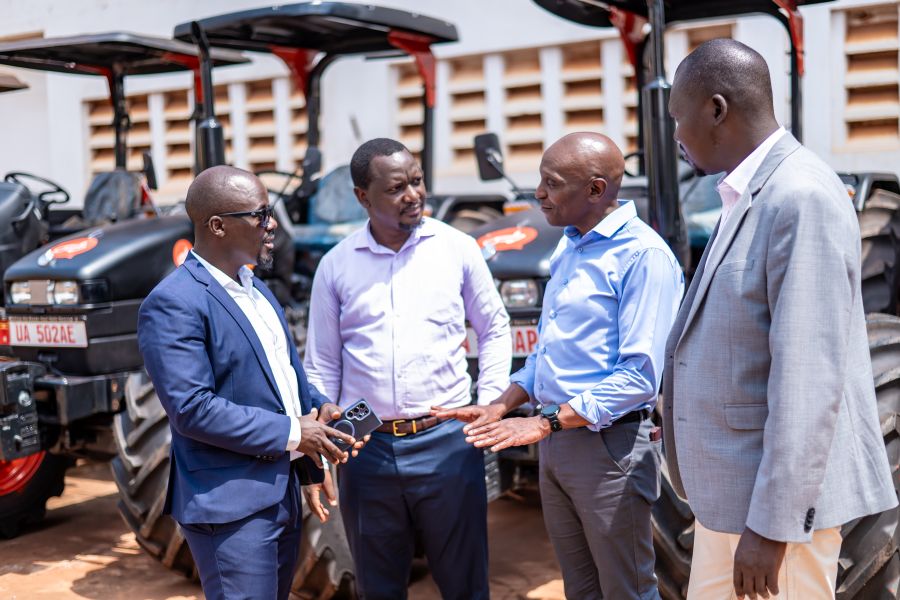
Heifer International has partnered with agri-tech company Hello Tractor to expand access to affordable agricultural mechanization through a Pay-As-You-Go (PAYG) tractor financing model targeting smallholder farmers and youth entrepreneurs across Uganda.
The partnership was formalized at a handover event held on September 12, 2025, at Mascor Uganda in the Kampala Industrial Area, where ten tractors were delivered to young entrepreneurs enrolled as Hello Tractor booking agents.
The tractors are part of a scale-up initiative under the PAYG model, which allows farmers to access mechanization services without needing collateral.
Hello Tractor, which operates a digital booking platform and installs IoT tracking devices in tractors, enables real-time access and booking of tractor services by smallholder farmers using a mobile phone application.
The PAYG model, backed by Heifer International, provides a sustainable pathway for young agripreneurs to own tractors, repay gradually, and service their communities with much-needed mechanization.
Speaking at the launch, Ronald Wabwire, the Technical Lead for Heifer International Uganda’s Signature Programme, emphasized the role of innovative partnerships in transforming rural agriculture.
“Our partnership with Hello Tractor furthers Heifer International’s mission of ending global poverty and hunger while caring for the earth. By unlocking agri-finance for resource-constrained farmers, we are increasing food production, creating jobs, and improving livelihoods,” Wabwire said.
He noted that since the pilot phase of the Tractors for Africa project began in Uganda in June 2022, Heifer has facilitated access to 26 PAYG tractors through Hello Tractor.
Combined with additional units deployed by Hello Tractor itself, the total number of tractors on the platform now stands at 172. This initiative has created 396 jobs for tractor operators and 576 for booking agents.
To date, over 70,000 smallholder farmers have benefited from mechanization services through the platform, with more than 183,000 acres of land serviced.
Wabwire highlighted that Uganda — like much of Africa — suffers from an extreme shortage of tractors, with fewer than 2 tractors per 1,000 hectares compared to Asia’s average of 10 per 1,000 hectares. With 80% of farming still reliant on hand hoes and 15% on animal traction, only 40% of Uganda’s arable land is under cultivation.
“This situation has contributed to Uganda’s food import bill of USD 1.2 billion annually. Mechanization is not just about efficiency — it’s about food security and economic independence,” he said.
During the event, several beneficiaries of the PAYG model shared testimonies of how access to tractors has transformed their communities and livelihoods.
Ogwang Moses Odongo, a booking agent from Dokolo Youth Oilseed Farmers’ Cooperative Society, said that after supporting his cooperative to acquire a tractor under the PAYG model, he was inspired to apply for one himself.
“Today, I am proud to be among the youth receiving tractors. This opportunity allows me to earn while helping smallholder farmers access timely land preparation services,” he said.
Joshua Waigolo, a young entrepreneur from Kamuli District, said the tractor would fill a long-standing gap in the region, where most commercial machinery prioritizes large-scale sugarcane farms.
“Smallholder farmers in my area can now prepare their land on time and improve yields. The PAYG model makes tractor ownership possible even for people like me who never thought it was attainable,” he noted.
James Macharia, Director of Credit at Hello Tractor Group, commended the success of the PAYG product, noting a loan repayment performance rate of 95% — significantly higher than the 86% average reported by commercial banks.
He attributed this success to favorable loan terms of 36 to 60 months, strong after-sales support, and capacity-building programs for tractor operators and technicians, all delivered in collaboration with Heifer and other ecosystem partners.
“Hello Tractor remains committed to leveraging technology and patient capital to democratize access to mechanization. We believe this model can be scaled across Africa to close the mechanization gap and boost agricultural productivity,” Macharia said.
The initiative is expected to continue expanding in Uganda and other African countries where mechanization remains a major barrier to scaling smallholder agriculture.
The head of operations at Hello Tractor Uganda, Frank Muhumuza said one tractor has a multiplier effect, benefiting over 5,000 farmers.
” We’re changing lives as we make mechanized farming affordable to each and every one in society. We have been able to create over 10,000 jobs here in the form of booking agents, tractor owners, themselves, and the operators. So it’s something that’s changing the landscape. When we are talking about impact, we are looking at enabling financing, which is data and tech enabled,” Muhumuza said.