









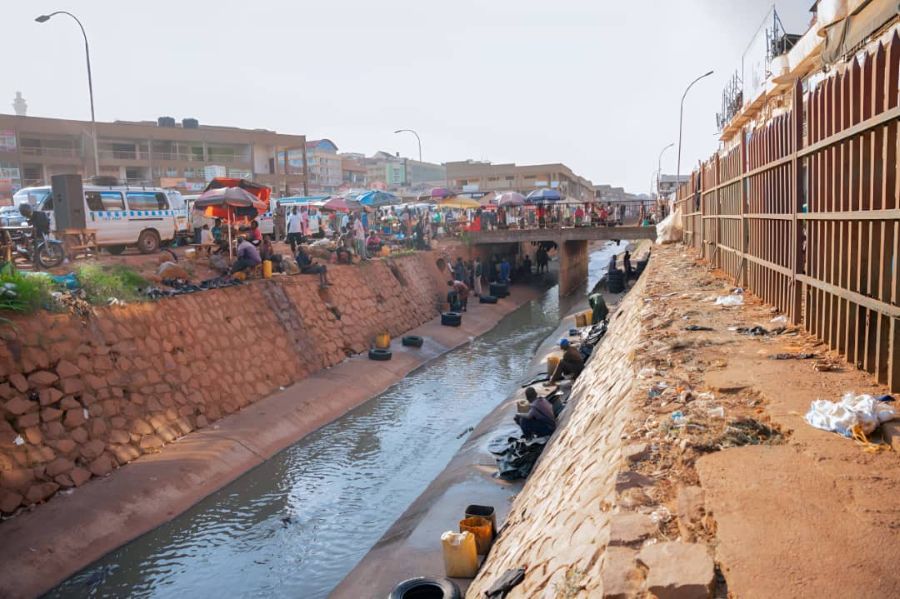
Kampala’s most notorious drainage challenge, the Nakivubo Channel is being reborn as a modern, eco-friendly urban corridor thanks to a bold partnership between city businessman Dr. Hamis Kiggundu (Ham), the Kampala Capital City Authority (KCCA), and technical guidance from the Confederation of African Football (CAF) and CHAN inspection teams.
For decades, Nakivubo Channel, which snakes through the city’s central business district, has been synonymous with floods, pollution, and danger.
Today, it stands at the center of an ambitious redevelopment drive that promises to transform it into a safe, green, and smart urban space ahead of Uganda’s hosting of the Africa Cup of Nations (AFCON) in 2027.
Recent inspection teams from CAF have already praised the progress of the works, emphasizing that upgrading Nakivubo to international standards is essential for Kampala’s readiness to host Africa’s most prestigious football tournament.
Their recommendations are now guiding the project’s roll-out to ensure it delivers both environmental safeguards and world-class infrastructure.
KCCA, which is providing technical oversight and aligning the initiative with the city’s drainage master plan, has welcomed the public-private partnership as a blueprint for solving Kampala’s toughest challenges.
“The collaboration between public institutions and private investors such as Hamis Kiggundu is exactly what Kampala needs to address long-standing urban challenges. This is not only about AFCON; it is about leaving a permanent legacy of safety, beauty and functionality for city residents,” said a KCCA official.

For Ham, who is financing the redevelopment, the project goes beyond infrastructure.
“Nakivubo Channel has been a source of floods, insecurity and loss of life for too long. This redevelopment is about giving Kampala a clean, safe and modern urban drainage system. It’s a responsibility we owe our people, and a statement that Uganda is ready for the future,” he said.
Once complete, the new Nakivubo Channel will feature underground flood-control chambers, advanced waste-filtration systems, pedestrian-friendly walkways, and landscaped green spaces. What was once a scar running through Kampala will instead become a symbol of smart city design, resilience, and pride.
Urban planners and residents alike are hailing the initiative as a model of self-driven development, powered by local investment rather than foreign aid.
It is being celebrated not just as a solution for Kampala’s flooding woes, but also as a statement of national ambition and innovation.