









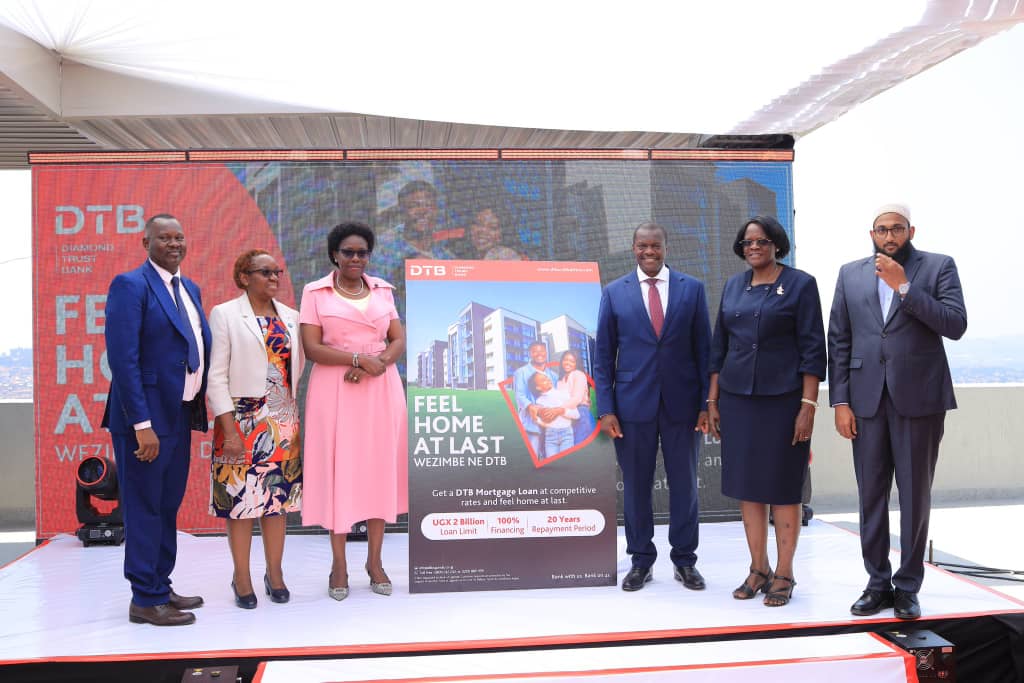
Lands, Housing and Urban Development Minister Judith Nabakooba has challenged real estate developers and financial institutions to design affordable housing and mortgage products tailored to Uganda’s vast informal sector, saying millions of hardworking Ugandans are being locked out of home ownership by conventional lending requirements.
Speaking at the launch of the DTB Mortgage Finance Solution at Emerald Residence in Mutungo on Wednesday, Nabakooba said Uganda’s housing crisis cannot be resolved if mortgage financing remains accessible only to formally employed workers.
“Do not look only at the top five percent in formal employment. Design products that recognize cash flows in our informal sector—the traders, the women and the youth who drive our economy but lack the traditional payslip,” Nabakooba said.
“The traditional payslip is not easy, but there are those people who are trying to earn a living and are also looking forward to home ownership. If you can help design products for them too, that will be very good for us.”
The minister said Uganda faces a housing deficit of 2.4 million units, with fewer than 40,000 active mortgages serving a population of about 45 million people. Mortgage penetration, she noted, remains below one percent of the country’s Gross Domestic Product (GDP).
According to Nabakooba, the low uptake of mortgages is driven by high interest rates, insecure land tenure, difficulties in verifying income for workers in the informal sector, and banks’ reliance on short-term deposits to finance long-term home loans.
She said the government is implementing reforms aimed at expanding access to housing finance, including the proposed Mortgage Refinance Institution Act, the Valuation Act, and the continued digitisation of land records to simplify transactions and reduce fraud.
Nabakooba also urged DTB to expand mortgage financing beyond Kampala to emerging cities such as Lira, Gulu, Mbarara, Mbale, Jinja, Arua and Soroti.
“These cities are starving for structured real estate financing. Be the financial institution of choice that anchors home ownership in these new regional hubs,” she said.
She reiterated that the government would continue investing in infrastructure—including roads, water, electricity and sewerage—to support large-scale housing developments through public-private partnerships.
DTB Uganda Chief Executive Officer Godfrey Ssebaana said the bank developed the mortgage solution after recognising that access to long-term and affordable housing finance remains one of Uganda’s biggest development challenges.
“We are not only here to launch a mortgage product, but we are here to solve a housing problem,” Ssebaana said.
He said the bank is offering mortgage financing with repayment periods of up to 20 years and interest rates ranging between 15 and 20 percent, depending on a borrower’s risk profile.
Ssebaana also challenged property developers to build homes that are affordable to ordinary Ugandans instead of focusing primarily on high-end developments.
“The clarion call is for you to put up products that are relevant to our different classes. We can also avail homes for a Ugandan whose earnings come in on a daily basis,” he said.
He added that DTB would finance both home buyers and property developers to increase the supply of affordable housing.
“We remain committed to delivering innovative financial solutions that improve livelihoods, support sustainable economic growth and create lasting value for our customers,” Ssebaana said.
Godfrey Lule, Sales and Marketing Manager at Bakaima Real Estate Agents, said Uganda’s real estate sector continues to grow steadily and that initiatives such as the newly launched mortgage finance solution will make it easier for more Ugandans to own homes.
He also appealed to the Ministry of Lands, Housing and Urban Development to expedite land transaction processing, saying faster approvals would improve efficiency in the property market.
Lule said Bakaima has deliberately introduced flexible payment plans to enable low-income earners to access land and housing opportunities.
“Low-income earners are welcome at Bakaima. We have payment plans starting from Shs10,000 per day or Shs300,000 per month. With this arrangement, a person can acquire land worth Shs13 million,” he said.
He added that the company has partnered with manufacturers of construction materials, including cement and clay product suppliers, to make home construction more affordable.
“To ensure no one is left behind, we have partnered with manufacturers and established an online hardware platform where customers can save money gradually. Once they have accumulated enough funds, they can begin purchasing construction materials and start building their homes,” Lule said.
The DTB Mortgage Finance Solution aims to help address Uganda’s housing deficit by providing long-term financing to property developers and affordable mortgage options for individuals and corporate employees.
The initiative is expected to boost the supply of quality housing, expand access to home ownership, and enable more Ugandans to build long-term wealth through property ownership.