










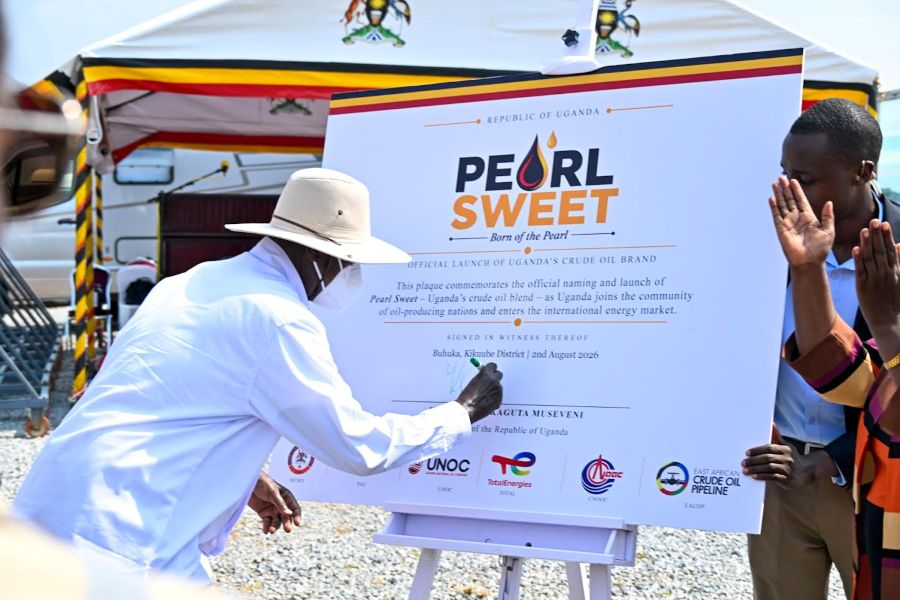
President Museveni has explained why Uganda’s crude oil has been named “Pearl Sweet”, saying the name combines the country’s identity as the Pearl of Africa with the low sulphur content of its crude.
Museveni unveiled the name on Wednesday, September 2, during a visit to the Kingfisher Development Area in Kikuube District, as Uganda moves closer to commercial oil production.
The President described the occasion as the “christening” of Uganda’s oil, marking a symbolic milestone after years of exploration and development.
“We are here to celebrate and give this baby (oil) a name. These people have told me to name this baby Pearl Sweet Petroleum,” Museveni said.
He explained that the word “Sweet” has a technical meaning in the petroleum industry and refers to crude with relatively low sulphur content.
“We call it sweet because it does not have sulphur. When it has sulphur, it is more expensive to remove the sulphur. This one either has little or no sulphur,” he said.
Crude oil with low sulphur is generally easier and less costly to refine than high-sulphur, or “sour”, crude. Uganda’s crude is also described as waxy, meaning it requires heating to remain fluid during transportation.
The word “Pearl”, meanwhile, draws from Uganda’s long-standing description as the “Pearl of Africa”, giving the crude a distinctly Ugandan identity as it prepares to enter international markets.
Energy and Mineral Development Minister Dr Monica Musenero said the name reflects both the characteristics of Uganda’s crude and the country’s identity.
She explained that “Sweet” refers to the crude’s very low sulphur content, which makes it cheaper to refine, while “Pearl” reflects Uganda’s long-standing identity as the Pearl of Africa.
“For many years, petroleum in Uganda was an aspiration; something discovered, studied, debated and planned for. Today, that resource is being translated into productive assets, infrastructure, skills, businesses and, very soon, commercial production,” Dr. Musenero said.
She described the milestone as a testament to President Museveni’s long-term vision and persistence in developing Uganda’s petroleum sector.
The naming comes as Uganda prepares to move from petroleum development to production and commercialisation. The country’s crude will be produced from the Kingfisher and Tilenga projects and transported through the 1,443-kilometre East African Crude Oil Pipeline to Tanga in Tanzania for export.
At Kingfisher, operated by CNOOC Uganda Limited, the Central Processing Facility has reached mechanical completion and is designed to handle up to 40,000 barrels of crude oil per day. Authorities say commissioning activities are underway as the project approaches first oil.
For Uganda, the name gives its crude a recognisable identity ahead of its entry into the international oil market, where crude grades are distinguished according to their origin and characteristics.
But for Museveni, the significance of Uganda’s oil extends beyond the name or the start of production. He has repeatedly argued that petroleum revenues should be used to support industrialisation and develop durable infrastructure rather than finance consumption.
“The petroleum industry would push us very far,” the President said, pointing to the planned refinery and other investments that he says could strengthen Uganda’s productive capacity.
He also reiterated that Uganda would prioritise the use of associated gas from Kingfisher for electricity generation and liquefied petroleum gas production rather than flaring it.
President Museveni also emphasised that Uganda’s planned oil refinery remains a priority alongside the East African Crude Oil Pipeline (EACOP).
He said refining crude oil locally would help reduce the cost of petroleum products by eliminating some of the transportation and transit costs associated with importing refined products.
“Our refinery will be one of the most profitable because, first of all, it’s far from the ocean and it does not have the transportation cost which imported oil has. When we refine our oil here, you don’t pay transit charges,” he said.
President Museveni said Uganda would save substantially by refining some of its crude domestically rather than transporting it to the Tanzanian coast.
“When we pump our crude to Tanga, we pay $12.77 per barrel just for transport. When we refine our oil here, we don’t pay that money. We shall no longer spend $2 billion importing petroleum,” he said.
“You can export some of the crude, but the refinery must get priority. That is what is in our agreement,” he added.
The Permanent Secretary in the Ministry of Energy and Mineral Development, Eng. Pauline Irene Batebe, said the Kingfisher project was about 80 per cent complete, with first-oil readiness at 98 per cent and commissioning tests underway.
She said first oil was expected by the end of September.
“Its Central Processing Facility has reached mechanical completion and is built to handle 40,000 barrels a day,” Eng. Batebe said.
The crude produced at Kingfisher is waxy and low in sulphur and solidifies at normal temperatures, requiring it to be kept hot during transportation.
It will be transported to Tanzania’s Tanga Port through the 1,443-kilometre East African Crude Oil Pipeline, which will be heated along its entire length. The pipeline was 92.7 per cent complete, according to Batebe.
CNOOC Uganda Limited President Liu Xiangdong said the progress at Kingfisher was the result of years of investment, partnership and commitment, including support from the Ugandan Government.
“Your Excellency, when we look around Kingfisher today, we can see how far this project has come. What we see here is the result of many years of hard work, partnership and commitment. It is also a reflection of the support and guidance we have received from the Government of Uganda,” Xiangdong said.
He said CNOOC’s objective was to develop the resource while protecting the environment and working closely with surrounding communities.
“CNOOC Uganda Limited remains committed to working with the Government of Uganda, its partners and the communities around Kingfisher to deliver a safe, responsible and sustainable development that creates lasting value for Uganda,” he said.
Prime Minister Robinah Nabbanja said Uganda’s oil programme had contributed to significant development in the Bunyoro sub-region, including the construction of Kabalega International Airport, Kabalega Industrial Park, more than 500 kilometres of tarmacked roads and upgraded health facilities.
She described President Museveni’s visit to Kingfisher as an opportunity to assess progress on a vision he initiated decades ago, recalling his decision after coming to power in 1986 to send young Ugandans abroad to acquire expertise in the petroleum sector.
The Chinese Ambassador to Uganda, Wu Guangrong, reaffirmed China’s commitment to strengthening bilateral cooperation with Uganda, particularly in oil and gas, trade, infrastructure, investment and other areas of economic development.
He said cooperation should extend beyond resource extraction to include skills development, employment, local content and industrialisation.