







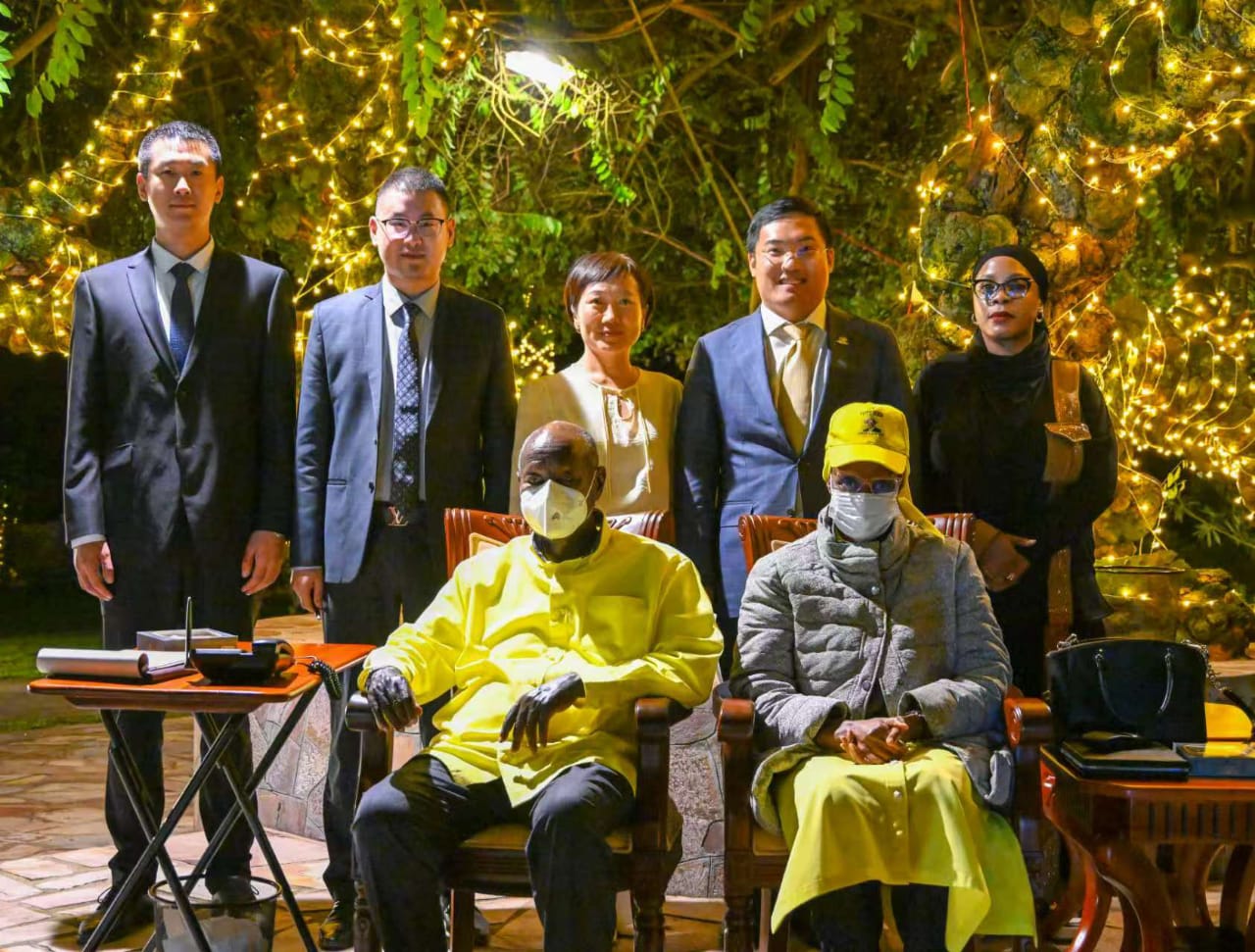
President Yoweri Museveni has approved a proposal to establish a second industrial park in Uganda, following a briefing from developers of the China-Uganda Mbale Industrial Park.
President Museveni and First Lady Janet Museveni hosted a delegation led by Ms. Lucy Zhang, Chief Executive Officer of the park’s developer, at their country home in Rwakitura on Friday evening. During the meeting, Ms. Zhang updated the President on progress at the Mbale facility and formally expressed the company’s intention to expand by setting up another industrial park at a new location.
The President welcomed the proposal and assured the investors of full government support to facilitate the expansion.
“Tonight, a team from the Mbale Industrial Park led by Ms. Lucy Zhang called on Mama Janet and me at Rwakitura. They updated us on progress at the park and informed us of their intention to set up another industrial park. I welcome their plan and assure them of our support,” Museveni said in a post on X (formerly Twitter).
The 619-acre China-Uganda Mbale Industrial Park, located in Mbale City in eastern Uganda, has been a key pillar of the government’s industrialization strategy since it became operational in 2018. By the end of 2025, the park is expected to host about 75 factories and employ more than 12,000 Ugandans.
Developers say four additional factories—specializing in steel, textiles, electronics, and paper production—are scheduled to begin operations in August 2025. The project has also benefited from major infrastructure investments, including a $2.5 million wastewater treatment facility, improved power supply, and upgraded road networks aimed at mitigating flooding.
With total investments estimated at $2.5 billion, the park manufactures a wide range of products, including glass, detergents, mobile phones, LED bulbs, and baby diapers.
Raw materials are sourced from both Uganda and China, with developers emphasizing alignment with the government’s Buy Uganda, Build Uganda (BUBU) policy by increasing the use of locally available inputs. Products from the park are sold domestically and exported to regional markets such as Kenya, Tanzania, South Sudan, the Democratic Republic of Congo, and Rwanda.
Speaking at an inauguration ceremony in late August, President Museveni reiterated that Uganda’s industrialization agenda hinges on attracting investors capable of creating jobs and supporting import substitution.
“As a nation, we must focus on sectors that generate wealth and employment for our people. This will also address the need for import substitution, especially for consumer and commercial goods,” Museveni said.
Among the flagship projects at the park are Uganda United Steel Investment Co. Ltd. and Xinlong Textile & Garment Technology Co. Ltd. The President also laid foundation stones for nine additional projects, including Hercules Automobile Manufacturing Co. Ltd. and Changjiang Industry.
Museveni further disclosed that Chinese investors are seeking an extra 500 acres of land to expand the Mbale park and called on local communities to cooperate with authorities to make the land available.
The proposed second industrial park aligns with the President’s broader vision of transforming Uganda from a trading economy into an industrialized nation. Museveni has pledged to develop similar industrial hubs in Masaka, Kyotera, and Kalungu to promote value addition and create employment opportunities, particularly for the youth.