






President Yoweri Kaguta Museveni has cautioned traditional and cultural leaders against meddling in politics, saying their primary responsibility should be preserving cultural heritage, promoting national unity and guiding their communities rather than engaging in political and administrative affairs.
Museveni argued that political leadership should remain the responsibility of elected representatives who are accountable to voters, noting that traditional leaders, whose positions are generally inherited, should not seek to exercise similar political authority.
“Therefore, no traditional leader should try to meddle in politics. As a cultural leader, you are a parent with grown-up children, the voters. Let them run their affairs,” Museveni said.
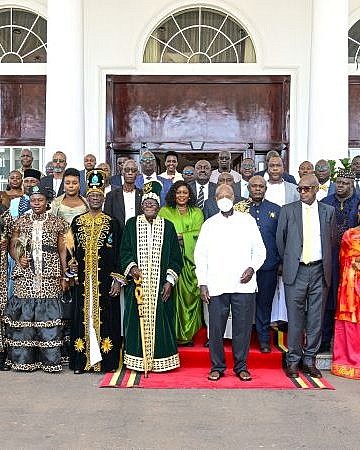
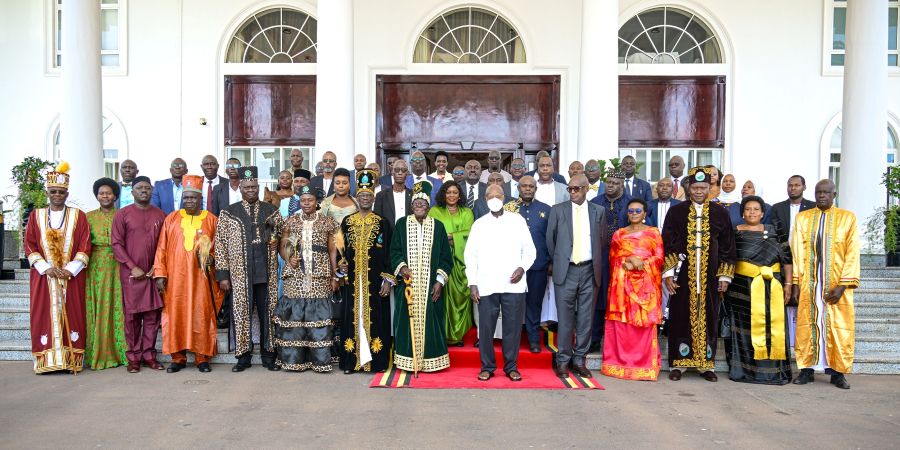
He made the remarks on Wednesday while addressing kings and other cultural leaders from across Uganda at the Cultural Leaders Conference held at State House, Entebbe.
The two-day conference, which concludes on Thursday, November 5, 2026, brought together heads of various cultural institutions to discuss their contribution to national unity, heritage preservation and development.
The President said responsibilities such as policy formulation, legislation and public administration should be left to elected political leaders, while adjudication should remain the responsibility of professional judges.
He explained that elected leaders derive their authority from the electorate and can be removed through elections if they fail to fulfil their responsibilities, unlike traditional leaders whose positions are largely determined by hereditary succession.
“Who does policy, and why? They had to withdraw from policy formulation, legislation, administration and adjudication. It is because one class of responsibilities belongs to the elected leaders: policy, administration and legislation, and the other cluster belongs to the professional judges,” he said.
To illustrate his position, Museveni compared the relationship between cultural leaders and their subjects to that between parents and their adult children, arguing that parents should allow their grown-up children to manage their own households unless they seek guidance.
“I do not try to run Muhoozi’s or my daughters’ homes. They are my children, but I cannot go, ‘You do this here.’ Me, I finished my job. I brought them up. Unless they come and beg me for advice, otherwise I am not available,” he said.
The President also revisited the political disagreements that preceded the abolition of kingdoms under former President Milton Obote, accusing the former leader of initially promising to support federalism before using force to abolish traditional institutions.
Museveni said he disagreed with Obote’s approach, contrasting it with that of former Democratic Party leader Benedicto Kiwanuka, whom he credited with openly explaining to kingdoms the political arrangements that were acceptable and those that were not.
“Obote pretended that he would support tribal federalism and then used force to abolish the kingdoms without even discussion. That was why I didn’t agree with Obote,” Museveni said.
He explained that cultural institutions had to relinquish certain responsibilities to avoid conflicts with the country’s political and administrative structures and to allow Uganda to pursue what he described as five historical missions.
Museveni further urged cultural leaders to promote national integration, arguing that tribal chauvinism and limited integration had weakened indigenous societies.
He noted that traditional African communities had developed strong foundations in agriculture, livestock keeping, craftsmanship, medicine and other specialised occupations, which he said should be preserved and promoted as part of Africa’s heritage.
He emphasised that cultural institutions have an important responsibility to safeguard indigenous languages, cultural practices and traditional knowledge while allowing elected leaders to manage political and administrative affairs.
“Our cultural leaders have an important role in preserving our languages, culture and indigenous knowledge, while leaving politics and administration to elected leaders,” he said.
The President also called for greater patriotism and Pan-Africanism, arguing that Uganda and Africa provide a broader foundation for the prosperity and development of their people.
The conference brought together kings and other traditional leaders representing cultural institutions across Uganda to discuss the role of traditional leadership in preserving heritage, strengthening national cohesion and supporting the country’s development agenda.