









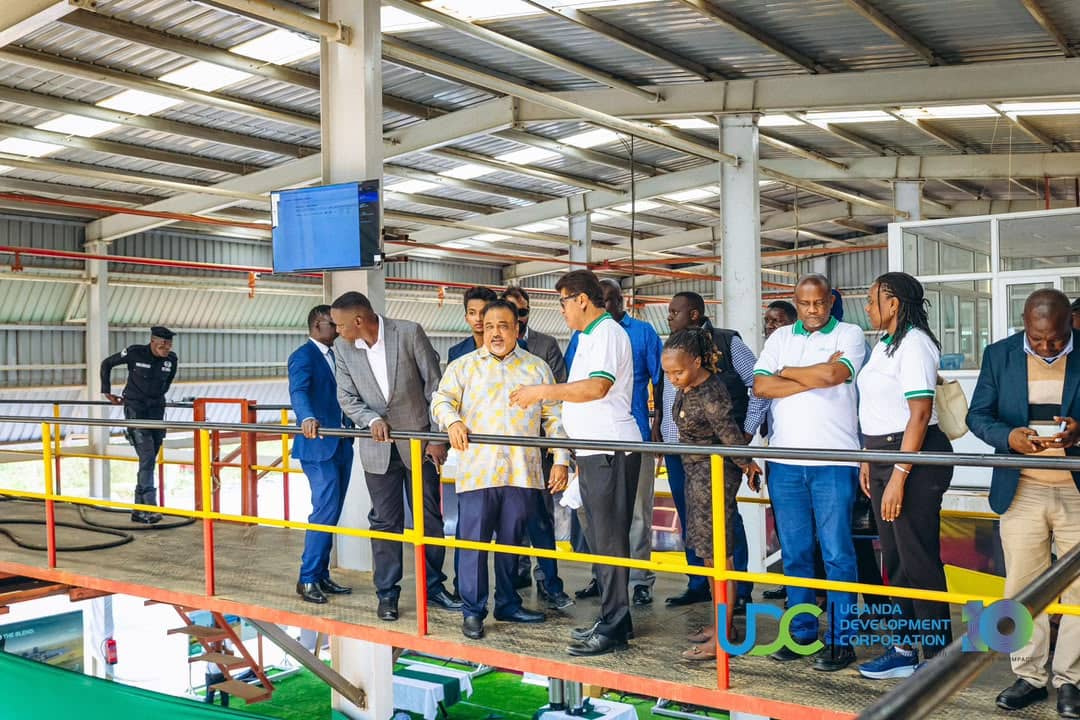
Uganda’s efforts to transform agricultural produce into industrial products have received a boost following the commissioning of an ethanol-petrol blending plant by Bukona Agro-Processors Limited in Malaba, Tororo District.
The facility, commissioned by Minister of Trade, Industry and Cooperatives Sanjay Tanna, is expected to increase the use of locally produced ethanol in petrol while creating additional demand for maize, cassava and other agricultural produce supplied by Ugandan farmers.
The investment, supported by the Uganda Development Corporation (UDC), marks another milestone in the government’s drive to promote agro-industrialisation, reduce fuel imports and develop industries that utilise locally available raw materials.
Speaking at the commissioning ceremony, Tanna said Uganda could no longer afford to export agricultural produce in its raw form when the same products could be processed into valuable industrial inputs.
He identified cassava and maize as crops with significant industrial potential, particularly in regions where farmers have previously struggled to find reliable markets for their produce.
“In 2021, when I campaigned in Northern Uganda and Northeastern Uganda, there was a lot of cassava that was rotting in Katakwi, Kaberamaido, Amuria, Nwoya, Pader and across the Lango, Acholi and Teso sub-regions. We had cassava but there was no market,” Tanna said.
He noted that ethanol production was helping address this challenge by creating an additional market for agricultural produce that can be processed into fuel.
Tanna also urged Bukona to improve the prices it pays farmers as the company expands its operations, emphasising that industrial growth should translate into better incomes for agricultural producers.
“I would like to ask that as the company prospers, the plea of the Members of Parliament be heard that the final price given to the farmers is enhanced as the company grows,” he said.
UDC Executive Director Patrick Birungi said the facility demonstrates how investment in local industries can strengthen the linkages between agriculture and other sectors of the economy.
He explained that ethanol produced from cassava, maize and molasses is now being used in petrol blending, creating a market for farmers while reducing Uganda’s dependence on imported fuel.
“The significance of this plant goes beyond Bukona. It links Uganda’s farms to its fuel supply,” Birungi said.
He described farmers as central to the success of the investment, noting that the consistent supply of fuel-grade ethanol depends on their ability to deliver adequate quantities of agricultural raw materials.
“The day they stop farming, the fuel will stop flowing. So the farmers are the engine of this fuel blending facility,” he said.
Birungi added that UDC would continue working with Bukona to expand its operations, including exploring opportunities to establish a zero-waste production facility that would convert manufacturing waste into other useful products.
The partnership between the two institutions dates back to 2021, when UDC acquired a 28.5 per cent shareholding in Bukona to help revive the company following financial difficulties.
UDC Board Member Jacklyn Makaaru said the corporation’s investment provided working capital that enabled the company to improve its performance, safeguard jobs and diversify its product range.
She said the commissioning demonstrated what public investment could achieve when combined with private-sector expertise and locally available resources.
However, Makaaru challenged the company to maintain sound financial management and high operational standards as it expands its market.
She also emphasised that consistent implementation of the national fuel-blending programme and reliable purchase agreements with fuel marketing companies would give ethanol producers the confidence to increase production and purchase more agricultural produce from farmers.
Bukona Director Bhagyan Kekal said the company, which started operations in 2016, currently produces between 40,000 and 60,000 litres of ethanol per month.
He said the company blends ethanol into petrol at a rate of 3 per cent and has saved more than Shs29 billion through import substitution.
Kekal added that the initiative supports more than 50,000 farmers, particularly in Northern Uganda, by providing a market for their agricultural produce.
He thanked Tanna for providing the land on which the Malaba facility stands, saying the support had enabled the company to expand its operations.
Soroti County MP Patrick Ayeku said the investment should not be measured solely by the volume of ethanol produced but also by the improvements it brings to the livelihoods of farmers and surrounding communities.
He urged Bukona to ensure that farmers supplying maize and cassava benefit from better prices as demand for their produce increases.
“We want to see a change in the price of cassava. We want to see a change in the price of maize,” Ayeku said.
Meanwhile, Hatimu Muyanja, an official from the Ministry of Energy and Mineral Development, said Uganda was targeting an increase in ethanol blending in petrol from the current 3 per cent to 5 per cent by January 2027.
He said the ministry had licensed 14 bioethanol producers with a combined committed production capacity of 134 million litres, although only six were currently operational.
Muyanja noted that the available capacity could support a 10 per cent ethanol blend if all licensed producers achieved full production.
He added that the ministry was working with the Uganda National Bureau of Standards to ensure that blended fuel meets the required quality standards.
Bukona Board Chairman Emmanuel Aliba Kiiza described the conversion of cassava into fuel as a major opportunity for Uganda, saying it was adding value to the crop and creating new uses beyond food production.
He said the development could also support the expansion of clean cooking initiatives as the company continues to promote ethanol as an alternative fuel.