







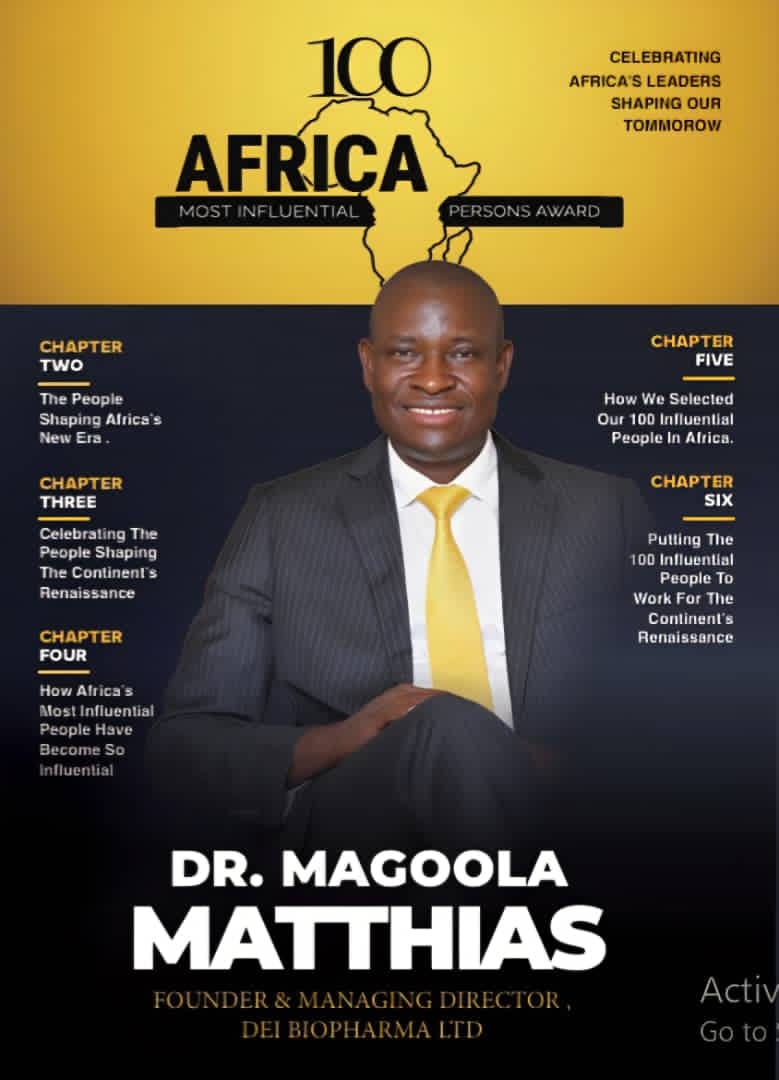
Ugandan scientist and Dei BioPharma founder Dr Matthias Magoola has been named among the 100 Most Influential People in Africa, in recognition of his work in biotechnology and pharmaceutical manufacturing.
Magoola received the recognition at a ceremony in Kigali, Rwanda, on Friday, where organisers cited his leadership in biotechnology and efforts to reduce Africa’s dependence on imported medicines.
His citation recognised what the organisers described as his “visionary leadership and groundbreaking innovations” in healthcare and economic development.
The 100 Africa Most Influential Persons Awards, now in their third year, were organised by the Accra-based Business Executive Media Group in partnership with the International Business Council Africa and the African Chamber for Trade.
This year’s awards were held under the theme “Recognising the People Determining Africa’s Socio-Economic Direction.”
The ceremony at Kigali’s M Hotel brought together award recipients from Uganda, Ghana, Kenya, Tanzania, Malawi, Zimbabwe, Rwanda and other African countries. The honourees represented sectors including business, law, healthcare and community development.
Dr Baroness Paulette Kporo, chairperson of Business Executive Media Group, said the awards recognise individuals whose achievements and positions of influence have contributed to shaping Africa’s economic, political and cultural direction.
“As a region integrated into the global community of nations and the emergent global economy, we honour those who have greatly influenced specific communities, sectors of socio-economic activity, segments of society, or geographical regions,” she said.
According to the organisers, the selection process begins with research conducted by consultants, after which a 12-member jury comprising experts in economic, political, cultural and diplomatic affairs makes the final selection.
The jury considers nominees’ impact at continental, regional and national levels, as well as their contribution to Africa’s engagement with the wider international community.
University of Rwanda Vice-Chancellor Prof Didas Muganga Kayihura presided over the ceremony and called on African institutions to pursue innovation that strengthens the continent’s economies.
Magoola’s recognition comes as African countries seek to expand local production of medicines and vaccines.
Africa remains heavily dependent on imported pharmaceutical products, a vulnerability that became particularly evident during the Covid-19 pandemic. The African Union has set a target for the continent to manufacture at least 60 per cent of its health products by 2040.
Dei BioPharma, founded by Magoola in 2014, is among the companies seeking to contribute to that effort.
The company is developing a 250-acre manufacturing campus in Matugga, Wakiso District, north of Kampala. According to the company, the planned facility will eventually accommodate about 30 factories.
Dei BioPharma says it has submitted 65 product applications to Uganda’s National Drug Authority, with 40 approved for manufacture and 14 approved for sale.
Speaking after the Kigali ceremony, Magoola dedicated the recognition to Uganda and acknowledged the support he said his work has received from the country’s leadership.
“We are grateful for this recognition and for the support from everyone, especially His Excellency President Yoweri Kaguta Tibuhaburwa Museveni,” he said.
He added that he regarded the achievement as recognition for Uganda and its scientists.
The award comes shortly after Dei BioPharma was registered as a manufacturer under the African Pooled Procurement Mechanism on September 1.
The mechanism, operated by the Africa Centres for Disease Control and Prevention (Africa CDC), seeks to aggregate procurement by African governments to create larger and more predictable markets for pharmaceutical manufacturers on the continent.
The company’s listing is valid for five years and allows it to participate in bids for continental supply contracts.
Magoola has described the development as an important step in the company’s transition from infrastructure development towards manufacturing regulated pharmaceutical products for markets beyond Uganda.
The scientist has identified affordable cancer treatment, reducing Africa’s reliance on imported vaccines and developing a new generation of African researchers among his priorities.
Magoola has filed more than 100 patent applications with the United States Patent and Trademark Office covering proposed treatments and vaccines targeting diseases including cancer, HIV/AIDS, Alzheimer’s disease, sickle cell anaemia, malaria, tuberculosis and diabetes.
According to Dei BioPharma, more than 70 of the applications have been published by the US patent office.
In August, Magoola filed seven additional applications relating to a proposed family of mRNA-based cancer vaccines.
The company says the proposed vaccines are intended to target recurring genetic changes found across groups of patients, rather than being developed separately for individual patients.
Another published patent application relates to a proposed vaccine against foot-and-mouth disease, a highly contagious livestock disease that causes significant economic losses among cattle farmers in East Africa.
Magoola has argued that local production of such vaccines could reduce Uganda’s expenditure on imported veterinary vaccines.
The Kigali recognition adds to a series of awards received by Magoola for his work in biotechnology. In 2025, he received the Ratna Pharma Award in India for vaccine research. In December 2024, he was named Researcher of the Year at the International Molecular Biologist Awards, where his work on mRNA-based medicines and vaccines was recognised.