










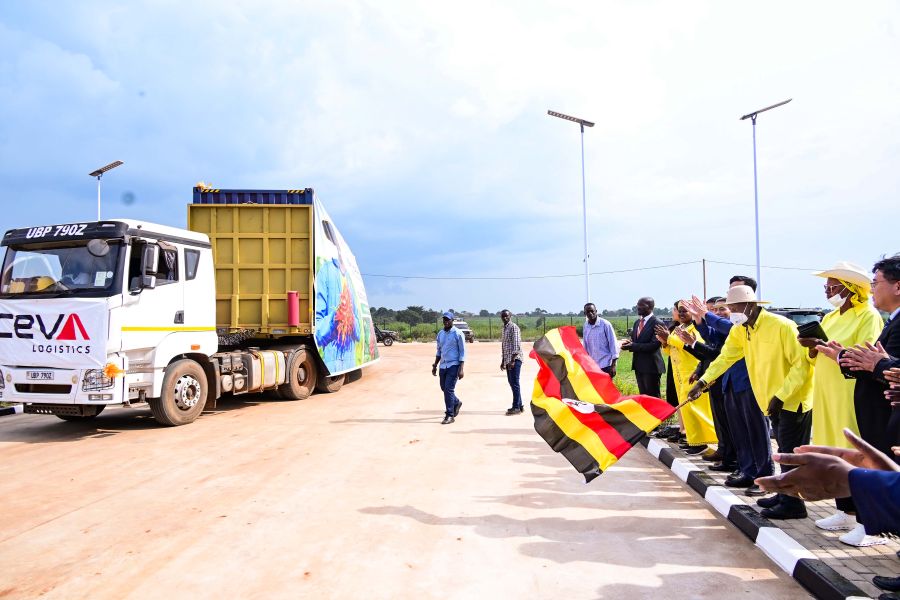
Uganda achieved a major milestone in its agricultural export journey this week , as President Museveni flagged off the country’s first consignment of dried chili bound for China.
The ceremony, held in Bunambo Village, Namasagali Sub-county in Kamuli District, attracted top government officials, diplomats, investors, and farmers who celebrated what many described as a historic breakthrough for Busoga and Uganda’s agro-export sector.
President Museveni, accompanied by the First Lady and Minister of Education and Sports, Janet Kataaha Museveni, presided over the flag-off of three containers carrying 11 tonnes of dried chili.
He hailed China as one of Uganda’s most dependable partners, noting that the export deal aligns perfectly with Uganda’s strategy for agro-industrialization and value addition.
“I would like to congratulate the Republic of China for working with Africa. China has been supporting us since 1949 and has always related with us on equal terms,” he said. “The Chinese are not arrogant. That is why our cooperation is smooth.”
The President described chili as a “gold crop” with the potential to transform household incomes in Busoga, a region that has long battled widespread poverty. He encouraged farmers to embrace chili cultivation, noting that the Chinese market was only beginning to open up.
“These crops—chili—are among the gold mines that we Africans must embrace,” he said. “This is just an introduction. They should buy more and more. If we take this seriously, it will take us very far.”
The First Deputy Prime Minister and Minister for East African Community Affairs, Rebecca Alitwala Kadaga, described the moment as the result of years of lobbying, cooperation agreements, and groundwork with Chinese partners.
She celebrated the government’s support for the chili project but also reminded the President of pending commitments, such as extending electricity to farming communities and establishing an industrial park to support value addition.
China’s Ambassador to Uganda, Zhang Lizhong, congratulated Busoga and the entire country, noting that the chili export marks another milestone in the strong diplomatic and trade relations between Uganda and China. He credited the 2024 chili export protocol signed during the FOCAC Summit in Beijing as a cornerstone of the achievement.
“This event reflects the deep bond between our two countries and our shared commitment to mutual development,” he said. The Ambassador noted that China had expanded zero-tariff access for all products from 53 African nations, including Uganda, and that bilateral trade between the two countries had grown rapidly—reaching USD 1.3 billion by August 2025. Uganda’s exports accounted for about USD 100 million, double the previous year’s figure.
He also highlighted successful ongoing exports such as fish maw and wild aquatic products, and praised the cooperation between the Busoga Consortium for Development and the China–Uganda Agricultural Cooperation Industrial Park, commonly known as Kehong.
The Busoga Consortium for Development, working with Chinese agro-industrial partners, has mobilised thousands of farmers to grow chili and other high-value crops for export. The Consortium’s Director General, Dr. Mula Anthony, emphasized chili farming as a household transformation strategy.
“Chili farming is not just a crop project, it’s a household transformation strategy,” he noted, expressing confidence that Busoga could become Uganda’s leading chili-producing region.
The event was attended by several government officials, including the 3rd Deputy Prime Minister Rukia Nakadama Isanga, the Minister of State for Agriculture Fred Bwino Kyakulaga, local leaders, investors, and delegations from the Busoga Consortium for Development.