








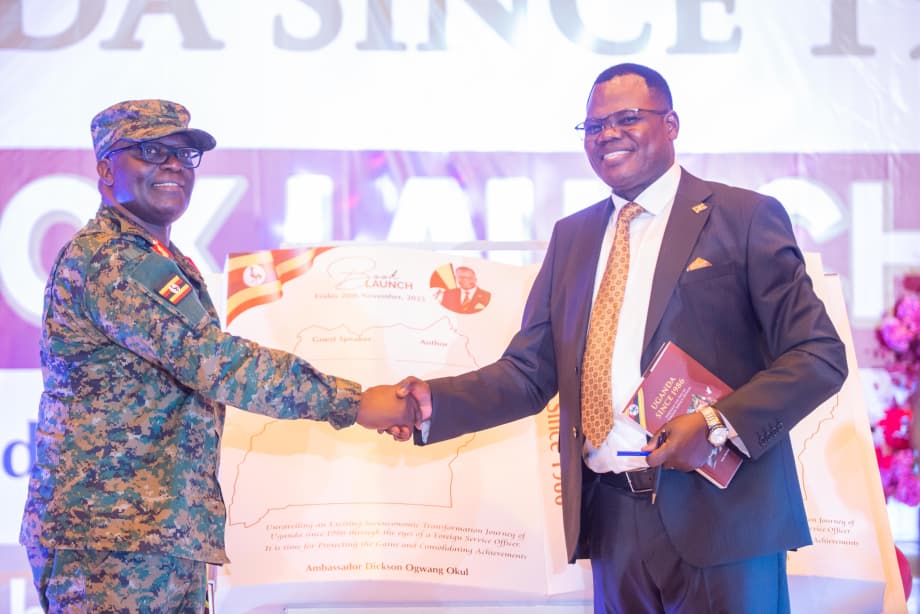
Ambassador Dickson Ogwang Okul has launched a new book, Uganda Since 1986: The Socio-Economic Transformation Journey of Uganda Through the Eyes of a Foreign Service Officer, a publication that examines Uganda’s modern history and development path since the National Resistance Movement came to power.
The book was unveiled at a ceremony held at the Serena Conference Centre and presided over by Brigadier General Paddy Ankunda, representing the Chief of Defence Forces, General Muhoozi Kainerugaba. The event drew senior government officials, diplomats and technocrats, underscoring the national relevance of the publication.
In the book, Ambassador Ogwang blends personal experience with historical and policy analysis to document Uganda’s recovery from the political instability and economic decline that marked the pre-1986 period. He details what he describes as a time of institutional collapse before outlining the policy reforms and leadership decisions that laid the foundation for the country’s recovery.
Ogwang structures Uganda’s transformation into four major phases: stabilisation and recovery in the late 1980s and 1990s; economic expansion and diversification in the 1990s and early 2000s; a shift toward value addition and industrialisation in the 2000s and 2010s; and the current phase focused on knowledge, innovation and technology-driven growth.
Governance emerges as a central theme, with the author likening the state to an orchestra in which the Executive, Legislature, Judiciary and security institutions play complementary roles.
He argues that sustained peace and security have been critical to economic recovery, enabling the revival of education, markets and infrastructure development.
The book also highlights the role of diplomacy in economic transformation. Drawing on his experience in the Foreign Service, Ogwang contends that Uganda’s diplomatic missions should function as platforms for commercial diplomacy, investment promotion and market access, rather than serving only administrative roles.
While acknowledging Uganda’s progress, the author points to persistent challenges, including corruption, inequality and high production costs, which he warns could undermine development gains if not addressed. He calls for stronger accountability and integrity in public service as the country plans for the future.
Positioned within the broader national discourse on safeguarding development gains, Uganda Since 1986 is presented as a civic education resource, particularly for younger generations who have grown up during a period of relative stability. The book adds to the growing body of literature analysing Uganda’s post-1986 trajectory and is expected to interest policymakers, scholars and citizens seeking a deeper understanding of the country’s contemporary political and economic development.