











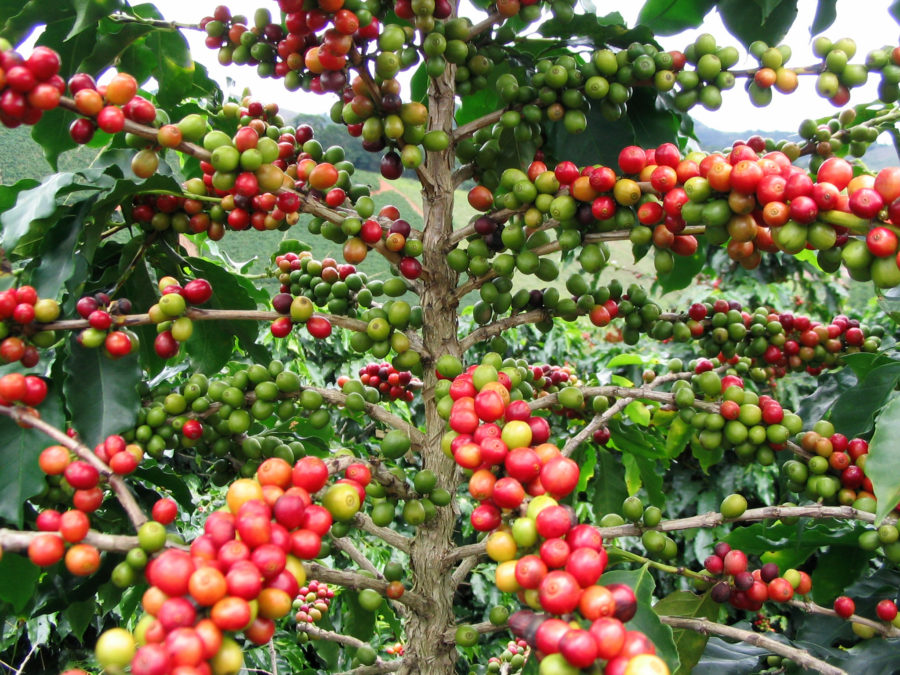
Uganda’s coffee industry is facing a double blow from prolonged drought and falling international prices, with the Ministry of Agriculture linking weather-related production challenges to a sharp decline in coffee exports and earnings.
Agriculture Minister Frank Tumwebaze said prolonged dry spells and unusually high temperatures in major coffee-growing areas have affected flowering, cherry development, bean filling and the quality of coffee produced by farmers.
“Uganda has experienced a prolonged period of drought and unusually high temperatures in several coffee-growing areas, including parts of Greater Masaka, Kyotera, Sembabule, Luwero and other regions,” Tumwebaze said in a statement issued on Sunday.
He said the resulting water stress has reduced processing out-turn in affected areas by an estimated 10% below the normal average, with the impact now being felt across the national coffee value chain.
The production challenges come as international coffee markets face downward pressure from increased supplies from major producers, particularly Brazil and Vietnam.
Tumwebaze said Uganda’s coffee exports dropped from 997,105 60kg bags in July 2025 to 846,376 bags in July 2026, representing a 15% decline.
Export earnings also fell from US$250.7 million (about Shs902.5 billion) to US$204.1 million (about Shs734.8 billion), a decline of about 18.6%.
The Minister said the reduced supply has coincided with increased caution among traders, who are now paying greater attention to coffee quality.
“Consequently, traders are becoming more cautious and selective in the way they offer prices to different quality categories. Farmers bringing well-dried, properly harvested and good-quality coffee may be offered a substantially better price than one bringing immature, poorly dried or mixed coffee,” he said.
The decline in global prices has also filtered into Uganda’s farm-gate market.
The Ministry said prices for Robusta FAQ, considered the more appropriate benchmark for commercial-quality coffee, fell from Shs13,500–14,000 per kg in September 2025 to Shs11,500–12,000 per kg in the first half of September 2026.
This represents a decline of about 14.5%.
Robusta Kiboko prices also dropped from Shs6,000–7,000 per kg to Shs5,000–6,000 per kg over the same period.
However, the impact has not been uniform across coffee varieties. Arabica parchment prices increased from about Shs14,500 per kg in 2025 to approximately Shs15,750 per kg this year, representing an 8.5% increase.
Tumwebaze said lower Robusta prices should not automatically be interpreted as farmers making losses because profitability also depends on production costs, productivity, quality and post-harvest handling.
“A decline in price is not the same thing as making a loss,” he said.
According to the Minister, government coffee-farming business models indicate that farmers who improve productivity and undertake basic value addition can break even when the price of FAQ reaches Shs7,000 per kg. However, farmers affected by severe drought can still suffer considerable financial losses.
The weather and supply concerns are also affecting the cocoa business, with international cocoa prices recently experiencing sharp corrections.
Tumwebaze said the correction has largely been driven by expectations of increased supplies and higher inventories, with increased production and shipments from Côte d’Ivoire contributing to the movement.
He said fluctuations in both commodities should not be interpreted as a disappearance of global demand.
“Coffee and cocoa are internationally traded commodities. Their prices in Uganda are, therefore, influenced not only by what happens on our farms, but also by production, inventories, weather, shipping, currencies, consumption and buying decisions in major producing and consuming countries,” Tumwebaze said.
With weather emerging as a major risk to production and farmer incomes, the government says it is shifting greater attention towards climate resilience.
Tumwebaze said the Ministry of Agriculture, Animal Industry and Fisheries is working with the Ministry of Water and Environment and other government agencies to expand irrigation for agricultural production.
“We shall continue to scale up irrigation schemes across the country and promote smaller and farmer-managed irrigation systems,” he said.
The government is also distributing fertilisers and other productivity-enhancing inputs in key producing regions, while farmers are receiving improved planting materials, technologies and water-management practices under the Climate Smart Agricultural Transformation Project.
Tumwebaze said restoring production after the drought remains a priority, while the Ministry will continue monitoring international and domestic coffee and cocoa prices.
He urged farmers not to panic or harvest immature coffee, saying better harvesting, processing and grading can help them secure higher returns even when international markets are under pressure.
“To our farmers, do not panic. Do not harvest immature coffee. Do not compromise quality. Farmers can increase their returns considerably by moving from raw Kiboko into better processed and graded coffee,” Tumwebaze said.
The Minister said the government expects global supply, weather and production conditions in major producing countries to remain key drivers of coffee and cocoa prices over the next six months, while Uganda works to restore production and strengthen farmers’ resilience to climate shocks.