








Uganda and Somalia have signed a labour agreement aimed at regulating the employment of Ugandan citizens in Somalia and strengthening protections against workplace exploitation.
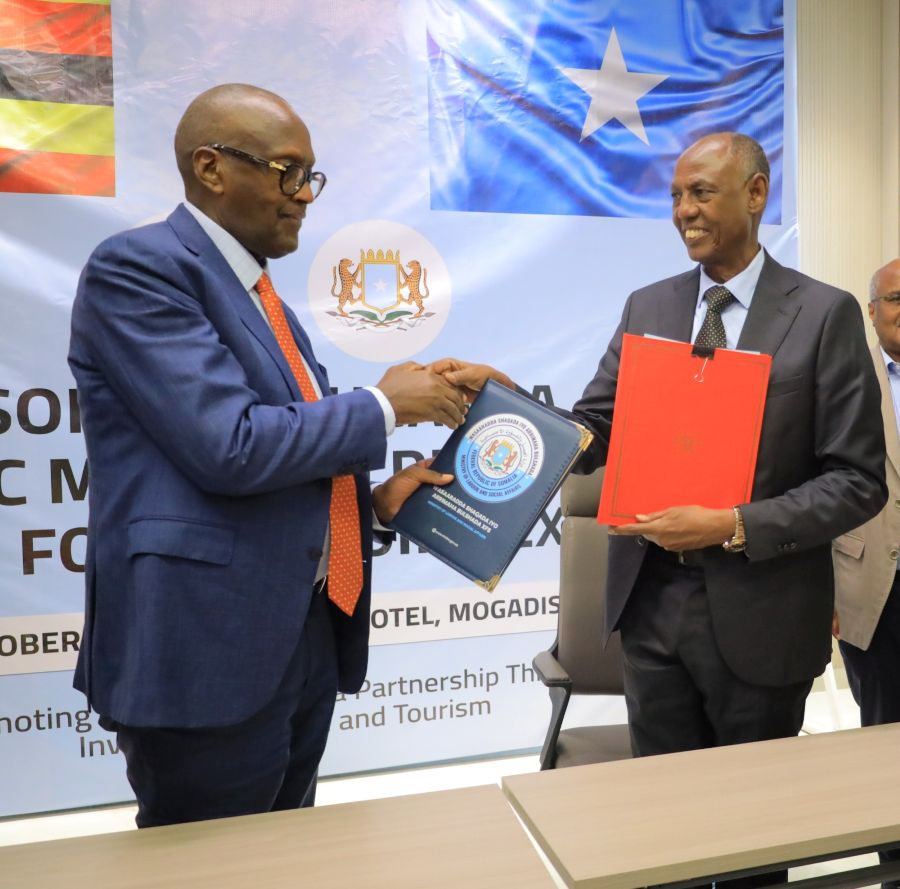
The agreement was signed in Mogadishu on Thursday by Gen. Henry Tumukunde, Uganda’s Minister of Gender, Labour and Social Development, and Prof. Salim Alio Ibro, Somalia’s Minister of Labour and Social Affairs.
The signing took place on the final day of the mid-term review of the Uganda–Somalia Joint Permanent Commission (JPC).
According to Uganda’s Ministry of Foreign Affairs, the agreement establishes a framework for regulated recruitment, fair employment practices and the protection of workers’ rights.
The ministry quoted Tumukunde as saying that goodwill between the two countries must translate into practical commitments that improve the welfare of their citizens.
Uganda estimates that more than 20,000 of its citizens are working in Somalia, with many employed in education, healthcare, logistics and private security.
Officials who attended the talks said Tumukunde highlighted several challenges facing Ugandan workers in Somalia, including unlawful dismissals, unpaid benefits, confiscation of passports and restrictions on communication with families.
He also raised concerns about unpaid visa arrears, the denial of return tickets, employment without contracts or valid permits, and recruitment through foreign employment agencies that are not registered in Somalia.
The agreement introduces requirements intended to improve transparency in recruitment and ensure that workers understand their employment terms before travelling abroad.
Under its provisions, workers must be at least 21 years old and have a written employment contract signed before departure. The contract must also be registered with the host country’s labour ministry upon arrival.
Any changes to the terms of employment must be made in the worker’s favour.
The agreement places several obligations on employers, including payment of visa costs, transport to and from the workplace, and a return trip home every two years.
Employers will also be required to pay salaries into bank accounts held in workers’ names, provide payslips and insure employees against death and disability.
The provisions prohibit forced labour and the confiscation of workers’ passports. They also protect employees’ rights to communicate with their families and respective embassies.
Workers will be allowed to change employers if they are not provided with the work they were promised under their contracts.
In cases where a worker dies in Somalia, the agreement provides for the repatriation of the body at the request of the family.
Uganda, in turn, is required to ensure that workers recruited for employment in Somalia have no criminal records, have undergone medical examinations and are not subjected to excessive recruitment charges.
The labour agreement will take effect after both governments confirm that the necessary internal approval procedures have been completed.
It will remain in force for three years and will be automatically renewed, according to the terms outlined in the agreement.
The arrangement is expected to provide a formal framework for managing labour migration between the two countries and addressing disputes involving recruitment agencies and employers.
The labour deal forms part of broader efforts by Uganda and Somalia to strengthen bilateral relations through the Joint Permanent Commission.
During the commission’s second session in Kampala in October 2025, the two countries signed agreements covering security, education and immigration management.
According to Uganda’s Ministry of Foreign Affairs, both governments have committed to fully constituting a Joint Permanent Investment and Business Council by November 30, 2026.
Uganda is also expected to submit a draft agreement on finance and banking by the same date, while a meeting between the two countries’ trade ministries is scheduled to be hosted by Uganda by February 2027.
The commitments are intended to broaden cooperation beyond security to include investment, trade and financial services.
Uganda has played a significant role in international security operations in Somalia, becoming the first country to deploy troops to Mogadishu in 2007 under the African Union mission.
Uganda has stated that it intends to complete the withdrawal of its troops by August 1, 2027.
Somalia is scheduled to host the third session of the Uganda–Somalia Joint Permanent Commission in 2027, with both countries expected to review implementation of their bilateral commitments annually.
The labour agreement marks a further step in the two countries’ relations, with its implementation likely to be central to efforts to improve the welfare and legal protection of Ugandans working in Somalia.