










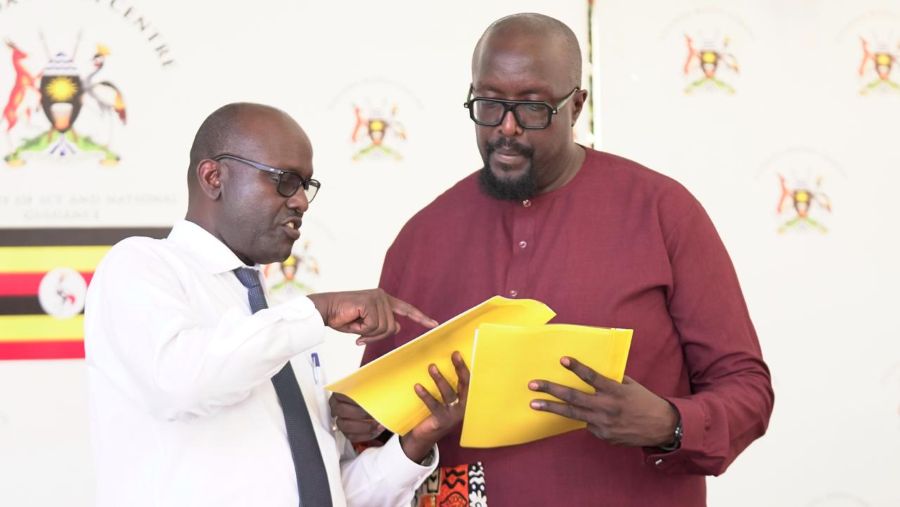
Newly appointed Uganda Media Centre Executive Director Allan Kasujja has unveiled an ambitious reform agenda aimed at transforming government communication into a more coordinated, impactful, and development-driven function.
In his first remarks after assuming office, Kasujja signaled a clear break from the past. “This is not just a mere change of guard. This is a fundamental change. It is not business as usual,” he said.
He described Uganda as being at a critical juncture, emphasizing that how the country communicates its story will shape its future. “Uganda is at an inflection point, and the story we tell about our country—and how we tell it—will shape the decade ahead,” he noted.
Kasujja linked communication directly to Uganda’s long-term development ambitions, including the target of tenfold economic growth under Vision 2040. He said the strategy, anchored on agro-industrialisation, tourism, mineral development, and science, technology and innovation, requires deliberate and effective communication.
“A vision this powerful demands communication that is equally powerful. Citizens across the country must understand and believe in this plan,” he emphasized.
He stressed that government communication must go beyond traditional public relations. “Government communication is not a public relations exercise. It is nation-building, and it must be taken seriously,” he said.
A key pillar of his agenda is the unification of government messaging. Kasujja warned that fragmented communication across ministries, departments, and agencies undermines credibility and weakens public trust.
“We want to see a government that speaks with one voice. Fragmented messaging is not only inefficient, it erodes public trust—something we cannot afford,” he said, adding that harmonisation across MDAs will be an immediate priority.
He clarified that speaking with one voice is about coherence rather than uniformity. “It is about being heard and understood. It is about building trust and delivering impact,” he added.
Kasujja also underscored the need for stronger institutional support, calling for increased funding to enable the Uganda Media Centre to effectively deliver on its mandate. “The Media Centre needs adequate funding. We should not have to keep asking for resources. We need the support to deliver,” he said.
Beyond structural reforms, he signaled a shift toward development-focused communication, particularly around economic empowerment and livelihoods. “We are not interested in politics. The political season has ended. Our focus now is on development—putting money in people’s pockets and showing young people where the opportunities are,” he said.
He introduced the concept of “stomach infrastructure,” highlighting the importance of addressing everyday needs. “We are focused on ensuring that people are well fed and that families are taken care of. These are the conversations that matter,” he explained.
Kasujja also noted that Uganda has many untold success stories that need to be amplified. “There are many positive developments happening in this country. The challenge has often been how the story is told,” he said.
Reaffirming his vision, he said the Uganda Media Centre will play a central role in shaping the national narrative. “One government, one voice, moving forward together—that is our philosophy. The Media Centre will be the engine room for telling that story,” he said.
The Minister for ICT and National Guidance, Dr. Chris Baryomunsi, welcomed Kasujja’s appointment and emphasized the need for coordinated communication in an evolving media landscape.
“We now have hundreds of radio stations, numerous television channels, and a wide range of print and digital platforms. Social media has further transformed the communication landscape. This evolution makes it necessary to have strong institutions and systems to regulate and coordinate communication,” he said.
Permanent Secretary at the ministry, Dr. Amina Zawedde, also welcomed the appointment, thanking President Yoweri Museveni for entrusting Kasujja with the role.
“Communication today goes beyond government messaging. It is about how the entire country is perceived. This is not just an administrative transition—it is a shift in leadership at a time when public communication matters more than ever,” she said.