











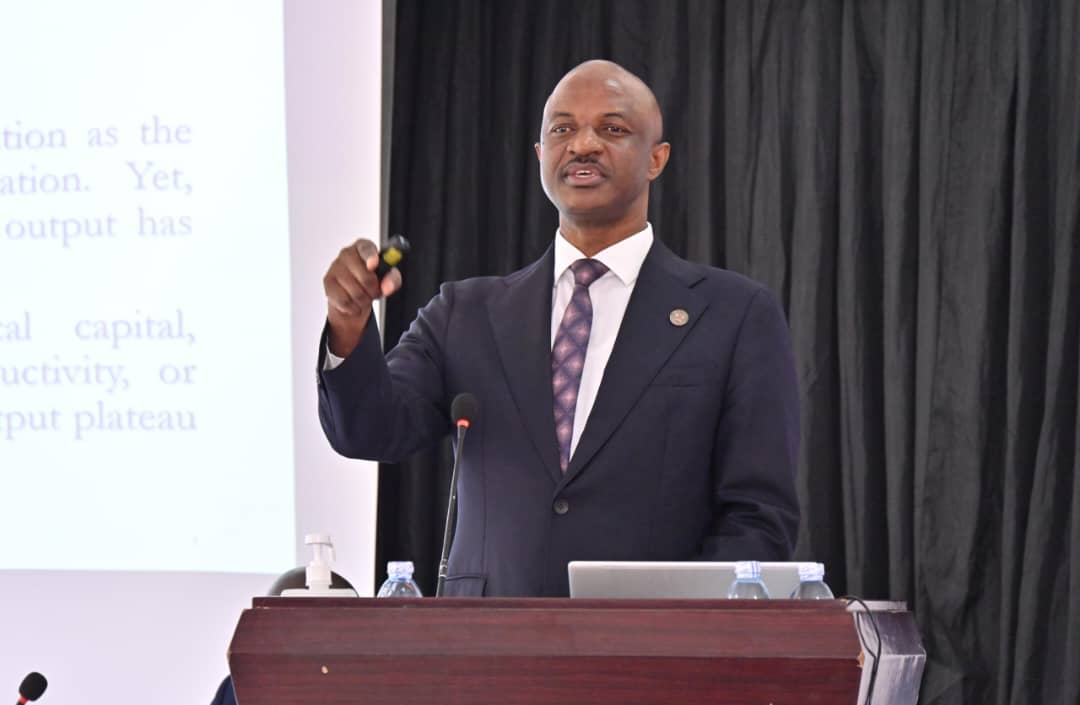
Improving corruption control could significantly boost Uganda’s industrial output, with a one percentage-point improvement in the corruption control measure associated with a 9.99% increase in industrial output, according to a new study by Finance Ministry Permanent Secretary and Secretary to the Treasury, Dr Ramathan Ggoobi.
The findings are contained in Ggoobi’s PhD research examining the key determinants of industrial sector growth in Uganda. The study was presented during a public policy dialogue at the Uganda Management Institute (UMI), where government officials and policy experts discussed its implications for industrialisation.
Finance Minister Henry Musasizi said the findings would inform government policy and investment decisions under the Tenfold Growth Strategy, which seeks to accelerate economic expansion.
The research identifies corruption control, market expansion, access to credit and borrowing costs as important factors influencing industrial performance.
It also found that a 1% increase in commercial lending rates was associated with a 3.11% decline in industrial output, highlighting the potential impact of expensive credit on businesses seeking to expand production.
Population growth was also positively associated with industrial growth, with a 1% increase linked to an estimated 8.48% increase in industrial growth.
The findings point to the importance of improving the business environment, lowering financing costs and expanding markets as Uganda seeks to strengthen its industrial base.
Speaking at the policy dialogue, Musasizi said industrial development requires deliberate decisions on how public resources are allocated, particularly given competing demands on the national budget.
“Industrial policy requires deliberate choices on investments in industrial parks, economic infrastructure, industrial land, subsidised electricity tariffs for investors and fiscal incentives,” Musasizi said.
He added that government must prioritise interventions that generate the greatest economic returns.
“Given limited resources, we need to identify interventions that deliver the greatest gains in industrial productivity, jobs and exports for every shilling of public money,” he said.
The study also identifies price stability, inflation control and exchange-rate stability as important considerations for industrial growth. It recommends reducing the cost of capital and improving access to long-term financing through pension reforms and the development of deeper capital markets.
Other recommendations include expanding affordable credit for industrial businesses, strengthening domestic value chains and aligning technical and vocational training with the skills required by industry.
The research further calls for more efficient regulation through digitisation, alongside carefully designed trade and foreign investment policies that strengthen domestic producers and improve export competitiveness.
Government has introduced several initiatives aimed at supporting investment and expanding access to financing, including the Parish Development Model and the capitalisation of the Uganda Development Bank.
Musasizi said other measures, including lower electricity tariffs for industrial users and targeted tax incentives, were intended to support manufacturers and attract investment.
He said the research would help government evaluate the effectiveness of its interventions as it implements the Tenfold Growth Strategy.
“Dr Ggoobi’s findings will inform the Ministry’s policy decisions and implementation of the Tenfold Growth Strategy, helping Government assess the benefits and costs of its interventions and strengthen industrialisation, job creation and economic transformation,” Musasizi said.
Musasizi also congratulated Ggoobi on being awarded a Doctor of Philosophy degree in Economics by Nelson Mandela University in South Africa, commending his research contribution to Uganda’s economic policy debate.
UMI Director General Prof. James Luyonga Nkata said the policy dialogue provided a platform for translating academic research into practical policy interventions.
“The dialogues are conducted under the Uganda Policy Development Management Forum, a think-tank established to support evidence-based policy formulation,” Nkata said.
He said the forum brings together stakeholders to review existing policy frameworks and develop proposals aimed at promoting socioeconomic transformation.
Nkata also commended Ggoobi for choosing UMI for the first presentation of his PhD thesis in Uganda, adding that the institute was ready to support government through research, capacity development and technical expertise.
The study adds to ongoing discussions about the structural and institutional reforms needed to accelerate industrialisation, expand employment and improve Uganda’s competitiveness.