District leaders have been urged to take greater responsibility for identifying, documenting and protecting government land in their respective areas to prevent encroachment, illegal allocations and loss of public assets.
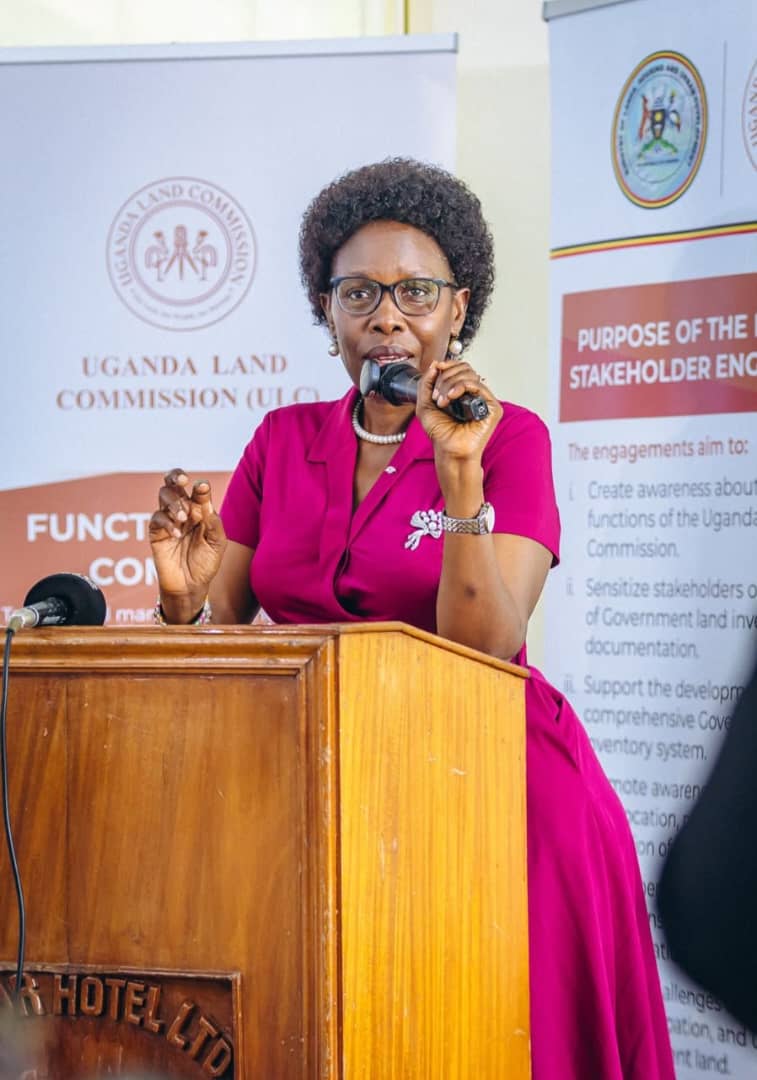
The call was made by the Minister of Lands, Housing and Urban Development, Judith Nabakooba, during a regional stakeholders’ workshop on the development of a comprehensive government land inventory held on Thursday at Ridar Hotel in Seeta, Mukono.
The workshop brought together district leaders and land management officials from Mukono, Wakiso, Buikwe, Kayunga, Nakasongola, Luweero and other districts to discuss ways of improving the documentation, protection, administration and allocation of government land.
Nabakooba said district officials should not wait for the Ministry of Lands or Uganda Land Commission to intervene whenever government land is threatened, arguing that local authorities are closer to the land and therefore better placed to identify and protect it.
“Do not wait for the ministry or ULC to tell you that government land in your district is being encroached upon because you have the eyes and we believe that you are more closer to it than even these ULC officials or the ministry officials,” Nabakooba said.
“Take charge and take control of this government land. Know its boundaries very clearly, work with the district surveyors, have the records complete.”
The Minister particularly cautioned district land boards against allocating land occupied by public institutions such as schools, hospitals and security facilities simply because such land does not have a title.
“Even if a school or a hospital has no title, it is your duty as a key stakeholder to first protect that entity that is housed on that piece of land which is not titled, before you parcel the land,” she said.
Nabakooba warned that government land should not be treated as vacant land available for allocation to individuals or developers.
“Government land is not vacant land waiting for somebody to find and use for it without authorization from government. Government land is a public asset which must be respected and protected,” she said.
She expressed concern over instances where district land boards allocate government property on freehold tenure, warning that such decisions can create lengthy and costly legal battles for government when attempts are later made to recover the land.
“The most annoying thing is to give government property and you even give it in totality freehold. Freehold titles are given because once somebody gets a freehold, that is his property,” Nabakooba said.
She said officials must act before government land is occupied or disputed, noting that delays make recovery increasingly difficult.
“The longer we delay securing government land in rapidly developing areas, the more exposure we are exposing this land to and it will become even very difficult for us to achieve what we want,” she said.
Nabakooba also urged district chairpersons, Resident District Commissioners, Chief Administrative Officers, town clerks, district land boards, land officers, physical planners, surveyors and area land committees to take the inventory exercise seriously.
She said complete records of government assets are essential, especially because local governments are required to maintain asset registers.
“If every year annually you are expected to present an asset register, so which assets are we presenting if our records are not clear and if we don’t know what we have?” she asked.
The Minister further called for the use of satellite imagery and other technologies to verify claims of long-term occupation of government land.
She said some people claim to have occupied government land for decades, yet satellite images can show that settlements were established only recently.
Nabakooba said government must also begin planning for future population growth and urban expansion by protecting land for agriculture, industries, public facilities and infrastructure.
She proposed greater consideration of vertical development in urban areas to prevent uncontrolled expansion and preserve agricultural land.
“We need to begin thinking about that,” she said. “Can we now begin thinking of going vertical when you are building offices and spaces for accommodation so that we are compacted in one area as people then the rest of the land is used for agricultural purposes?”
Uganda Land Commission Chairperson Prof. Pen-Mogi Nyeko also urged district land boards to stop allocating government land to individuals and instead preserve it for strategic public development.
“Chairpersons and members of the district land board, do not give out government land to individuals. Let government land be used for the community in that area and for the benefits of Ugandans at large,” Nyeko said.
Nyeko said government land could provide space for major industrial and development projects that create jobs and stimulate local economies.
He cited the Amuru Sugar Works project, saying major government-supported investments can bring jobs, infrastructure and other economic opportunities to communities.
“Protect government land in your area for major government developments,” Nyeko said.
He added that government needs an accurate inventory of its land so that strategically located parcels can be identified for future investments.
“If we know that there is two, three square miles of land belonging to government in Nakasongola, we recommend that area for industrialization,” he said.
Nyeko also warned against the loss of land belonging to schools and other institutions, noting that some of the institutions occupy land that is vulnerable to grabbing.
“There are schools where you studied, and most of these schools were mainly religious background: Catholic, Protestant, Muslim. And these lands are being grabbed,” he said.
He urged district officials to help the Uganda Land Commission identify such properties and ensure that they are titled and protected.
Meanwhile, Uganda Land Commission Secretary Andrew Nyumba said the commission already has records relating to government land, but the information is fragmented and does not yet provide a comprehensive picture of the country’s public land assets.
Nyumba said the inventory is intended to create a continuously updated information base that will help government make decisions on land acquisition, protection, planning, development, regularisation and dispute management.
“For every identifiable government land holding, we should, as far as possible, be able to answer a set of basic but critical questions,” Nyumba said.
He said the inventory should establish the location, size and boundaries of each parcel, evidence of government ownership, the institution responsible for it, its current and intended use, documentation status and whether it is occupied, encroached upon or affected by disputes.
Nyumba emphasized that the exercise will involve verification rather than simply collecting lists of land from districts.
“An institutional record may indicate that a school occupies a particular piece of land. However, the land registry may contain a corresponding title, and the district may have a different survey plan or historical record. And also, the community may know the physical boundary on the ground,” he said.
He said information from different sources will therefore have to be compared to establish the reliability of the inventory.
“A discrepancy in information is not necessarily a failure of the exercise. It is also information. It tells us where further technical work is required,” Nyumba said.
The Uganda Land Commission plans to draw information from its existing records, land registration and cadastral data, ministries and government agencies, local governments, district land boards, survey and physical planning records, institutional asset registers, acquisition and compensation records, historical archives, communities and local leaders.
Nabakooba said the inventory is not intended to dispossess lawful private landowners, emphasizing that disputes involving private land should be handled through lawful and peaceful processes.
She, however, maintained that government must urgently secure land reserved for public purposes.
“We must act now and not tomorrow,” Nabakooba said. “We are late but better late than never.”
She said a comprehensive government land inventory would help Uganda safeguard land needed for future infrastructure, public facilities, industrialisation, agriculture and environmental protection.
“As Uganda continues the journey towards socio-economic transformation, land will remain at the center of almost every major investment we undertake,” Nabakooba said.
“Our responsibility is to ensure that government does not arrive at the future only to discover that the land required to build that future was taken or went a long time ago.”